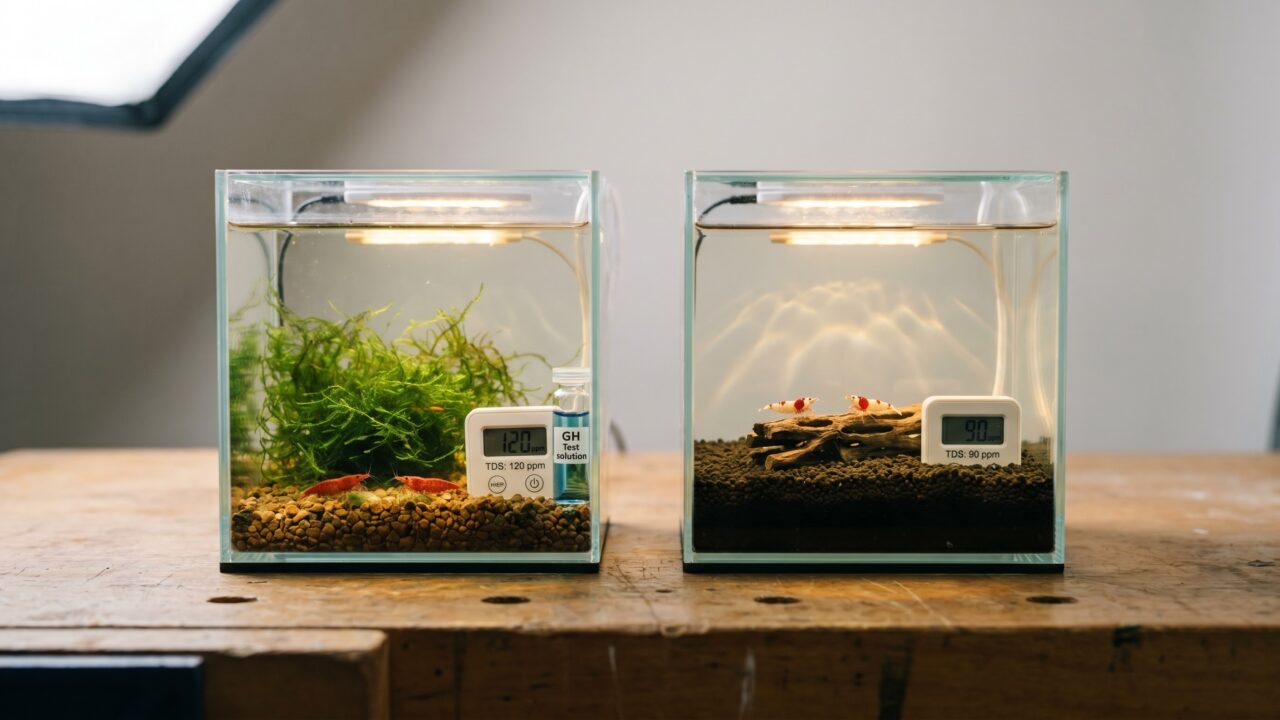
Put a Neocaridina cherry shrimp and a Caridina crystal red in the same tank and you are asking two very different animals to share one set of water. It does not work. Neocaridina come from broad, forgiving conditions across Taiwan, China, Korea, and Vietnam; they tolerate a wide range of water chemistry and breed freely even when parameters are not perfect. Caridina cantonensis, the ancestor of crystal reds and Taiwan bees, evolved in cool, soft, acidic mountain streams in Taiwan, where the water is closer to rainwater than to the mineral-rich water most tap supplies carry. Getting the parameters right for one genus actively undermines the other.
This guide puts every critical number side by side and explains the why behind each one, so you can set up your tank with confidence, test intelligently, and stop guessing.
The full parameter comparison at a glance
The table below is the reference you can pin or bookmark. Use it before buying shrimp, before mixing water, and before troubleshooting a struggling colony. All values represent the sweet spot for keeping and breeding, not the absolute minimum for survival.
| Parameter | Neocaridina | Caridina | Why it matters |
|---|---|---|---|
| GH (general hardness) | 6-8 dGH | 4-6 dGH | Calcium and magnesium for exoskeleton building. Too low = failed molts. |
| KH (carbonate hardness) | 2-4 dKH | 0-1 dKH | Buffers pH for Neocaridina; must stay near zero for Caridina so active substrate can hold pH down. |
| TDS (total dissolved solids) | 150-250 ppm | 100-150 ppm | Reflects the total mineral load. Sudden swings cause osmotic shock. |
| pH | 6.5-7.5 | 5.8-6.4 | Drives enzyme activity and mineral availability. On active soil Caridina sit at 5.8-6.4 and Neocaridina at 6.5+, so the real-world overlap is essentially nil. |
| Temperature | 18-26°C (64-79°F) | 20-24°C (68-75°F) | Caridina need a narrower, cooler band. High temps increase bacterial risk for both. |
| Substrate type | Any inert substrate | Active buffering substrate required | Only a genuine active soil (ADA Amazonia, Fluval Stratum, GlasGarten Environment) holds pH down at 5.8-6.4 without adding KH. Inert mineral additives like JBL ProScape Volcano Mineral do not. |
| Water source | Tap water often acceptable if GH/KH fit; RO + GH/KH remineralizer for precision | RO water + GH-only remineralizer always required | Tap KH destroys active substrate buffering capacity and raises pH into the danger zone for Caridina. |
| Difficulty | Beginner-friendly | Intermediate to advanced | Neocaridina forgive small parameter drift. Caridina do not. |
Two non-negotiables that come before any number in that table
Both genera share two hard requirements that override every GH, KH, and TDS target below. Get either of these wrong and the perfect parameters in the table above will not save your shrimp.
The tank must be fully cycled, with ammonia and nitrite at 0
Never add shrimp to a tank that is not finished cycling. Shrimp are far more sensitive to ammonia and nitrite than most fish, and for shrimp an ammonia or nitrite spike kills faster than any GH or KH mistake you could make. A fully cycled tank reads 0 ppm ammonia and 0 ppm nitrite at all times, with the beneficial bacteria able to convert a dose of ammonia to nitrate within a day. Test and confirm both read zero before a single shrimp goes in. This matters even more with Caridina, because fresh active soil leaches ammonia for the first weeks; that soil has to be cycled out completely before it is safe. If you only ever remember one rule from this guide, make it this one: cycle first, stock second. The full process is in how to cycle a shrimp tank.
Keep copper out of the water
Dwarf shrimp are killed by copper levels that most fish tolerate without visible harm. It is the single most common silent killer of an otherwise healthy colony, and it applies equally to Neocaridina and Caridina. The usual ways it gets in are easy to overlook: copper-based fish or snail medications (almost any anti-parasite or anti-snail treatment), some plant fertilizers that list copper among trace elements, and old or copper plumbing leaching into your tap water, especially the first water drawn in the morning after it has sat in the pipes overnight. Treat every medication and fertilizer as suspect until you have confirmed it is copper-free, never dose a copper medication in the shrimp tank, and if you are on old plumbing, run the tap a minute or two or use RO water. A whole colony can crash within hours of a copper exposure, with no parameter on your test kit looking wrong. For the full breakdown of where copper hides and how to keep it out, see copper and shrimp: the silent killer.
GH: the mineral shrimp actually build their shells from
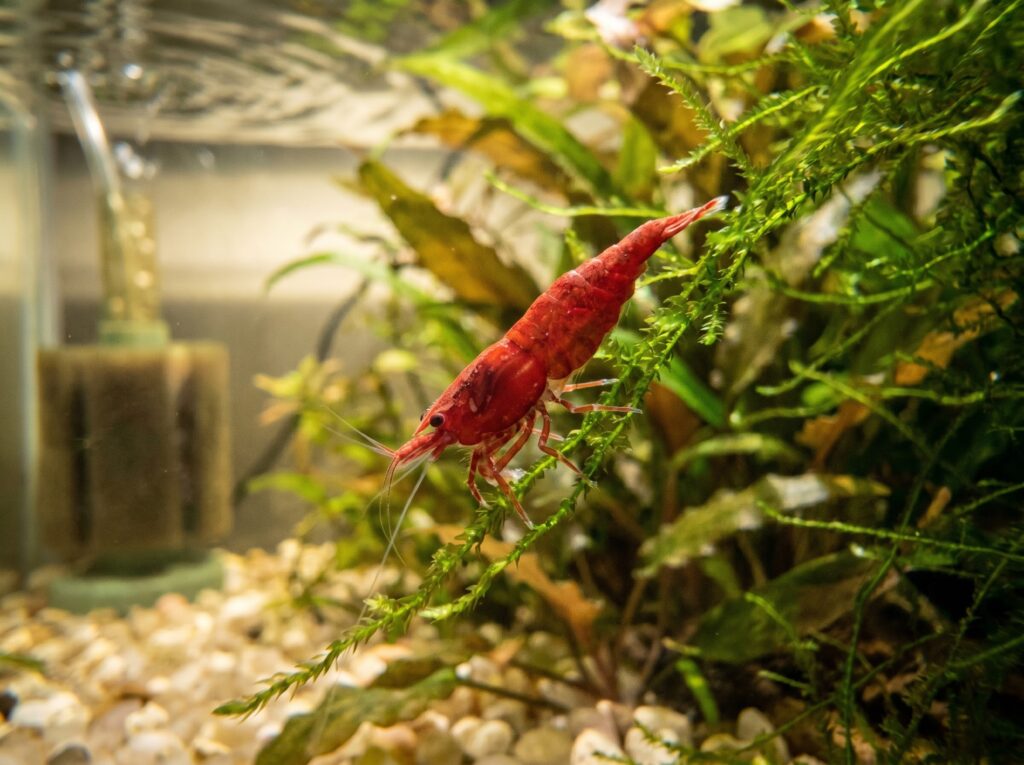
General hardness measures dissolved calcium and magnesium, the two minerals shrimp draw on to form and harden each new exoskeleton after a molt. Every time a shrimp molts, it needs enough of both ions in the water to complete the process. When GH falls too low, the new shell cannot harden properly. The result is what keepers call the white ring of death: the animal splits the old shell but cannot extract itself cleanly, leaving a pale, exposed band at the joint and dying before the new shell hardens.
Neocaridina breeders broadly recommend keeping GH at 6-8 dGH. That range keeps calcium and magnesium available without making the water so hard that the shrimp struggle to crack the old shell during the molt. Caridina tolerate a slightly lower range, 4-6 dGH, which matches the soft water of their native mountain streams.
One practical point: GH and TDS move together when you remineralize. The complete guide to shrimp water parameters covers how to test and adjust both without chasing numbers compulsively.
KH: why the two genera need opposite approaches
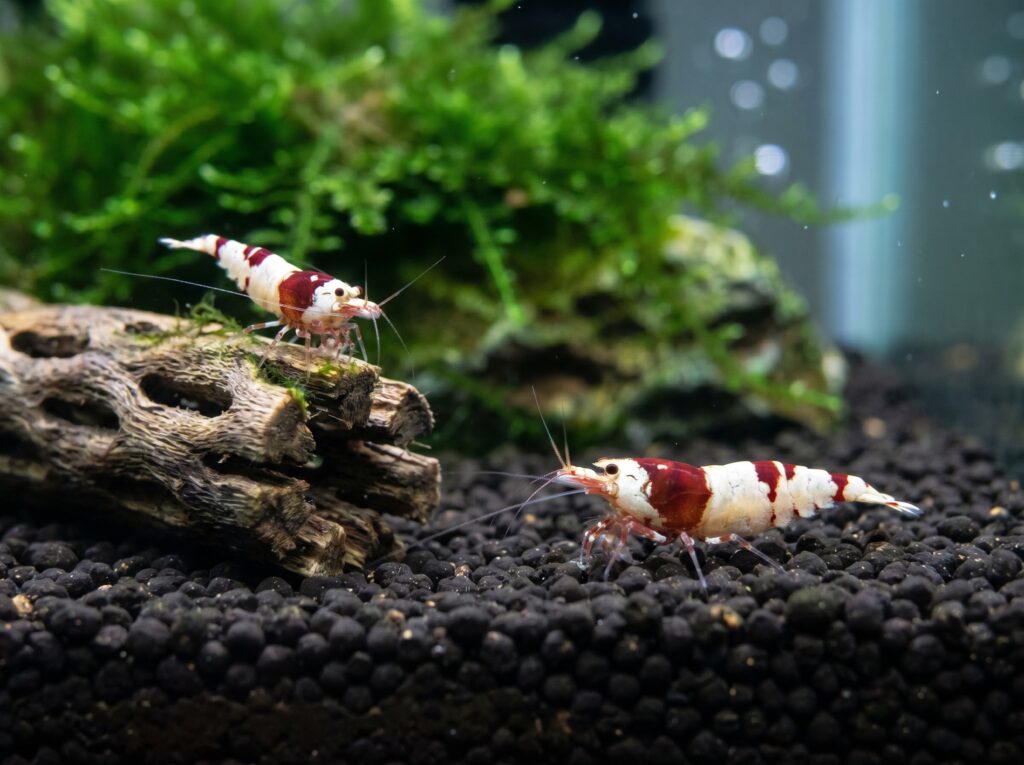
Carbonate hardness (KH) measures the concentration of carbonate and bicarbonate ions in the water. Its main job in an aquarium is buffering pH: carbonate ions neutralize acids before they can crash the pH. For Neocaridina, sitting at a neutral-to-slightly-alkaline pH of 6.5-7.5, a KH of 1-4 dKH gives the water enough buffering capacity to stay stable between water changes. Without any KH, even normal biological activity (fish waste, bacterial respiration, organic breakdown) can cause the pH to drift downward unpredictably.
For Caridina, KH must stay at 0-1 dKH, and to see why you have to understand how active soil actually lowers pH. The soil is not adsorbing minerals and "giving back acid" in trade. It works two ways: it leaches humic and organic acids into the water (the H+ bound to carboxyl groups in the soil's humus unbinds and acidifies the water), and it exchanges ions, swapping its stored protons for calcium and magnesium it pulls from solution. Both of those release acidity, and that acidity is what holds pH down in the 5.8-6.4 band Caridina want.
KH is the direct enemy of that process. Carbonate and bicarbonate are bases: the moment they meet the acidity the soil releases, they neutralize it, converting it back toward CO2 and water and propping pH straight back up. Worse, every carbonate ion the soil has to neutralize is drawn from the soil's finite, non-renewable store of acid-releasing capacity. That is the real meaning of "exhausting the soil." A Caridina tank run on RO water with zero KH spends that capacity slowly and lasts its full 12-18 months; the same soil fed tap water with 4-6 dKH burns through it in a fraction of the time, because most of its acid is being spent neutralizing incoming carbonate instead of holding pH down. When the capacity is gone, nothing counters the KH, pH climbs out of range, and the colony fails.
This is not a minor technicality. It is the reason Caridina keepers use only RO (reverse osmosis) water remineralized with a product that raises GH without touching KH, such as SaltyShrimp Bee Shrimp Mineral GH+, which the manufacturer formulates to hold the KH-to-GH ratio at roughly 0.06:1 (effectively zero KH at normal doses). Using the GH/KH+ product designed for Neocaridina in a Caridina tank is a common and expensive mistake.
For a deeper look at how KH interacts with your choice of remineralizer, see the comparison at GH/KH remineralizer: which one to choose.
TDS: the number that tells you the whole mineral picture
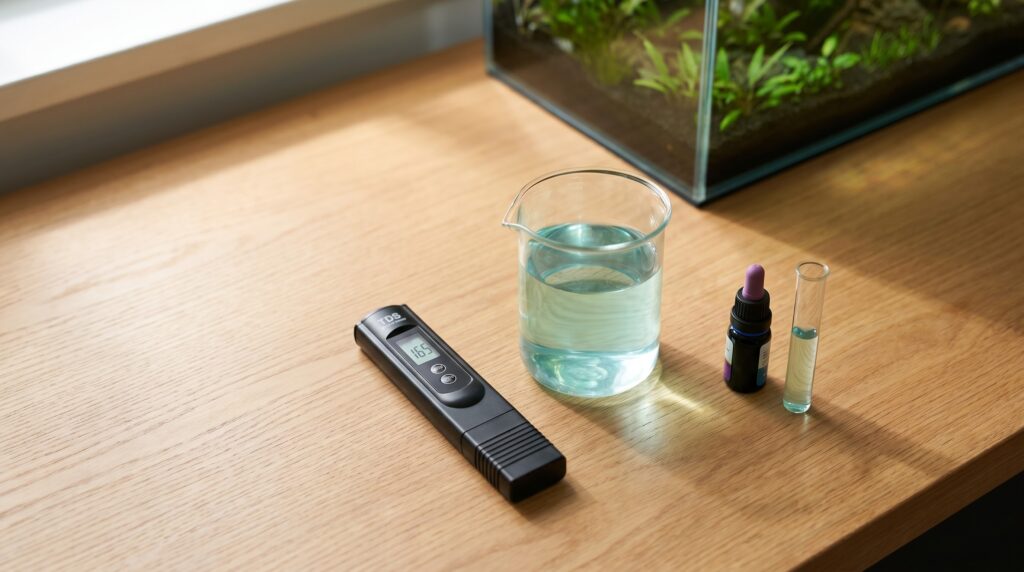
Total dissolved solids, measured in parts per million (ppm) with a cheap pocket TDS meter, gives you a single reading that reflects every mineral, salt, and ion in the water combined. It does not tell you what those solids are, but it tells you how much is there.
Neocaridina do best at 150-250 ppm. The higher end of that range is fine for healthy adults; what matters is not the exact number but its steadiness. A TDS that lurches 50 ppm from one water change to the next does more harm than one that simply holds at 220 ppm. Shrimp regulate their internal fluid balance against the surrounding water through osmoregulation. A sudden drop in TDS pulls water into their tissues; a sudden spike draws it out. Either direction causes osmotic shock, and osmotic shock kills.
Caridina are more sensitive still, working best at 100-150 ppm. That lower mineral load matches their native soft-water streams. At higher TDS, their osmoregulatory workload increases and breeding rates drop off noticeably.
The manufacturer guidance backs this up: SaltyShrimp's Shrimp Mineral GH/KH+ (for Neocaridina) targets roughly 300 µS conductance, which corresponds to around 150-200 ppm TDS. Bee Shrimp Mineral GH+ (for Caridina) targets roughly 200 µS, approximately 100-130 ppm TDS. Conductance and TDS track each other closely enough that both readings confirm the same range.
Always adjust TDS gradually. For a practical method, see TDS for shrimp: what the number means and how to use it.
pH and temperature: two ranges that sit apart, not together
pH
Neocaridina are comfortable anywhere from 6.5 to 7.5. Their carbonate-buffered water resists drift, so pH stays stable with normal maintenance. Caridina, kept on active soil, settle at 5.8-6.4, with most serious breeders running crystal reds and Taiwan bees right around 6.0-6.2. Line those two up and there is no shared window: Caridina top out near 6.4 on a healthy active soil, Neocaridina start at 6.5, and the gap between them is exactly where neither genus is happy. You cannot pin a single tank at, say, 6.4 and serve both. To hold a Caridina-low pH you must strip KH to zero and run active soil, which leaves Neocaridina without the carbonate buffer they depend on; to give Neocaridina that buffer you add KH, which neutralizes the soil's acidity and drives pH back up out of Caridina range. There is no middle ground to split.
Temperature
Neocaridina handle a wide range: 18-26°C (64-79°F). Many breeders find that 22-24°C produces the best combination of breeding activity and longevity. Caridina prefer a narrower, cooler band of 20-24°C (68-75°F). At the upper end of both ranges they become more vulnerable to bacterial infections. Higher temperature also accelerates active substrate depletion in Caridina tanks, shortening the replacement cycle.
Both genera need a stable temperature more than a perfect one. A tank that holds 24°C reliably is better for the shrimp than one that swings between 20°C and 27°C on hot days.
Why you cannot split the difference and keep both in one tank
The question comes up constantly, especially from keepers who want variety without running two systems. The answer is straightforward: there is no single set of parameters that genuinely serves both genera.
Consider what a compromise tank would look like. You pick a pH of 6.8-7.0, which suits Neocaridina but already sits above the 6.4 ceiling Caridina want, so they start out in the wrong water on day one. To hold that pH at all you need some KH, and any KH neutralizes the acidity an active soil releases and burns through its capacity, or you skip active soil entirely and let pH drift upward in a Caridina-hostile direction. You set TDS around 180 ppm, fine for Neocaridina but above the 100-150 ppm where Caridina breed reliably. The Neocaridina will probably be fine. The Caridina will likely survive but molt irregularly, breed poorly, and be more prone to bacterial problems. That is not keeping them; it is slowly wearing them down.
There is also the crossbreeding question. Neocaridina color strains interbreed with each other and revert to wild brown coloration within a few generations. Caridina and Neocaridina will not cross (they are separate genera), but placing them in one tank at any shared parameter still compromises at least one species. The separate-tank rule exists for the shrimp's benefit, not as hobbyist snobbery.
For a more detailed breakdown of what each setup looks like in practice - filtration, cycling, substrate choices, and layout - see Caridina vs Neocaridina: setting up the right tank for each.
What each genus actually needs from you, step by step
Setting up for Neocaridina
- Source water: tap water if your GH is 6-8 and KH is 1-4; otherwise, RO water remineralized with a GH/KH+ product (SaltyShrimp Shrimp Mineral GH/KH+ is the most widely used; it targets roughly 6 dGH and 3 dKH at the recommended dose).
- Substrate: any inert substrate (gravel, sand, or standard aquarium soil with no active buffering). Active substrate is wasted cost and adds unnecessary complexity.
- Target TDS: 150-250 ppm. Test after remineralizing and before adding to the tank.
- Water changes: keep them small and consistent at 10-15% weekly, matched to the tank TDS. Large, infrequent changes cause the parameter swings that kill shrimp. See how to do shrimp tank water changes without stressing your colony.
- Start the colony: 10-15 individuals gives you enough genetic diversity and behavioral activity to get breeding started without crowding a new tank.
Setting up for Caridina
- Source water: RO water only. Zero-TDS base. Remineralize with a GH-only product (SaltyShrimp Bee Shrimp Mineral GH+, or equivalent) to reach 4-6 dGH and roughly 100-150 ppm TDS. Never use a GH/KH+ product; the KH it adds will undermine your active substrate.
- Substrate: a genuine active buffering soil (ADA Aqua Soil Amazonia, Fluval Stratum, Brightwell Rio Escuro, GlasGarten Environment Soil, or UNS Controsoil). These soils lower and hold pH down to roughly 5.5-6.5 by leaching humic and organic acids and through ion exchange, settling a Caridina tank around 5.8-6.4, and typically last 12-18 months before that acid-releasing capacity is spent and pH starts to climb. Do not confuse them with inert mineral additives such as JBL ProScape Volcano Mineral, which is a porous volcanic base layer that does nothing to lower pH.
- Monitor pH closely: once the substrate ages and pH drifts above 6.5 consistently, plan a substrate refresh. Many keepers do partial replacements to avoid a full tank reset.
- Temperature: 20-24°C. A small fan or chiller in summer is often necessary.
- Water changes: 10% or less at a time, with water matched precisely to tank TDS. Even small mismatches in TDS are felt more acutely by Caridina than by Neocaridina.
For the full Caridina parameter setup including GH testing schedules and substrate cycling, see Caridina water parameters: the complete guide.
The stability principle: more important than hitting the exact number
Both genera share one overriding need: stability. A Neocaridina colony living at 7.2 pH and 200 ppm TDS for three months is thriving. The same colony exposed to a sudden 50 ppm TDS drop from a large water change with unmineralized water faces real osmotic stress; shrimp osmoregulate against the ambient water chemistry, and rapid shifts in either direction disrupt that balance.
A shrimp does not drop dead the moment GH ticks one degree past the range. The ranges mark where the animal is least stressed and where it breeds, and a colony held rock-steady a touch outside the ideal usually does better than one bounced around inside it. Consistency beats precision.
Test weekly when a tank is new. Once parameters are stable, monthly testing is usually enough for Neocaridina. Caridina tanks warrant weekly pH checks throughout the active substrate's life, especially as it ages past 12 months.