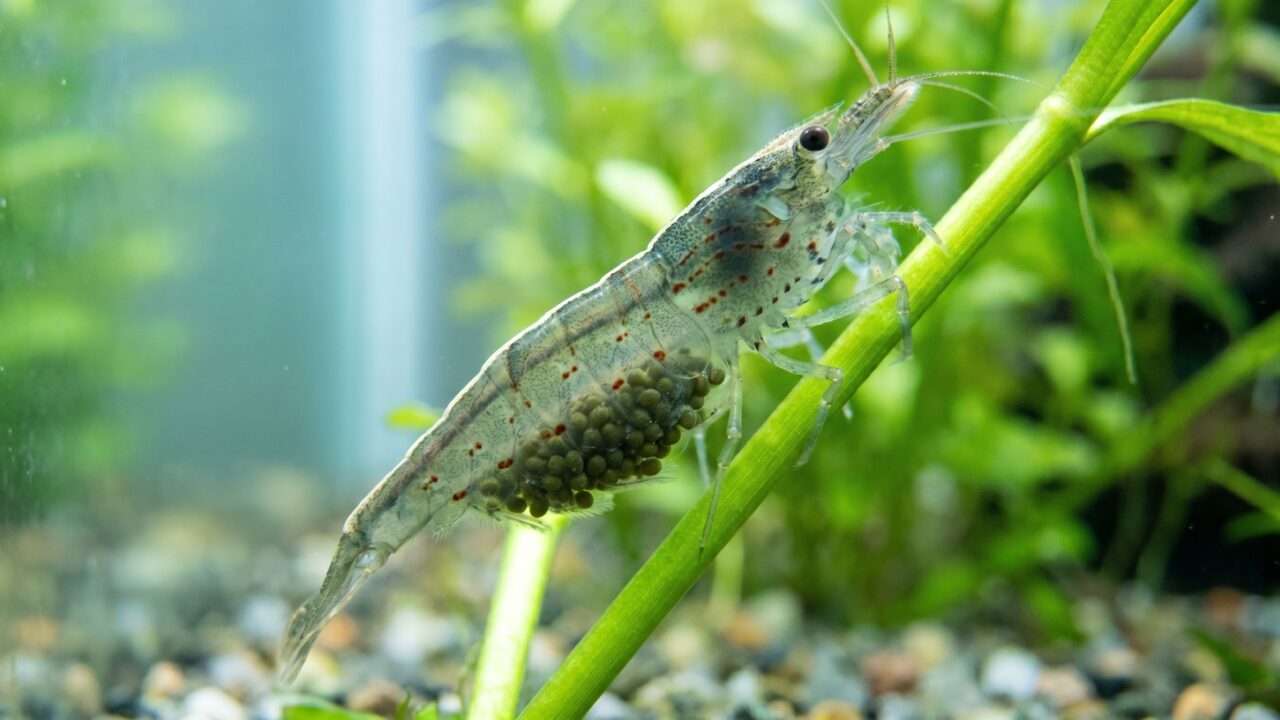
Your amano shrimp are berried, the eggs are developing, and then a week or two after hatching, every single larva disappears. No shrimplets, no survivors. Before you start blaming your water or your feeding routine, here is what is actually happening: amano larvae are biologically incapable of completing their development in freshwater. This is not a husbandry failure. It is evolution.
Caridina multidentata (previously called Caridina japonica until a 2006 reclassification) is what biologists call an amphidromous species. Adults live their entire lives in freshwater rivers and streams in Japan and Taiwan. But when a female releases her larvae, those tiny animals must reach saltwater within a matter of days or they will die. In the wild, they drift downstream to coastal estuaries, develop through nine distinct zoeal stages in brackish or full-strength seawater, then migrate back upstream as juveniles to join the freshwater population. In a home aquarium, there is no estuary. The larvae hatch, swim frantically for a few days, and perish.
The larval cycle, explained stage by stage
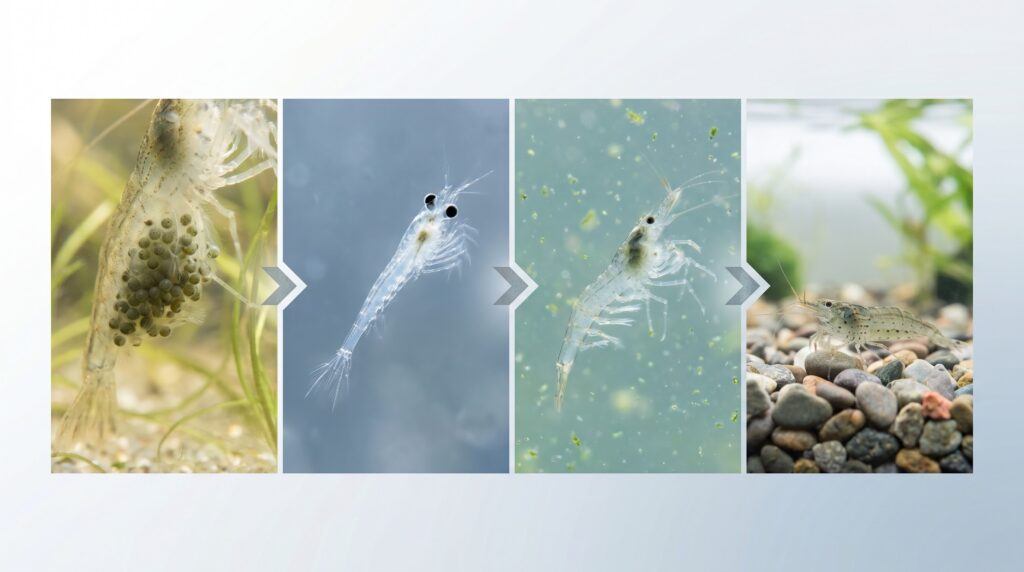
Understanding why the cycle fails in freshwater starts with knowing what the cycle actually looks like. The table below maps the complete progression from egg to juvenile.
| Stage | Environment | Approximate duration | What is happening |
|---|---|---|---|
| Egg incubation | Freshwater (on female) | 4-5 weeks | Female fans eggs constantly; embryos develop inside the egg case; eyes become visible near hatching |
| Zoea stages 1-2 (lecithotrophic) | Transition - brackish or marine | Days 1-5 approx. | Larvae live off internal yolk reserves; no external food needed yet; must reach saline water during this window |
| Zoea stages 3-9 (planktotrophic) | Brackish to full marine (17-34 ppt) | Weeks 1-6 approx. | Larvae begin feeding from the third stage onward; filter-feed on phytoplankton and fine particles; molt through seven more stages |
| Metamorphosis / postlarval | Brackish, then transitioning | Days around week 5-7 | Larvae take on recognizable shrimp body form; full-strength seawater becomes harmful; must be acclimated back toward freshwater |
| Juvenile | Freshwater | Onward | Miniature adults; feed normally; require standard freshwater shrimp parameters |
Peer-reviewed research on C. multidentata confirms that larvae can develop across a wide salinity range of 17 to 34 ppt, with higher survival achieved at temperatures around 26°C. At 4.25 or 8.5 ppt - the barely-brackish range - larvae of this species do not survive to metamorphosis. Pure freshwater is not even in the dataset; the larvae die before researchers can measure anything.
One detail worth knowing: the first two zoeal stages are lecithotrophic, meaning the larvae run entirely on yolk energy. This is an evolutionary adaptation for the downstream drift before the estuary. The larvae do not starve during transport. But from stage three onward, they must be actively feeding on microscopic algae and other particles. A brackish rearing tank with no phytoplankton will lose larvae to starvation even if the salinity is correct.
Why freshwater kills them (the biology in plain language)
The short version: osmoregulation. Every living cell needs to maintain the right concentration of ions - sodium, chloride, potassium, calcium - against whatever the surrounding water holds. In low-salinity or no-salinity water, the gradient between the larva's body fluids and the environment is so steep that the larva has to spend enormous energy fighting it. Research on amphidromous atyid shrimp larvae confirms that saline water is required for successful larval development - the physiology of the planktonic zoea stage is simply not equipped for a freshwater environment the way the adult body is.
The adult body has had time to develop the osmoregulatory machinery for freshwater life. The zoea has not. It is built for the estuary.
This also explains the "they hatched but then vanished" report that comes up constantly in the hobby. The larvae are real, they swim, and then they are gone by day 3 or 4. No disease, no predation, no water quality spike. Just the irreversible failure of freshwater larvae to osmoregulate.
Why almost every home breeding attempt fails
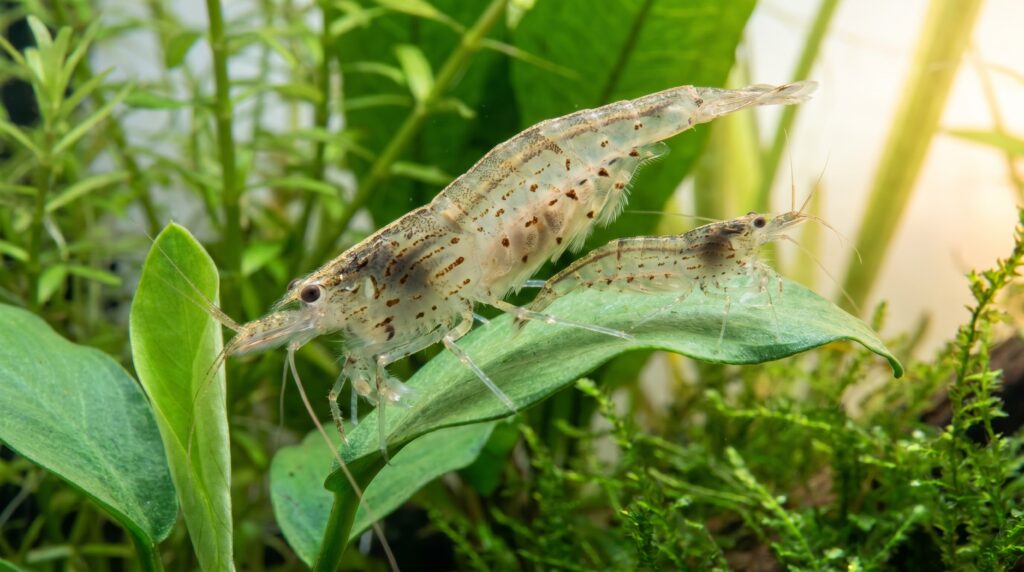
The honest picture: even dedicated keepers who set up a proper brackish rearing system report very low survival rates. A female carrying 1,000 to 3,000 eggs (a figure widely reported among experienced breeders, though no single controlled study has published a precise mean) might yield a few dozen juveniles if everything goes right. Most attempts yield zero.
These are the most common failure points, roughly in order of frequency:
- Delayed larval transfer. Larvae hatch in freshwater and have only a short window - a day or two at most - before their condition degrades. Keepers who wait too long, or who do not notice the hatch event, lose the entire batch before it reaches brackish water.
- Wrong salt. Marine salt mixes (the kind used for reef aquariums) contain trace minerals, calcium, magnesium, and buffering compounds that freshwater aquarium salt and table salt entirely lack. Larvae raised in plain NaCl-only solutions miss the ionic complexity they need.
- Wrong salinity level. The peer-reviewed range for C. multidentata is 17-34 ppt, with 17 ppt being the documented minimum threshold below which larvae do not reach metamorphosis. Many beginners guess at this with a basic hydrometer; a refractometer is the only accurate tool. A salinity of 10 ppt feels like "brackish" but is well below that documented minimum.
- No phytoplankton. Larvae are filter feeders from stage three onward. They need cultured live phytoplankton or a dense green-water culture - powdered fry food alone is rarely fine enough and fouls the water fast.
- Too much flow. A standard aquarium filter will draw larvae in and kill them. The brackish rearing tank needs only a gentle air stone with fine bubbles. The larvae are roughly 1 mm long at hatching.
- Rapid salinity drop at acclimation. After metamorphosis, juveniles can no longer tolerate full-strength seawater, but the transition back to freshwater must happen gradually over several days via drip acclimation. A sudden dilution is fatal.
None of these failures reflect bad shrimp keeping. They reflect how demanding the process genuinely is. If your other shrimp species are not breeding either, that is a different question - usually water parameters or maturity - and has nothing to do with this amphidromous biology.
The brackish rearing path: what it actually takes
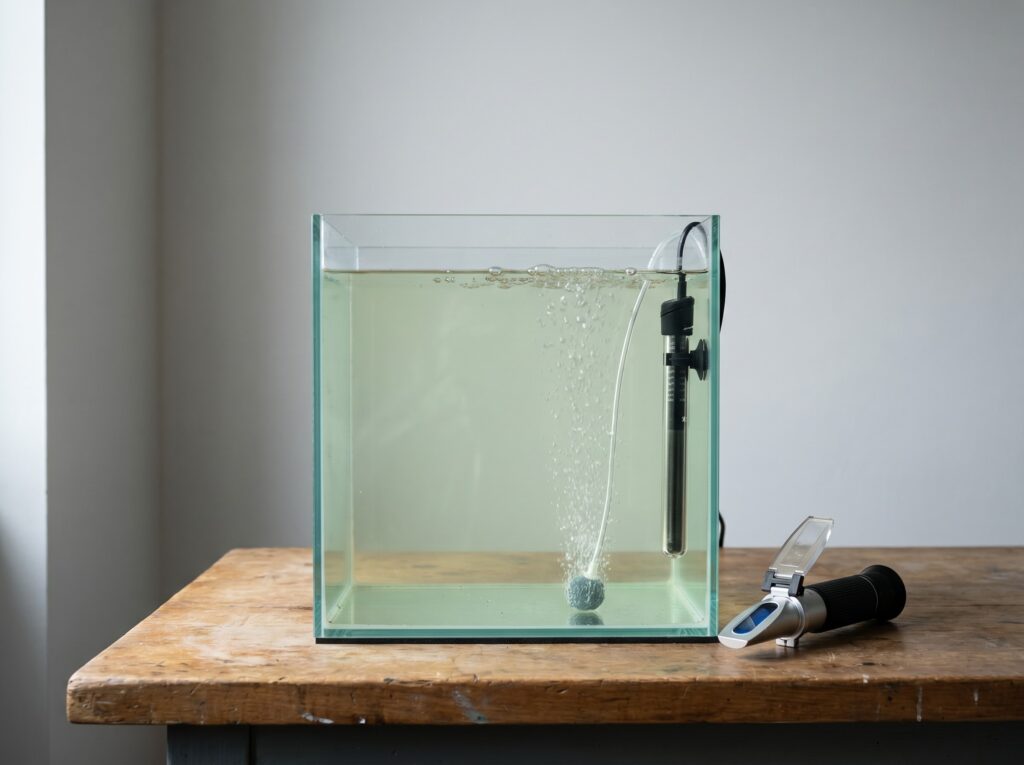
This section is for keepers who want to attempt the full cycle with their eyes open. It is a significant project that requires its own dedicated setup alongside the display tank.
What you need:
- A separate 5-10 litre rearing vessel (a glass jar or a small tank). No substrate, no filter.
- A high-quality marine salt mix - brands like Instant Ocean or Red Sea Salt are standard references in the hobby. Not aquarium conditioner salt, not table salt.
- A refractometer. Hydrometers have too much error margin for this application.
- A gentle air stone and air pump. Fine bubbles only.
- A small heater to hold 24-26°C.
- A live phytoplankton culture (Nannochloropsis or Tetraselmis are the most commonly used) or a dense green-water culture. Plan to feed small amounts multiple times per day.
Salinity target: Mix the brackish vessel to approximately 30-34 ppt before adding larvae. This sits at the upper end of the species' documented tolerance range and matches open-coastal salinity. (Peer-reviewed research confirms larvae can technically develop down to 17 ppt, but hobbyist experience points to the 30-35 ppt range for the best survival rates - so starting at 30-34 ppt is the practical recommendation.) Use a refractometer to confirm.
Transferring larvae: Watch the berried female closely. Larvae hatch as free-swimming zoea that look nothing like shrimp - they are tiny, elongated, transparent. Transfer them to the brackish vessel within a few hours of hatching using a pipette or gentle pour. No slow acclimation is needed going from freshwater to marine at this stage; the early zoea are adapted for that transition.
Feeding: Add phytoplankton in small quantities twice or three times per day. The water should have a slight green tint - clear water means the larvae are starving. Too much food rots and crashes the water quality; too little starves the larvae. Small daily water changes with salinity-matched saltwater help keep the water clean without dilution swings.
Timeline: If larvae survive to metamorphosis, expect that transition somewhere between four and eight weeks after hatching. The larvae change shape noticeably - they start to look like compressed shrimp rather than zooplankton. At that point, begin a slow salinity reduction over several days, targeting freshwater parameters that match your display tank. Drip acclimation is the right method here.
Success rate expectation: Experienced breeders who have refined the process over multiple attempts sometimes raise a few dozen juveniles per batch. First attempts rarely produce more than a handful, if any. This is normal and not a sign of technique failure - amphidromous larvae are genuinely fragile at every stage.
One more thing - copper. Amano shrimp of all ages are extremely sensitive to copper because their blood protein, haemocyanin, uses copper atoms to carry oxygen. Standard aquarium copper treatments carry enough dissolved copper to kill crustaceans quickly, because haemocyanin-based blood simply cannot function when its copper sites are displaced. New keepers sometimes dose copper treatments for fish disease and then conclude the larvae "disappeared due to breeding failure" - but that is a separate problem entirely. See our guide on copper and shrimp safety if you keep amanos alongside fish that might need medication.
Frequently asked questions
Will amano shrimp ever breed on their own in a freshwater tank?
No. Females will become berried and carry eggs to hatching in a well-maintained freshwater tank - that part of the cycle works fine. But the larvae cannot complete development without saline water. They will die within a few days every time, regardless of how good the tank parameters are. Water chemistry adjustments cannot change it.
If my amanos are berried, is there something wrong with my water?
Berried amanos are a sign of healthy, comfortable shrimp - not a problem. The females are doing exactly what they should. The challenge is that the downstream cycle requires a separate brackish setup that most home aquariums cannot provide. For a broader look at shrimp water parameters and whether your tank is running well, that guide covers what to check.
Where do commercially sold amano shrimp come from?
The great majority of amano shrimp in the trade are wild-collected from rivers in Japan, Taiwan, and surrounding regions. Captive-bred specimens are very difficult to produce at scale; some specialist breeders have achieved small-batch rearing using the brackish larval method described in this article, but this does not meaningfully alter global trade availability. This is why amano shrimp tend to cost more than Neocaridina varieties, and why availability can still fluctuate even as interest in captive breeding slowly grows.
Can I use ocean water instead of marine salt mix?
In principle, natural seawater has the right ionic profile, but it introduces unknown pathogens, pollutants, and organisms into a closed system. Synthetic marine salt mixes give you a clean, consistent, and measurable baseline. They are the standard approach for brackish larval rearing.
My amano larvae hatched but I was not prepared. Is there anything I can do now?
If you can mix a brackish vessel quickly - within a few hours of hatching - and transfer the larvae, some may survive. After 24 hours in freshwater, the window is effectively closed. For future batches, watch for the point when you can see small eyes visible through the egg cases; hatching follows within a day or two, giving you time to prepare.