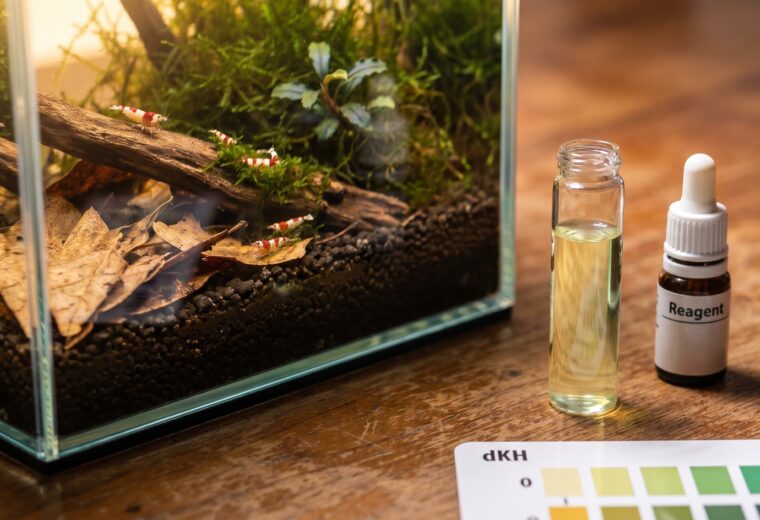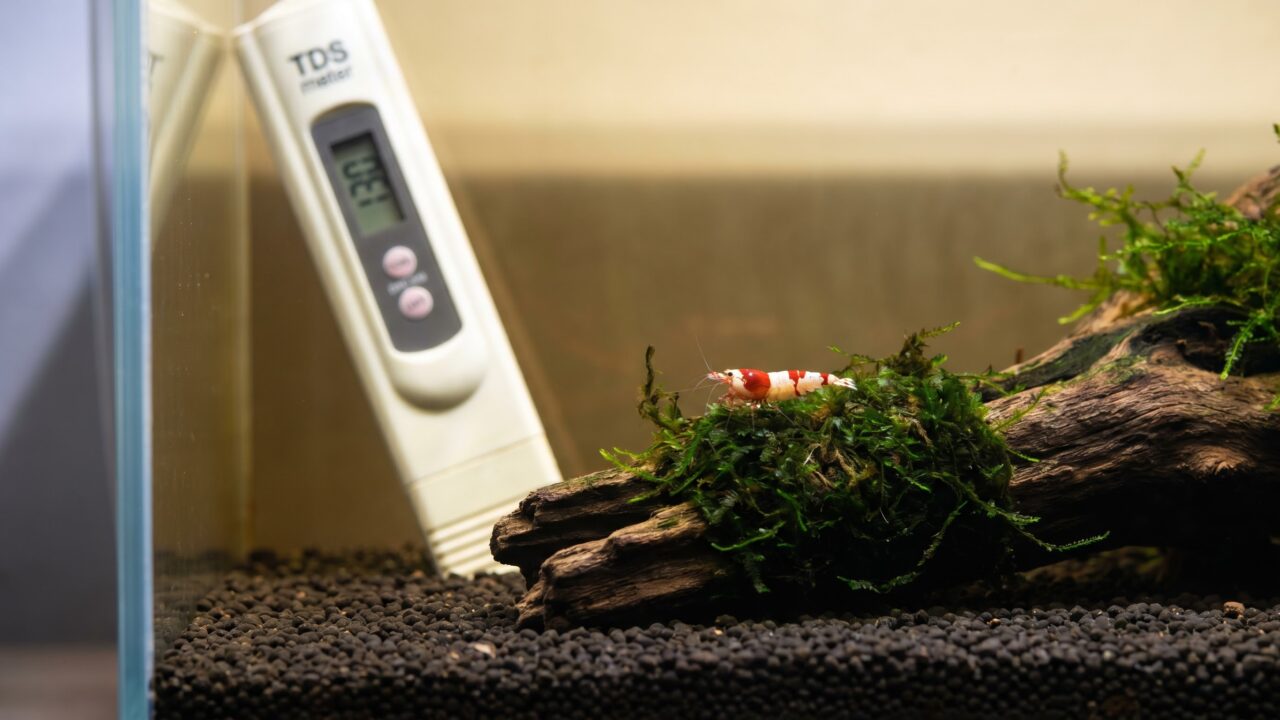
Four numbers define whether a crystal red or Taiwan bee shrimp thrives or slowly fails: GH 4-6 dGH, KH 0-1, TDS 100-150 ppm, pH 5.8-6.4. Miss any one of them by a meaningful margin and the colony rarely crashes overnight. It just stops breeding, stops coloring up, and quietly declines. Caridina are honest about their water. They just don't announce the problem until it is already months old.
This guide explains what those numbers mean, why the setup requires an active buffering substrate and RO water remineralized with a GH-only salt, and where the setup can go wrong over time. There is a full parameter and setup reference card below for quick reference once you understand the reasoning behind it.
Why Caridina need such specific water
Caridina cantonensis, the species behind crystal red, crystal black, and most Taiwan bee varieties, occurs naturally across southern China (Guangdong Province), Hong Kong, and Taiwan - soft, slightly acidic mountain and hill streams throughout that region. The species name cantonensis itself refers to Canton (Guangdong Province), and the original 1938 description by Yu was based on specimens from southern China. A 2020 phylogenetic revision covered by Seriously Fish confirmed the wider native range. Whatever the precise provenance of any captive line, the habitat signature is consistent: soft, low-mineral, slightly acidic water. As Wikipedia puts it, "their health depends on being raised in soft water that matches the pH of their native streams, making them more difficult to farm than other shrimp species." The hobby has spent 30-plus years dialing in what "soft and slightly acidic" actually means in practical tank terms.
Soft water means low dissolved minerals. Low dissolved minerals means low GH and low TDS. The key insight for keepers coming from Neocaridina is that Caridina want less of almost everything - less calcium, less magnesium, less total dissolved material, and critically, near-zero carbonate hardness. That last one drives the entire equipment list.
KH (carbonate hardness) measures the concentration of carbonate and bicarbonate ions, which act as a pH buffer in water. A KH above 1 keeps pH stable but keeps it stable too high for Caridina. With KH near zero, an active substrate can lower and hold pH in the 5.8-6.4 range the shrimp need. Add KH and the substrate fights a losing battle against the carbonates you keep pouring in with every water change.
This is the core reason the Caridina setup is considered advanced. It is not just the parameters themselves. It is the chain of dependencies: RO water, GH-only remineralizer, active buffering substrate, careful water changes, and a monitoring habit. If you are just getting started with shrimp, the article Caridina: why they're not for beginners walks through exactly what makes this genus harder to keep than cherry shrimp.
The parameters in detail
GH: 4-6 dGH
GH measures dissolved calcium and magnesium. For Caridina, the target is 4-6 dGH. This is lower than Neocaridina (which prefer 6-8) because the shrimp's native streams contain less dissolved rock. Calcium and magnesium still matter enormously - they are the raw materials for building a new exoskeleton during each molt. GH below 4 creates real molting risk. When a shrimp cannot source enough calcium or magnesium from the water to harden its new shell, the molt fails. The visual result is a white ring around the body where the shell split but the shrimp could not escape - the white ring of death. It is almost always fatal, and adding cuttlebone after the fact does not reverse a molt in progress. The right fix is preventive: maintain GH within range before the molt starts.
GH above 6 is not an emergency, but it tends to push TDS upward, which works against the low-TDS target. Keep it in the 4-6 window. For more on GH and what it does to molting success, see GH for shrimp: what it is and why it matters.
KH: 0-1
KH must stay near zero. For most Caridina setups, the target is 0-1 dKH - often measured as 0 on a standard API or Salifert test. This is not an accident of the hobby; it is the key that makes everything else work. An active buffering substrate maintains pH in the soft-water range by releasing hydrogen ions. Carbonates neutralize those hydrogen ions. If you add KH, you are neutralizing the substrate's buffering mechanism. Once the substrate loses that battle, pH climbs, and Caridina in water above pH 6.8 will start showing stress. The full explanation of the KH-pH relationship is in our article on KH for shrimp.
The only way to achieve KH near zero reliably is to start with water that has no KH to begin with - which means RO water - and add a remineralizer that does not contribute carbonate hardness.
TDS: 100-150 ppm
TDS (total dissolved solids) is a proxy for overall ionic load in the water. For Caridina, 100-150 ppm is the established target range, built from decades of keeper experience with this species. The reason the range exists is energetic: when freshwater crustaceans are in an osmotically stressful environment, they divert resources toward maintaining internal chemistry at the expense of growth, breeding, and immune function. Research on Macrobrachium nipponense (a large freshwater prawn) found that aquatic animals under osmotic stress "consume energy for osmotic regulation, which can account for 20-50% of the total energy consumption." While Macrobrachium is not Caridina, the underlying principle - that osmotic imbalance carries a real metabolic cost for freshwater crustaceans - is well-established across the group. Keeping TDS in the correct range means the shrimp is not spending a significant energy budget just keeping its internal chemistry stable.
Equally important: sudden TDS swings are dangerous. A large water change with mismatched water can shift TDS by 40-50 ppm in minutes. That rapid osmotic shift stresses shrimp even when the new water hits the "right" numbers. Keep water changes small - 10-15% at a time - and match the replacement water to your tank TDS before adding it. For more on managing TDS, see TDS for shrimp: what the number actually tells you.
pH: 5.8-6.4
The pH window is wider than many beginners expect. Caridina are comfortable anywhere from 5.8 to 6.4 as long as the water is stable within that range. A tank running at a steady 6.5 is fine. A tank swinging between 6.2 and 7.1 across the day is not. A tank locked at a steady 6.2 for six months will outperform one chasing 6.0 with daily swings.
Active buffering substrates naturally target the lower end of this range. A healthy new substrate in low-KH RO water typically holds pH around 6.0-6.4. As the substrate ages and its buffering capacity declines, pH drifts upward. When your tank consistently reads above 6.8, the substrate is giving out.
Temperature: 20-24°C (68-75°F)
Wikipedia records that C. cantonensis tolerates "70 to 78°F (21 to 26°C)," putting the lower floor at 21°C (70°F). Breeders have found colony health is best in the cooler portion of that tolerance range - around 20-24°C - rather than pushing toward the upper end. Above 25°C, the species shows higher juvenile mortality and reduced egg survivability. Many experienced breeders report that Taiwan bee and high-grade crystal red lines are even more temperature-sensitive than standard grades, though this is keeper consensus rather than published data. In warm climates, a small inline chiller is often part of the Caridina setup. Do not skip temperature as a parameter - it interacts with everything else. Faster metabolism at higher temperatures means faster breeding but also faster aging, less tolerance for water quality lapses, and stronger immune challenge.
The water source: RO water only
Tap water is incompatible with a Caridina setup for two reasons. First, most tap water carries KH that will exhaust the active substrate. Second, tap water can carry copper - from household plumbing, especially in older homes - at concentrations that kill shrimp. Copper disrupts the hemocyanin-based oxygen transport system that invertebrates use instead of hemoglobin. Freshwater invertebrates are significantly more sensitive to copper than fish are; 96-hour LC50 values for freshwater shrimp vary with water chemistry and species but can fall well below 1 mg/L in soft water - concentrations that would go unnoticed by most fish. Even chronic exposure to trace copper below any acute threshold creates cumulative stress in sensitive species. If copper is a concern in your supply, see our article on copper and shrimp for testing and mitigation options.
RO (reverse osmosis) water starts at TDS zero, GH zero, KH zero, and copper near zero. That blank slate lets you rebuild the water from the ground up, adding only what the shrimp need. The downside is that you need a remineralizer. Pure RO water will kill Caridina just as surely as hard tap water - the shrimp cannot molt with no calcium or magnesium available. For an overview of the RO vs. tap decision, see RO vs. tap water for shrimp.
The remineralizer: why GH-only is the correct choice
This is the single most common beginner purchasing mistake in Caridina keeping: buying a GH/KH remineralizer instead of a GH-only product. Products like SaltyShrimp Shrimp Mineral GH/KH+ are designed for Neocaridina. They add both calcium-magnesium hardness and carbonate hardness. Put that product in a Caridina tank and you are feeding carbonates directly into the water every water change, undermining your active substrate.
For Caridina, use a product specifically formulated to raise GH without raising KH. SaltyShrimp Bee Shrimp Mineral GH+ is the most widely cited example. The manufacturer's own product page specifies that it works by "raising the total hardness (°dH) without significantly influencing the carbonate hardness (KH)," with a target of approximately 6 dGH and a KH/GH ratio of 0.06/1.0. GlasGarten Mineral Junkie Bites and similar GH-only products work on the same principle.
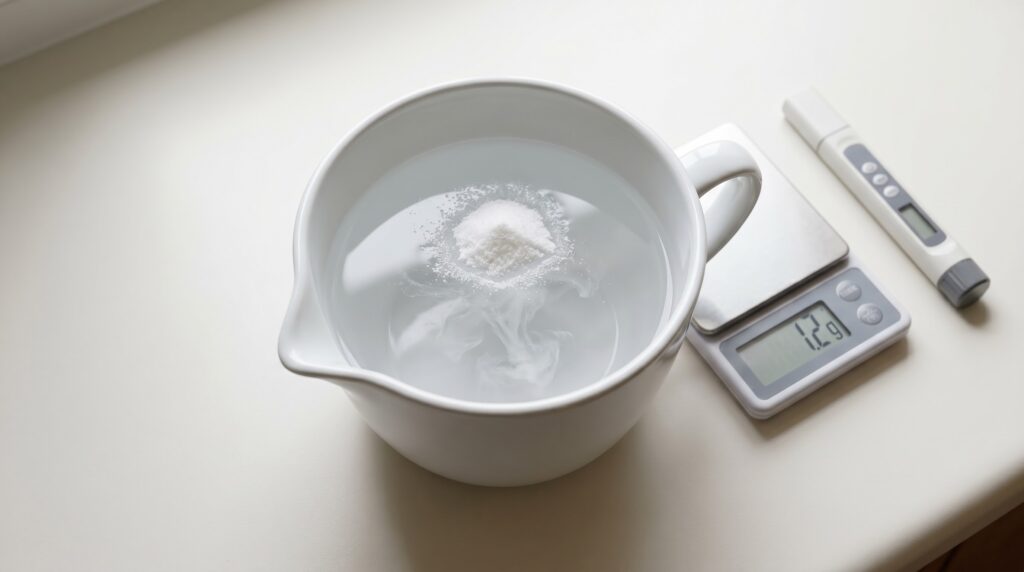
Dosing is straightforward: mix the remineralizer into your RO water in a separate container before adding it to the tank. Measure TDS before adding to confirm you have hit your target range. Reproducibility is the goal: the same measured amount of salt per liter on every change produces parameters that track reliably over months. Weigh your salt rather than estimating by eye. A 0.1g difference per liter compounds across every water change. For a full comparison of remineralizer products and when to use each, see GH/KH remineralizer: which one to use for Caridina and Neocaridina.
The active buffering substrate: what it does and when it runs out
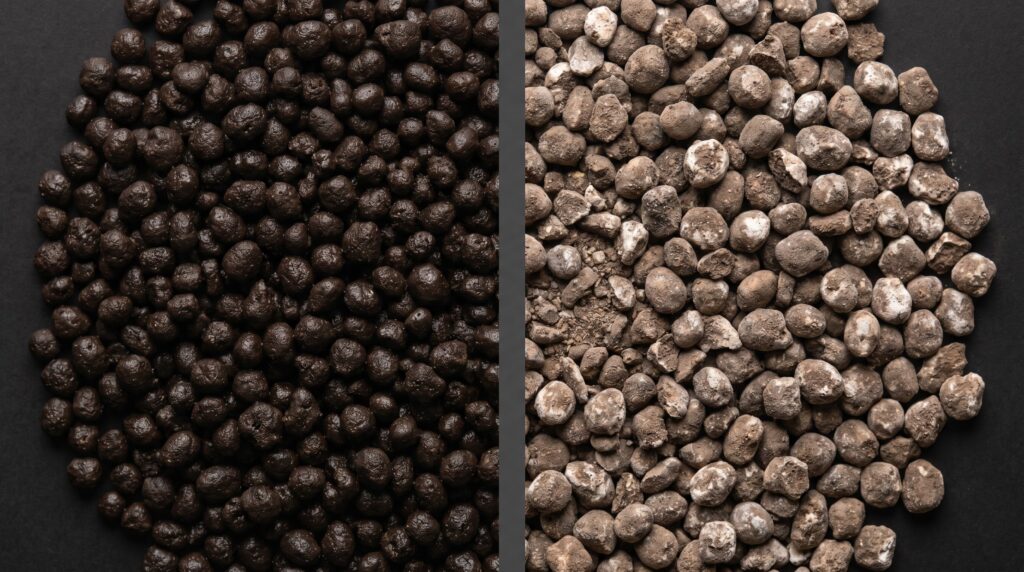
Active substrates - products like ADA Aquasoil Amazonia, GlasGarten Environment Aquarium Soil, and Fluval Stratum - are made from fired and processed clay that carries a high cation exchange capacity (CEC). When submerged, the clay particles exchange stored hydrogen ions for dissolved ions in the water, including the calcium and magnesium carbonates that form KH. This strips carbonates from the water column, driving KH toward zero and pH toward the acidic range. The substrate acts as a continuous pH buffer, not just a one-time treatment.
The mechanism is finite. Every exchange depletes the substrate's ion reservoir slightly. Two factors accelerate exhaustion: high-KH water (the carbonates keep replenishing what the substrate strips out, forcing it to work constantly) and time. Using RO water with KH near zero greatly extends substrate life because the substrate barely has to work. Even so, most Caridina breeders plan for a substrate refresh at 12-18 months. The tell is pH creeping upward past 6.8 even with your usual water maintenance. When that happens, the substrate is not failing your shrimp - it is spent, doing its job right up until the capacity ran out.
For a full breakdown of choosing and maintaining an active substrate, see active substrate for shrimp.
Caridina parameter and setup reference card
The table below puts every parameter and setup element in one place. Match each cell against your own setup as a checklist before adding shrimp.
| Parameter / element | Caridina target | Why it matters | Failure mode |
|---|---|---|---|
| GH | 4-6 dGH | Calcium and magnesium for exoskeleton building; too low causes failed molts | White ring of death (molt failure); GH >6 pushes TDS high |
| KH | 0-1 dKH | Near-zero KH lets active substrate hold pH low; added KH neutralizes buffering | pH climbs above 6.8; substrate exhausts prematurely |
| TDS | 100-150 ppm | Low ionic load reduces osmoregulatory energy cost; tracks remineralizer dosing | TDS >200 stresses colony; sudden swings cause osmotic shock |
| pH | 5.8-6.4 | Steady pH in range; daily drift is worse than being off-target | pH >6.8 indicates substrate exhaustion; swings cause stress |
| Temperature | 20-24°C (68-75°F) | Upper end of tolerance reduces egg viability and increases juvenile mortality | >25°C: colony declines even with perfect water chemistry |
| Water source | RO only | Blank-slate water; no tap KH or copper contamination | Tap water introduces KH and possible copper; both are colony killers |
| Remineralizer | GH-only product (e.g. SaltyShrimp Bee Shrimp Mineral GH+) | Rebuilds GH without adding KH; preserves substrate function | GH/KH+ product adds carbonates on every water change |
| Substrate | Active buffering soil | Continuously strips KH and holds pH in Caridina range | Substrate exhaustion at 12-18 months if not replaced; pH drifts high |
| Substrate lifespan | 12-18 months typical | Buffering capacity is finite; KH in water accelerates exhaustion | pH rise above 6.8 on normal water routine = time to replace |
| Water changes | 10-15% at a time, TDS-matched | Prevents osmotic shock; preserves substrate efficiency | Large changes crash TDS or KH balance; osmotic shock follows |
| Tank cycling | Full cycle required (ammonia 0, nitrite 0) | Ammonia and nitrite are highly toxic to shrimp | Adding shrimp to an uncycled tank causes rapid die-off |
| Copper | Zero tolerance | Toxic to invertebrates at trace concentrations; disrupts hemocyanin | Copper medications or copper-containing fertilizers kill the colony |
Before you add the first shrimp: three non-negotiables
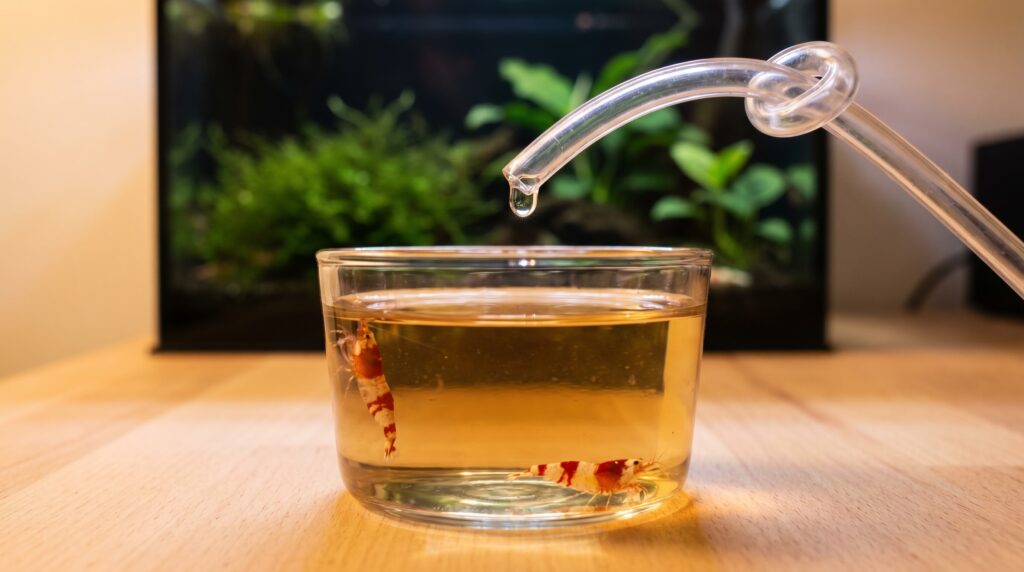
Even with perfect Caridina water parameters, colonies fail when keepers skip the setup fundamentals that apply to any shrimp tank.
The tank must be fully cycled. Ammonia and nitrite must both test at zero before any shrimp go in. Shrimp are far more sensitive to ammonia spikes than fish are. A fishless cycle on active substrate typically takes 4-6 weeks - often longer - because active substrate leaches ammonia in the early weeks, which can interfere with bacterial establishment and extend the timeline beyond what a bare-bottom or inert-gravel tank would need. Test patiently. Adding shrimp to an uncycled tank is the most common cause of complete colony loss in week one.
Drip-acclimate every new batch of shrimp, without exception. Set up airline tubing with a loose knot to restrict flow to roughly 2-4 drops per second and run it into the transport container for 1-2 hours. By the end, the container water has been diluted and replaced with your tank water gradually enough that the shrimp's osmoregulation has time to adjust. Once the time is up, net the shrimp directly into the tank and discard the container water. Shipping stress has already taxed their systems; even a close TDS match is not a reason to skip the acclimation.
Keep copper out of the tank permanently. That means no copper-based medications (most blue or green anti-parasite treatments), no fertilizers with copper listed in the ingredients, and if you are on older plumbing, let the tap run cold for 30 seconds before filling your RO unit's reservoir. RO membranes remove most copper, but reducing the incoming load is still good practice.
Why this setup is classified as advanced
Neocaridina - cherry shrimp, blue dreams, bloody marys - can be kept on dechlorinated tap water in many regions, with a basic GH/KH remineralizer if needed. They tolerate a range. Caridina do not tolerate a range. They require a specific, maintained chemistry window, a substrate that actively manages their water, and a keeper who monitors parameters regularly and replaces the substrate before it fails rather than after.
That is four hardware dependencies (RO filter, TDS meter, GH/KH test kit, active substrate) and an ongoing monthly cost in RO filter maintenance and eventual substrate replacement. It is not difficult work, but it is more work than most beginners realize when they see crystal reds at a shop and fall in love. If you are weighing whether to start with Neocaridina or jump straight to Caridina, the article why Caridina are not a beginner shrimp lays out the honest comparison.
For keepers who are ready for it, Caridina are genuinely rewarding. A healthy colony of high-grade crystal reds or shadow pandas in stable, dialed-in water is one of the best things in the hobby. The parameters are the price of admission. Get them right once, stay consistent, and the shrimp do the rest.