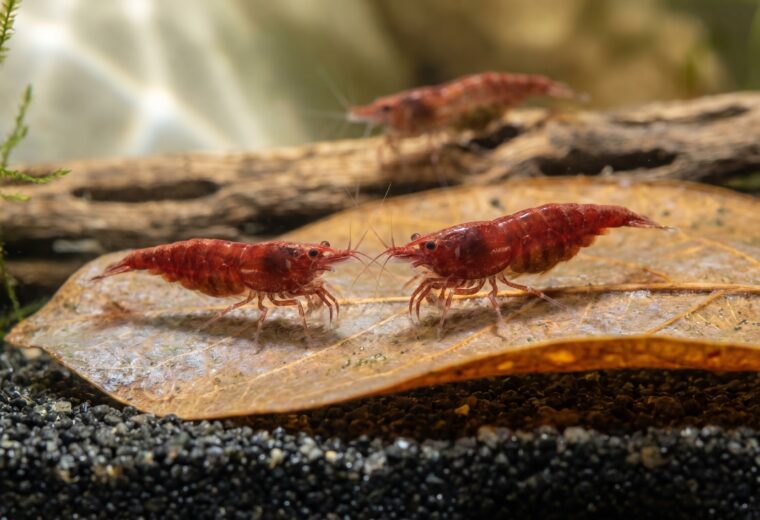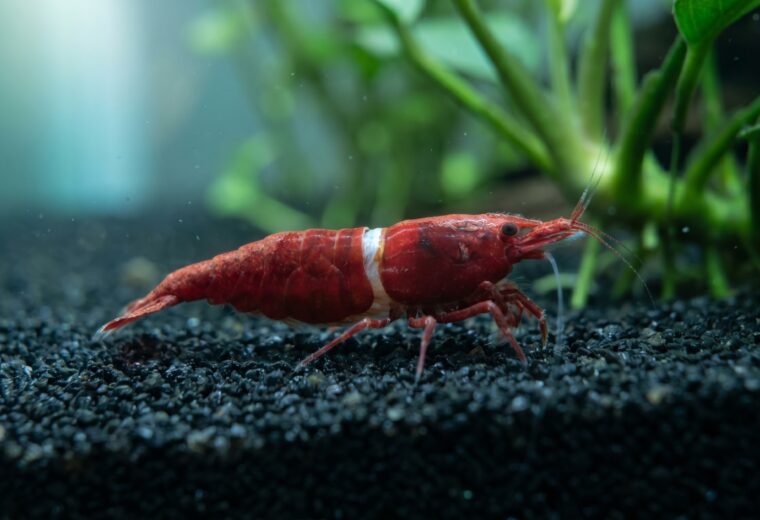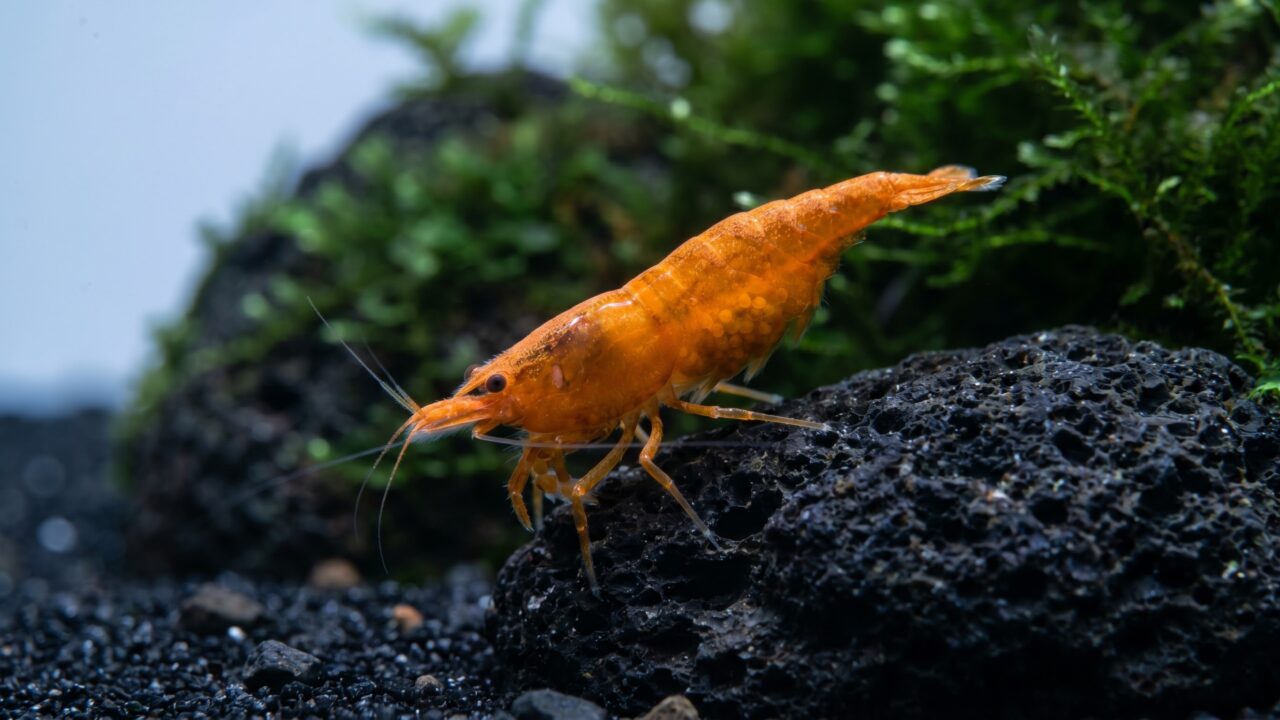
Orange is the Neocaridina color that punishes inattention more visibly than almost any other. Red cherry shrimp can hold a dull brick shade for months without anyone noticing the decline; orange fades toward cream fast enough that you can track it across a single molt cycle if the diet or water chemistry is slightly off. That volatility is also what makes orange rewarding to get right - a well-kept colony of high-grade Pumpkin or Sunkist shrimp is genuinely striking in a way that photographs cannot fully capture. These are still Neocaridina davidi, as beginner-friendly as red cherries, but holding the color takes a few deliberate choices around water chemistry, substrate, and food that this guide covers in full.
This guide covers how the orange variants are named and graded, what water they actually need, how to feed for color, and how to breed a colony that keeps improving generation after generation.
Orange Sakura, Pumpkin, and Sunkist: what the names actually mean
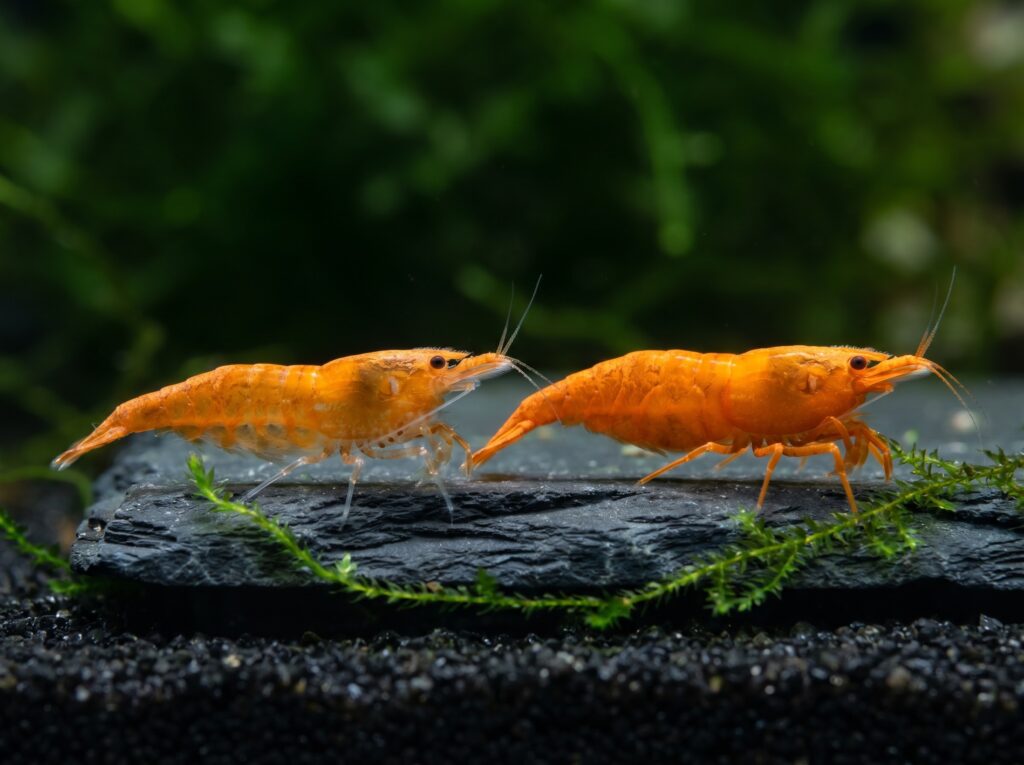
All of these shrimp are the same species: Neocaridina davidi. In the wild the species is a muted, mottled brown. Orange, like red, yellow, and blue, is a color line produced by long-running selective breeding acting on chromatophore cells. Research on color strains suggests the orange phenotype results from a combination of xanthophores (yellow-orange pigment) and erythrophores (red-orange pigment), though the exact chromatophore balance that separates orange from red or yellow is not as cleanly bifurcated as it might appear - these cells express carotenoid pigments absorbed from food, and diet plays a major role in how the color actually presents.
The different names you see - Orange Sakura, Pumpkin, Sunkist, Orange Fire - are marketing terms that mostly describe grade, meaning color coverage and opacity, not a separate genetic strain. There is no single industry standard that locks these names to exact grades, but the pattern is consistent enough to be useful:
| Name commonly used | What to expect visually | Grade equivalent |
|---|---|---|
| Orange / Orange shrimp (entry) | Mostly translucent body, scattered orange patches; legs may be clear | Low / no-grade |
| Orange Sakura | Solid orange coverage on the body with some translucent areas; females show clear color | Mid (Sakura) |
| Pumpkin / Sunkist | Dense, opaque orange from head to tail; legs tinted; minimal or zero clear patches | High / painted |
| Orange Fire | Full-body, saturated deep orange - the top end; best females look like a lit tangerine | Top / fire |
Note: grade names (Sakura, Pumpkin, Sunkist, Fire) are not standardized across sellers. The table above describes the pattern that is consistent in practice, not an official industry taxonomy. Check the seller's own photos rather than relying on the name alone.
Females carry considerably more color than males, as is true across the Neocaridina family. When you look at a seller's listing photo, check whether the featured animal is female. A tank of "Pumpkin" shrimp often contains males that are a pale orange-cream - perfectly normal, but worth knowing before purchase.
Because grade is a spectrum, not a binary, the same colony will contain shrimp at various points on it. Culling low-color animals and breeding selectively from the deepest orange individuals is how a line improves over generations. The neocaridina grading article explains the grading logic in detail across all color lines.
Water parameters: what orange cherry shrimp actually need
Orange cherry shrimp are Neocaridina, which means they are significantly more tolerant of variable water than Caridina species. They do best in moderately hard, near-neutral water. The numbers below are the working ranges that experienced keepers use:
| Parameter | Target range | Absolute limits |
|---|---|---|
| GH (general hardness) | 6-8 dGH | 4 min / 12 max |
| KH (carbonate hardness) | 2-4 dKH | 0 min / 8 max |
| TDS | 150-250 ppm | 150 min / 300 max |
| pH | 6.8-7.5 | 6.5 min / 8.0 max |
| Temperature | 22-25 C (72-77 F) | 18 C min / 28 C max |
| Ammonia | 0 ppm | Any detectable level is dangerous |
| Nitrite | 0 ppm | Any detectable level is dangerous |
| Nitrate | Below 20 ppm | Below 40 ppm |
GH is the most important number to get right. Calcium and magnesium - the minerals GH measures - are what shrimp extract from the water column during molting to rebuild their exoskeleton. Too low and molts fail; the symptom is shrimp found dead mid-molt, often split along the body. This failure is called the white ring of death, and no amount of cuttlebone added to the tank will reliably fix a low-GH problem - the fix is remineralizing to a stable GH of 6-8 before the shrimp ever enter the tank. See the full explanation at white ring of death.
KH buffers pH against swings. A KH of 2-4 keeps pH stable across the week without drifting dangerously low overnight. The SaltyShrimp Shrimp Mineral GH/KH+ product is designed specifically for this - it raises GH and KH at a fixed ratio of 1.0/0.5 (per unit GH, you get half that in KH), and the manufacturer specifies approximately 2 g per 10 liters of RO water to achieve the target conductance of around 300 microsiemens; on most TDS meters this reads approximately 150-200 ppm. The separate TDS target of 180-250 ppm in the table above is the broader keeper-standard range for Neocaridina and may be reached using different mineral sources or starting water - the SaltyShrimp dose gets you into the lower-to-middle part of that window.
Consistent parameters matter more than chasing a textbook number. Orange cherry shrimp kept at a steady GH 7.5 and pH 7.2 will build healthier molt cycles than those in a tank where GH bounces between 8 and 5 week to week. Test parameters weekly, not just when something looks wrong.
If your tap water is hard (GH already above 8), you can use it straight for Neocaridina after dechlorination - no remineralizer needed. Soft tap or RO water needs remineralizing. The options are covered in detail at how to remineralize RO water.
The tank must be cycled before any shrimp go in
Ammonia and nitrite kill shrimp quickly, and a new tank has neither the bacterial colonies to process fish waste nor the buffering capacity to absorb a spike. The nitrogen cycle typically takes four to six weeks from scratch. Add shrimp only when ammonia and nitrite both read 0 ppm on two tests taken 24 hours apart. There are no shortcuts here - shrimp added to an uncycled tank die, usually within days.
Copper is lethal, full stop
Even small amounts of dissolved copper that fish handle without visible symptoms will kill invertebrates. The sources include copper-based medications (Cupramine, a Seachem brand; methylene blue-copper combination products), some liquid fertilizers, and - importantly - the first draw from old copper plumbing in the morning. If your tap sits in copper pipes overnight, run the tap for 30-60 seconds before filling a container. Seachem Prime detoxifies heavy metals found in tap water at typical concentrations, but it is not a cure for dosing a copper medication into a shrimp tank. Never use copper treatments in a shrimp setup, and check the ingredient list of any fertilizer before adding it.
Setting up the tank for orange cherry shrimp
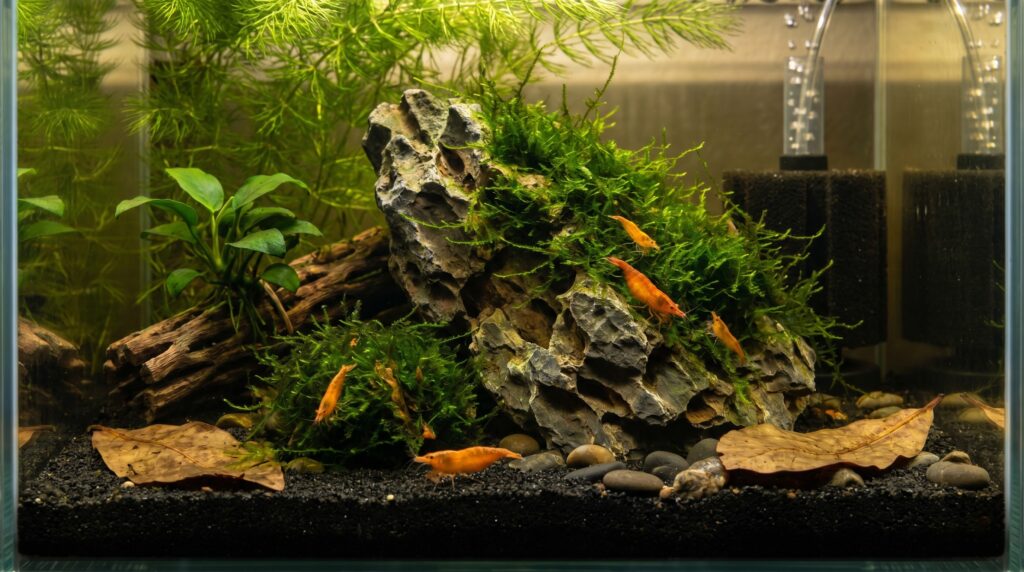
Orange cherry shrimp are comfortable in a tank as small as 10 liters (about 3 gallons), though 20-40 liters gives more stable parameters and room for a colony to grow. Start with at least 10 individuals - shrimp are colonial and a group of fewer than ten will breed slowly, if at all.
A sponge filter is the safest filtration choice. The foam surface grows the beneficial bacteria you need, the gentle flow suits shrimp, and there is no intake pipe to trap babies. If you use a HOB or canister, cover the intake with a fine sponge pre-filter.
Substrate and background color directly affect how vivid your orange shrimp look - and there is research behind this, not just keeper opinion. A study on Neocaridina heteropoda found that "pigmentation significantly increased as the darkness of background color increased" - shrimp on dark substrates and against dark backgrounds developed measurably deeper pigmentation than those on white. Dark-colored inert substrates (black, deep brown, dark grey) make orange pop visually AND appear to support more pigment accumulation. A planted tank with Java moss, Anubias, or java fern gives shrimplets hiding places, promotes biofilm growth, and further darkens the visual backdrop.
Inert substrate (plain gravel or sand, not active buffering substrate) is the right call for Neocaridina. Active substrates buffer pH downward toward the Caridina range and will gradually push your pH too low for optimal Neocaridina health.
Feeding for color: the role of astaxanthin and diet variety
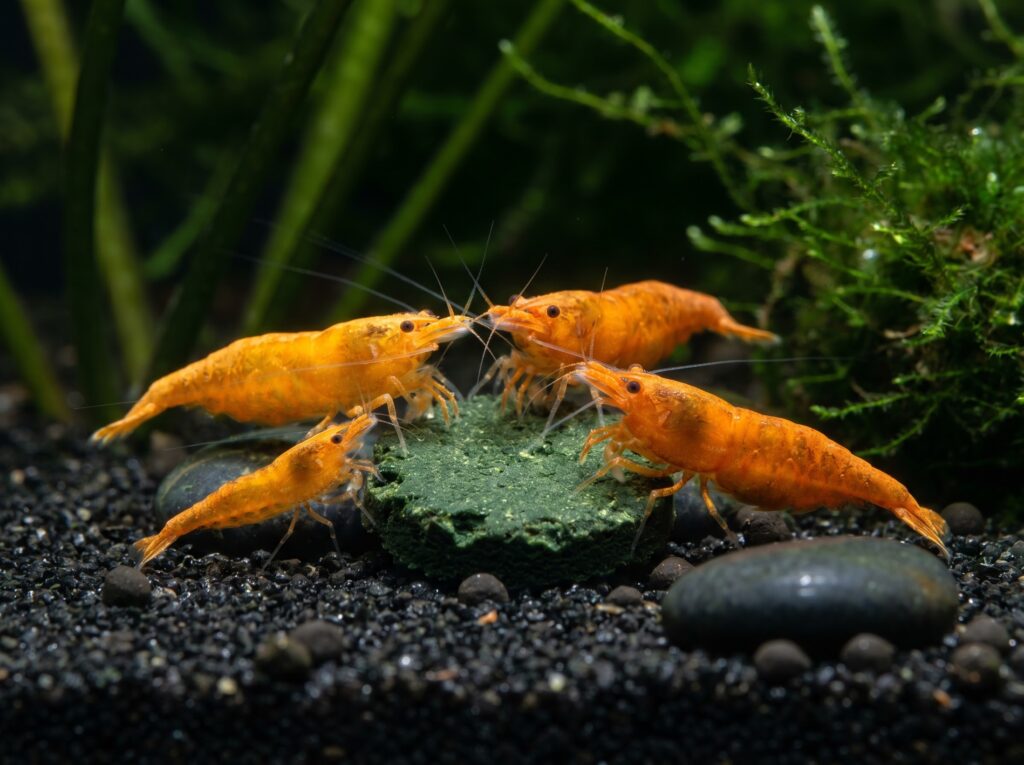
Orange in shrimp is a carotenoid pigment, and carotenoids come from food. Shrimp cannot synthesize enough astaxanthin - the primary pigment driving orange-red coloration - on their own; research on crustaceans confirms that "this conversion still does not meet the organism's full requirements, necessitating its acquisition through dietary sources." A colony on plain flake food will gradually fade. A colony fed a varied, carotenoid-rich diet holds and deepens color.
A study specifically on Neocaridina heteropoda found that astaxanthin-supplemented groups showed "significantly greater pigmentation than that of shrimp fed without astaxanthin" - the effect was statistically significant and visually clear. Astaxanthin and background color acted independently, meaning a dark substrate and a good diet each contribute separately, and you benefit from doing both.
In practice, a useful feeding approach for orange cherry shrimp:
- A quality formulated shrimp food 4-5 times per week. GlasGarten Shrimp Dinner 2 lists spirulina, chlorella, kelp, and crustacean meal as ingredients - all natural carotenoid sources. Hikari Crab Cuisine and similar crustacean-focused pellets work well too.
- Blanched vegetables once or twice per week: zucchini, cucumber, spinach. Remove after 24-48 hours to prevent ammonia spikes.
- Biofilm and algae growing naturally on hardscape and plants are a constant background food source. Do not clean every surface obsessively.
- Indian almond leaves or alder cones release tannins, lower pH slightly, and provide a surface for biofilm that shrimplets graze on from day one.
Feed only as much as the shrimp finish within a few hours. Leftover food rots and spikes ammonia. Shrimp in a well-planted, mature tank can go two to three days without supplemental feeding and do fine - what do shrimp eat naturally, and how much is too much? See what do shrimp eat for the full breakdown.
Breeding orange cherry shrimp
Orange cherry shrimp breed readily once established. A healthy colony in stable water at 22-25 C runs a continuous, overlapping cycle: females mature, saddle up, molt and mate, carry eggs for three weeks, and release a batch of shrimplets - while other females in the tank are at earlier or later stages of the same cycle. Getting the conditions right means getting that cycle turning; interrupting it (with a sudden GH drop, a temperature swing, a copper trace) is what stops a colony cold.
Females reach sexual maturity at roughly two months of age. Before a female is ready to carry eggs, she develops a visible patch of unfertilized eggs called a saddle - look for it on the dorsal surface at the junction of the cephalothorax (the head shield) and the abdomen, on the top of the shrimp just where the body begins to segment. After molting and mating, those eggs move under the tail to the swimmerets, where the female fans them constantly to oxygenate them. A female in this state is called berried.
Incubation time is temperature-dependent. Research on Neocaridina heteropoda heteropoda found that at 24 C the incubation period runs about 21 days, while at higher temperatures it shortens considerably - down to 12 days at 32 C (though 32 C is dangerously hot for a colony, and the same study found that females mating at that temperature lost their eggs entirely). In the practical keeper range of 22-25 C, expect eggs to hatch in roughly 18-25 days. Each female averages around 20-30 eggs, and the study recorded a mean of 24.2 juveniles actually hatching per female.
Shrimplets hatch as miniature adults - no larval stage. They are roughly 1 mm at hatching and transparent at first. They hide in moss and graze biofilm. Leave the moss and leaf litter undisturbed; that is where the survival happens. After four to six weeks, juveniles are large enough to be clearly visible and starting to show color.
The highest proportion of breeding females occurs at 28 C according to that same research, but the breeding rate in the 22-25 C range is still excellent and safer for colony health. Pushing temperature to 27-28 C to accelerate breeding can work in the short term but leaves less margin for error on hot days.
Keep the orange line pure
This is the rule that new keepers most often skip, and it costs them a colony. All Neocaridina color variants - orange, red, yellow, blue - are the same species. They interbreed freely, and when they do, offspring do not produce some blended intermediate color. Instead, the genetics mix toward wild-type, and typically within a few generations - the exact count varies depending on the allele frequencies in your starting stock - you end up with a tank of mottled brown shrimp. Keep orange cherry shrimp in a tank that contains no other Neocaridina color line. The only safe combination is the same color line at the same or higher grade.
Culling - removing low-color animals from the breeding pool - is how you push a line toward the deeper, more opaque end of the grade spectrum over time. You do not need to euthanize culled shrimp; moving them to a separate tank, trading them, or selling low-grade animals to beginners is perfectly reasonable.
Orange-strain quick reference card
| Topic | Key number or action | Why it matters |
|---|---|---|
| Species | Neocaridina davidi | Same species as red cherry, yellow, blue dream |
| GH target | 6-8 dGH | Calcium/magnesium for healthy molts; low GH = white ring of death |
| KH target | 2-4 dKH | Buffers pH; prevents overnight swings |
| TDS | 150-250 ppm | Proxy for dissolved mineral load |
| pH | 6.8-7.5 | Outside this, enzyme function suffers |
| Temperature | 22-25 C (72-77 F) | Optimal health; max breeding rate around 28 C but riskier |
| Ammonia / Nitrite | 0 ppm both - always | Any reading here is an active emergency |
| Tank size | 20+ liters recommended | Easier parameter stability; room for a colony |
| Colony start | Minimum 10 individuals | Below this, breeding is slow and genetics narrow |
| Substrate | Dark, inert | Enhances perceived color AND supports deeper pigment accumulation |
| Copper | ZERO tolerance | Lethal to all invertebrates; check meds and fertilizers |
| Acclimation | Drip, 1-2 hours | Osmotic shock from parameter jump kills new arrivals |
| Color feeding | Astaxanthin/carotenoid sources 4-5x/week | Color is dietary; shrimp cannot produce enough alone |
| Incubation | 18-25 days at 22-25 C | Temperature shortens/lengthens this window |
| Clutch size | ~20-30 eggs; ~24 hatch on average | Realistic colony growth expectation |
| Keep separate from | All other Neocaridina color lines | Crossbreeding reverts offspring toward wild brown |
Bringing in new shrimp safely
New shrimp arriving from a seller have been sitting in water that probably has different GH, KH, TDS, and pH than your tank. Pour them straight in and the parameter jump triggers osmotic shock - the single most common reason new shrimp die within 24-48 hours of arrival. A slow drip over one to two hours is the safest way to bridge the parameter gap. Set up airline tubing from your display tank into a bucket holding the shrimp and their bag water, crimp or knot the line until flow slows to a trickle, and keep going until the bucket holds roughly twice its starting volume. Lift the shrimp out with a net and leave all that diluted seller water behind.
If you are adding shrimp to an existing colony, a two-week quarantine period catches parasites and bacterial infections before they reach your established animals. Vorticella and Scutariella are the parasites most commonly introduced on new shrimp; both are treatable but far easier to handle in an isolated bucket than in a cycled display tank.
Common reasons orange cherry shrimp fade or die
- Color fading: Low GH, insufficient carotenoid in diet, or a light-colored substrate. Check GH first, then switch to a dark substrate and add a color-focused food. Color loss can also signal stress from parameter swings or a crash beginning - read why shrimp lose color to triage.
- Deaths after water changes: Large or fast water changes shift TDS and temperature simultaneously. Keep changes to 10-15% weekly - a conservative range chosen to refresh nitrates without creating a parameter shock; many successful keepers do 20-25% with no issues, but smaller and slower is the safer default for shrimp. Match temperature and GH/KH to the tank before adding. Full detail at why shrimp die after water changes.
- Slow die-off with no obvious cause: Usually copper contamination (check recent ferts or meds), an uncompleted cycle, or a new piece of decor leaching something. Test ammonia and nitrite first. If parameters look fine but shrimp keep dying, see parameters fine but shrimp dying.
- No breeding: Temperature below 20 C, GH too low for successful molting, or male-to-female ratio badly skewed. Need at least a 1:2 male-to-female ratio in a colony for consistent breeding.
- Molting deaths: Almost always GH deficiency. If shrimp are dying mid-molt or you see the white ring appear, test GH immediately and remineralize if below the target range of 6-8; anything under 5 is acutely dangerous for molts. Research confirms calcium and magnesium are essential for exoskeleton reconstruction during ecdysis (PMC4359132).