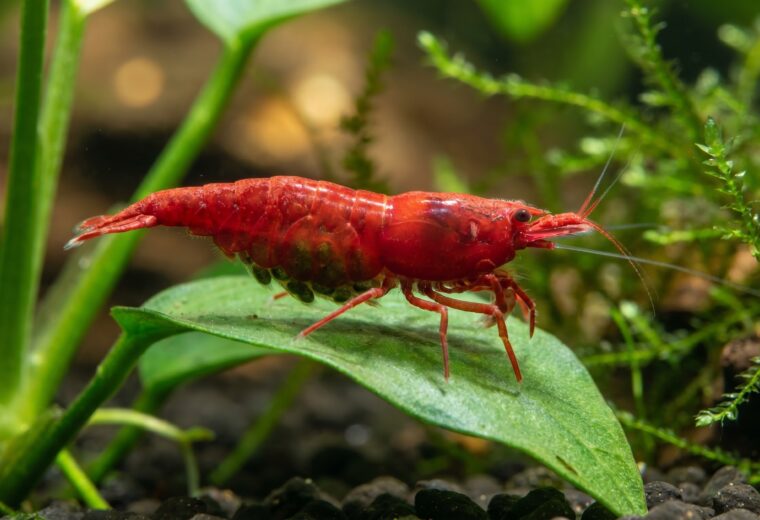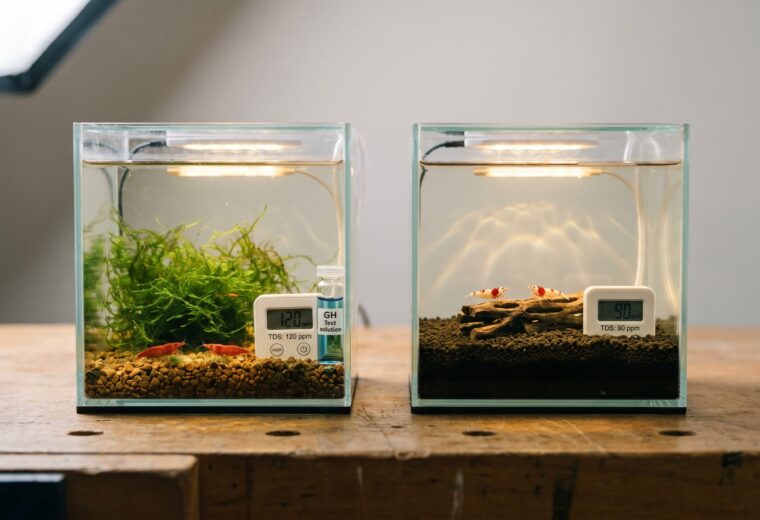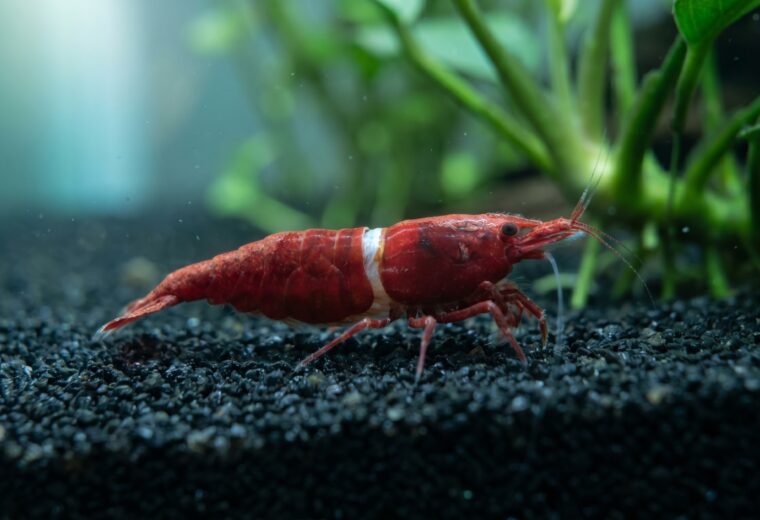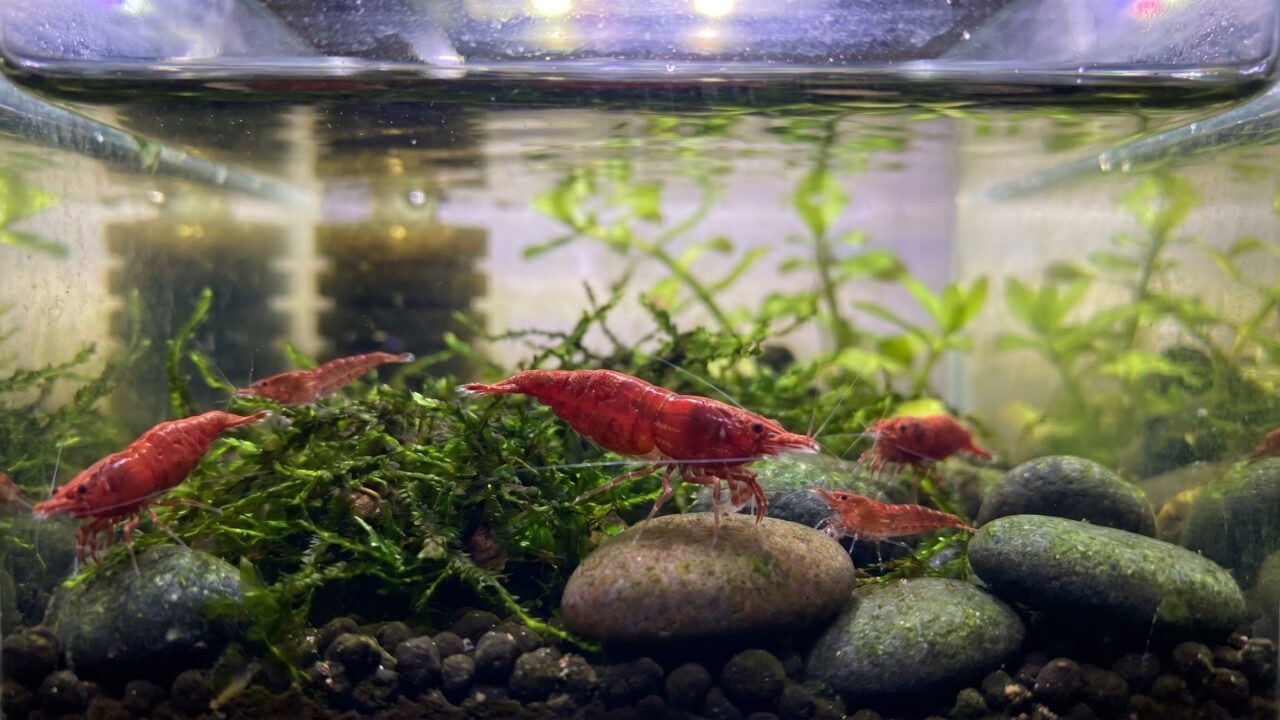
If you want shrimp that will actually survive your first tank, start with Neocaridina davidi and its color forms. Cherry shrimp, blue dream shrimp, yellow shrimp, black rose: they are all the same species underneath the color, and every one of them tolerates the kind of imperfect water chemistry that beginners inevitably produce. Crystal red shrimp and Taiwan bees look spectacular in photos, but they will die in water that Neocaridina would shrug off. Sulawesi species are even further out of reach. The pattern is consistent: start easy, get the fundamentals right, then upgrade if you want to.
Below is a difficulty ranking of the species you will encounter in the hobby, followed by the care logic that explains every placement in it.
| Species / group | Scientific name | Difficulty | Why |
|---|---|---|---|
| Cherry shrimp (all Neocaridina color forms) | Neocaridina davidi | Beginner | Wide parameter tolerance; breeds readily; forgiving of tap water |
| Amano shrimp | Caridina multidentata | Beginner (care) / no breeding | Tough adults; larvae require brackish water so they cannot reproduce in freshwater |
| Ghost shrimp | Palaemonetes spp. | Beginner (with caveats) | Cheap and hardy, but mixed-species bags and short lifespan create frustration |
| Crystal red / crystal black shrimp | Caridina logemanni | Intermediate | Demands soft, acidic, buffered water; active substrate required; sensitive to swings |
| Taiwan bee shrimp (King Kong, Panda, etc.) | Caridina hybrids | Intermediate-Advanced | Same demands as crystal red but even less forgiving; expensive losses if parameters slip |
| Sulawesi shrimp (Cardinal, White Orchid, etc.) | Caridina spp. (Sulawesi lakes) | Advanced | Require warm, alkaline, ultra-stable lake water (opposite of most shrimp); extremely narrow margins |
Why Neocaridina is the right first shrimp
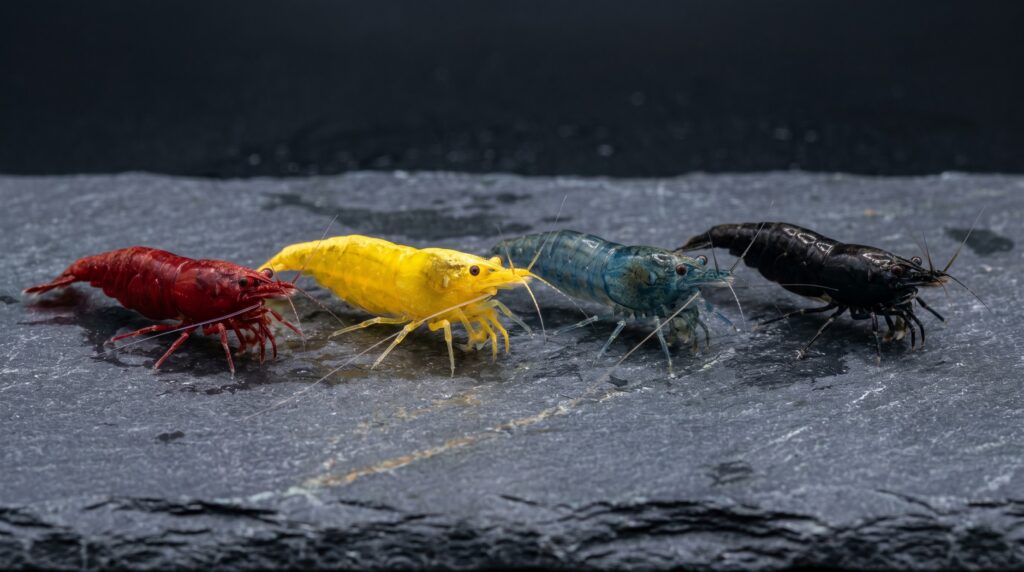
Neocaridina davidi originates from Taiwan, eastern China, the Korean Peninsula, and Vietnam, where it lives in ponds, rivers, and streams across a broad range of altitudes and conditions. Wikipedia's species account notes it "is also able to tolerate a wide range of environmental conditions," and that wide tolerance is exactly what makes it the beginner's friend.
The water parameters for a healthy Neocaridina colony: GH 6-8 dGH, KH 1-4 dKH, TDS roughly 150-250 ppm, pH 6.5-7.5, temperature 18-26°C (64-79°F). Those are wide enough that many areas' dechlorinated tap water lands inside them without any remineralization at all. Where tap water is very soft or very hard, a remineralizer such as SaltyShrimp Shrimp Mineral GH/KH+ (which targets ~6 dGH and conductance of 300 ±50 µS at the recommended dose) makes it straightforward to hit the range. See our comparison of Neocaridina vs Caridina water requirements for the full chemistry breakdown.
Females carry 20-30 eggs tucked under the tail (you will see the clutch fanning in a small dark mass). Eggs hatch in 2-3 weeks as fully-formed miniature shrimp, with no larval stage, no special food, no saltwater required. A colony of 10 adults will be 30-50 shrimp within a couple of months if parameters are stable. That fast feedback is encouraging for beginners.
Color does not change hardiness. A Painted Fire Red (PFR) cherry shrimp (fully opaque red from antenna to uropod) and a low-grade cherry shrimp with patchy color are the same species with the same physiology. The grade reflects how consistently color was selected over many generations, not how tough the animal is. You can safely start with whichever color appeals to you.
The one Neocaridina rule that trips beginners up: keep color lines separate. All the Neocaridina color forms (cherry red, blue dream, yellow, orange, black rose, green jade) are the same species. Cross two color lines and within a few generations the offspring drift toward the wild-type mottled brown. The precise genetics are not fully published - Wikipedia notes there is "limited public information about the heritability and inheritance patterns" - but the hobby's consistent experience is that mixed colonies lose their bred colors and revert toward brownish wild-type. The rate varies by which lines cross, but the outcome is reliable enough that experienced keepers treat it as a firm rule: pick one color and stock only that. For a full look at individual color forms, the articles on blue dream shrimp and cherry shrimp care go deep on each.
Ghost shrimp: cheap but not quite the same thing
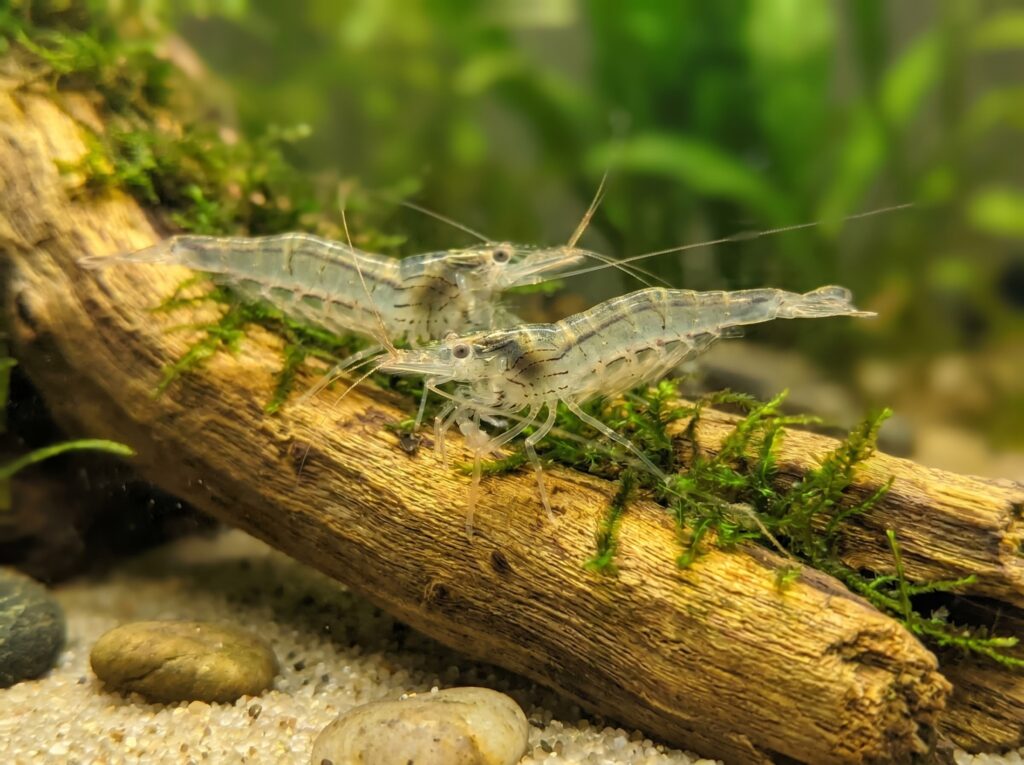
Palaemonetes ghost shrimp are sold at almost every fish store, often for less than a dollar each. They are genuinely hardy, with wider temperature and pH tolerance than Neocaridina in some respects, and they are useful scavengers. As a first shrimp they teach the basics cheaply. But there are two frustrations you should know about before buying a bag.
First, bags labeled "ghost shrimp" often contain a mix of species. Some are Palaemonetes paludosus (the common glass shrimp); others may be different species, or even small feeder shrimp from brackish farms that will gradually decline in freshwater. You have little control over what you receive. Second, ghost shrimp typically average 1-2 years under good conditions - the same general range as Neocaridina - but in practice you will see losses sooner, because fish stores often sell them already mature (or close to it) and at rock-bottom prices that suggest a feeder-shrimp supply chain rather than careful breeding stock. That combination of unknown age and uncertain origin means attrition is frequent regardless of your husbandry, and it can feel discouraging early on.
Ghost shrimp also rarely breed visibly in a home aquarium the way cherry shrimp do. Females will become berried, but shrimplets are tiny and usually eaten before anyone spots them. If watching a colony grow is part of what you want, cherry shrimp are a much more rewarding choice. The full care picture is in ghost shrimp care.
Amano shrimp: great workers, no colony
Amano shrimp (Caridina multidentata) are excellent algae eaters and very hardy as adults. They handle a broader range of water conditions than crystal reds and live 2-3 years under good care. Many planted-tank keepers add a few to control hair algae and never think twice about them.
The catch: you cannot breed them in freshwater. Wikipedia records their reproductive biology as amphidromous: "oviposition and hatching occurs in freshwater, and newly hatched larvae drift to saltwater and develop as juveniles, returning to freshwater in their adult forms." The larvae must make that journey to brackish or salt water to survive; they cannot complete development in a freshwater tank. Replicating the full amphidromous cycle at home requires a separate brackish rearing system, careful larval feeding, and a gradual transition back to freshwater. That is a project well beyond what a beginner should take on. Treat Amano shrimp as a one-time purchase that you replace as individuals die, not as a breeding colony. See why Amano shrimp cannot breed in freshwater for the full explanation.
Caridina (crystal red, Taiwan bee): why beginners should wait
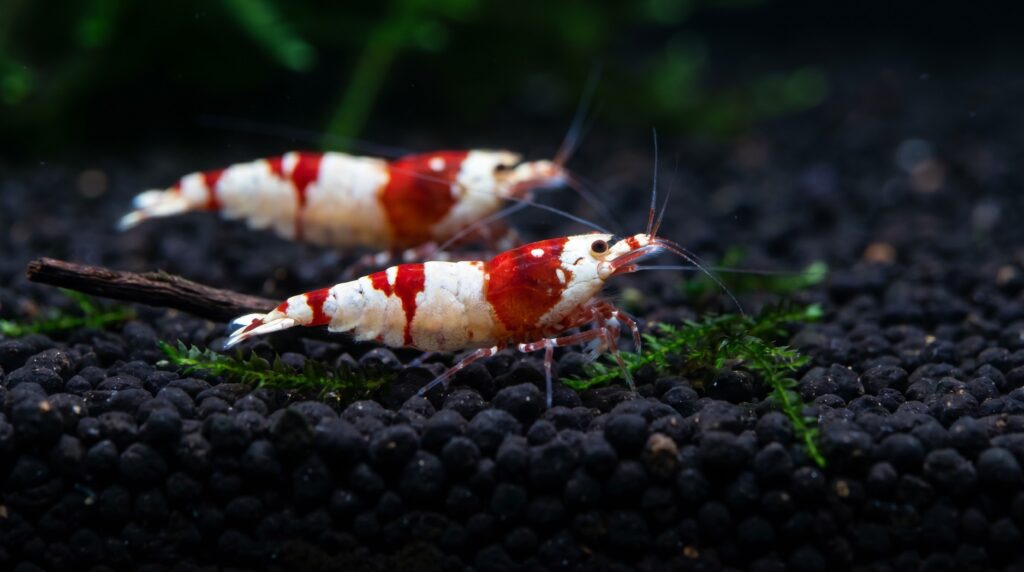
Crystal red and crystal black shrimp (Caridina logemanni) and their Taiwan bee hybrids (King Kong, Panda, Blue Bolt, and others) are the animals most often responsible for the "I killed a whole colony my first month" story. The parameters they need are narrow and they have essentially no buffer when conditions slide: GH 4-6 dGH, KH 0-1 dKH, TDS 100-150 ppm, pH 5.8-6.4, temperature 20-24°C (68-75°F).
Three things make these parameters hard to maintain reliably:
- They require an active buffering substrate (aquasoil) that absorbs KH from the water and holds pH down. That substrate needs replacing every 12-24 months, and it only works in low-KH water. Add high-KH tap water and the buffering exhausts quickly.
- They need RO water remineralized with a product specifically formulated for Caridina (no KH added). Using a Neocaridina-formula salt will push KH too high and destabilize pH.
- Any significant parameter swing - a large water change, a power outage that cools the tank, substrate that has run out of buffering capacity - can trigger stress, failed molts, or a colony crash.
The grading system for crystal reds (SSS being the top grade with near-total white coverage) also creates a false impression: that a higher-grade shrimp is somehow hardier. It is not. An SSS crystal red is just as delicate as a low-grade one, arguably more so, because the line-breeding that produced intense coloration also compressed the gene pool. Price per shrimp ranges from a few dollars at lower grades to tens of dollars for top-grade specimens. Losing a tank of Taiwan bees to a parameter mistake is an expensive lesson. The detailed reasoning is in why Caridina are not for beginners.
Sulawesi shrimp: a category of their own
Cardinal shrimp (Caridina dennerli) are endemic to Lake Matano in Indonesia, where the water has been isolated and stable for hundreds of thousands of years. White Orchid shrimp and other Sulawesi species inhabit neighboring ancient lakes including Lake Towuti and Lake Poso, each with their own distinct water chemistry. The parameters that reflect that chemistry are the opposite of what most shrimp keepers use: temperature 28-30°C (82-86°F), pH that specialist keepers typically target at 7.8-8.2 (though Lake Matano's wild pH is recorded around 7.4 - the higher aquarium target reflects accumulated captive-husbandry recommendations), high GH but extremely low KH, and TDS in the 100-200 range from a very specific mineral profile.
Water that is too cool, too acidic, or missing the right trace elements kills them within days. They do not tolerate standard aquasoil (it lowers pH, which harms them). They need coral sand or crushed limestone to maintain alkalinity, specialized remineralizers, and minimal water changes, often just topping off for evaporation. Even experienced keepers who move into Sulawesi shrimp spend considerable time dialing in the setup before stocking.
They are beautiful, and the day you succeed with them is genuinely satisfying. That day should not be day one.
The things that matter more than species choice
Even cherry shrimp die in an uncycled tank. Ammonia and nitrite must both read 0 ppm before you add any shrimp. The nitrogen cycle typically takes 4-8 weeks to establish from scratch (6-8 weeks is common at room temperature without a bacteria starter). American Aquarium Products' nitrogen cycle reference states clearly: "In healthy aquarium ammonia and nitrites should be at 0 ppm." Adding shrimp before that point causes gill damage and a slow, bewildering die-off that looks like a bad batch of shrimp but is actually an uncycled tank.
Once the tank is cycled, the three other non-negotiables:
- No copper. Copper is acutely lethal to all shrimp. Research on freshwater shrimp found the 96-hour median lethal concentration for copper was 0.0313 mg/L (a tiny amount), with gill tissue failure identified as the kill mechanism. The most common copper sources in a shrimp keeper's cabinet are ich medications (many copper-based), some plant fertilizers (check labels), and first-draw water from old copper plumbing. Never dose a shrimp tank with any medication without confirming it is copper-free.
- Drip acclimate new arrivals. Shrimp cannot regulate osmotic pressure across gills the way fish can. Pour a bag of cherry shrimp straight into the tank and you risk osmotic shock. The fix is a drip line from the tank into a bucket at 1-2 drips per second for 1-3 hours, letting the water chemistry equalize gradually. Tiny Menagerie's acclimation guide identifies improper acclimation as a primary driver of new-arrival losses. Full steps are in drip acclimation for shrimp.
- Keep GH stable. Calcium and magnesium (measured as GH) are the minerals that build a shrimp's new shell during a molt. When GH is consistently too low, shrimp get stuck mid-molt and you will see a white band around the body where the old shell separated. That is the white ring of death, and it is almost always fatal. Cuttlebone added to the tank does not reliably fix it; the remedy is maintaining GH in the correct range from the start. More on this at white ring of death explained.
Start with 10-15 Neocaridina in a cycled, filtered tank. A colony living at a steady GH 7 for six months will do far better than one where GH bounces between 4 and 10, even if that second tank averages the right number. Consistent water is what shrimp actually need. Do small water changes (10-15% at a time) with water matched to the tank in temperature and TDS. Once you have a colony reproducing and thriving, you have learned everything the harder species will demand, just with much lower stakes.