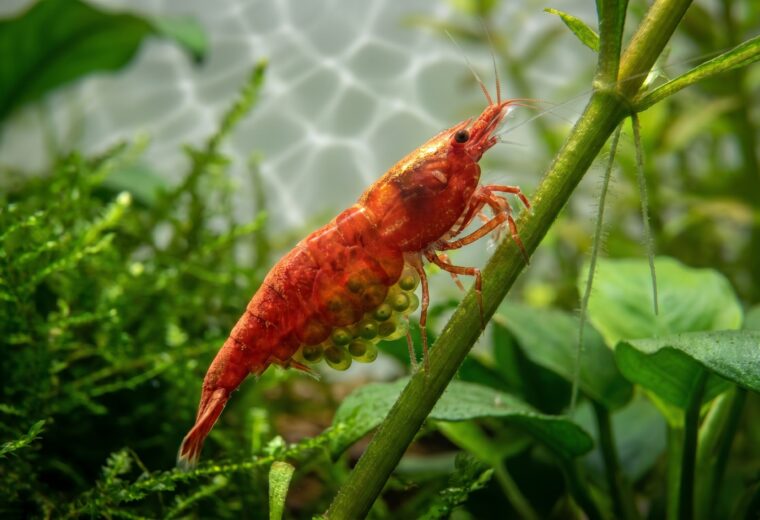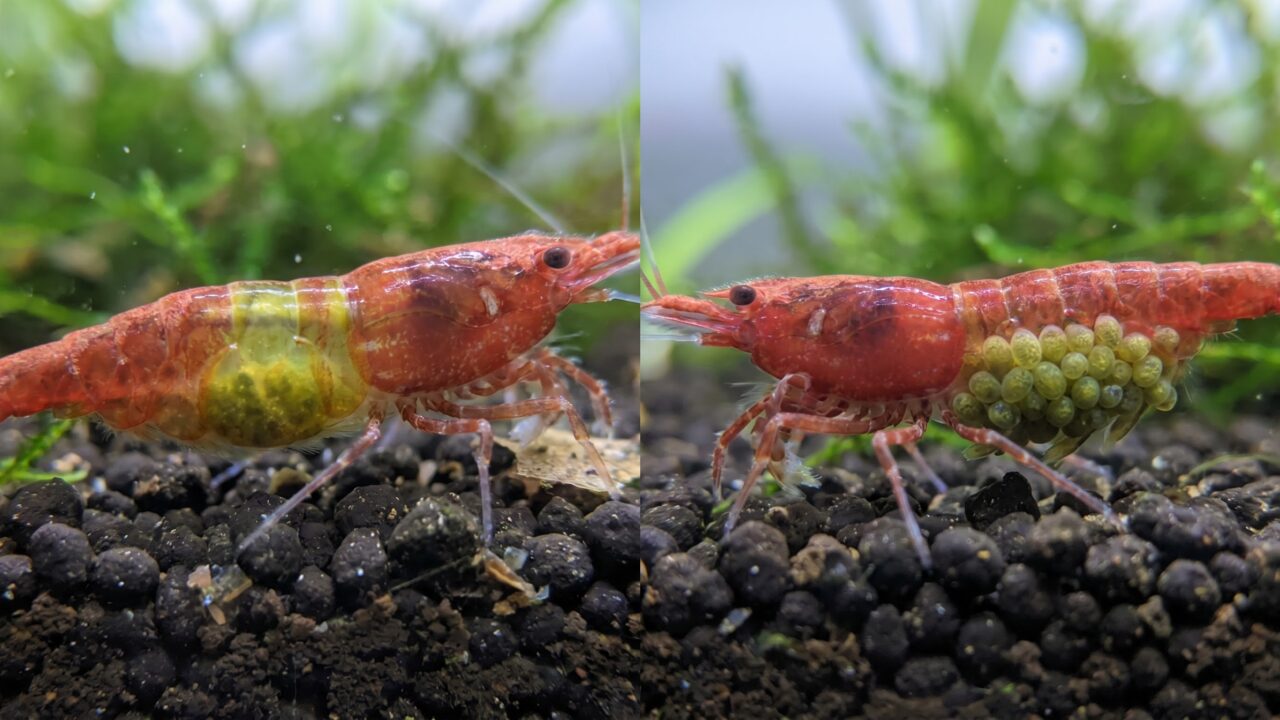
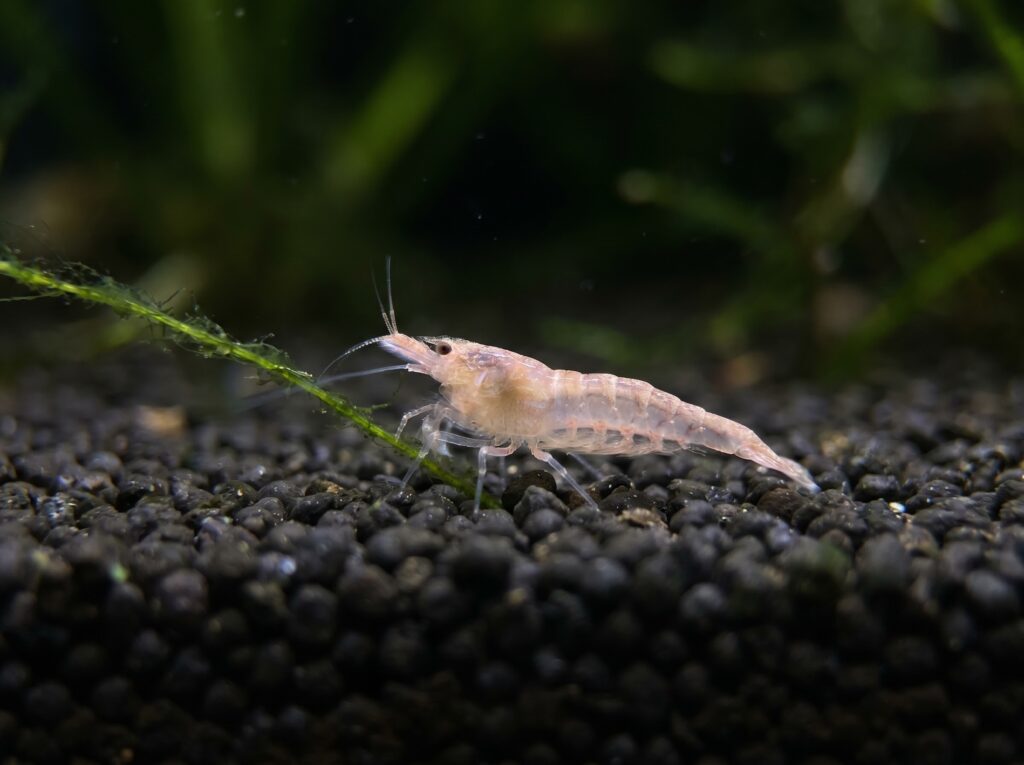
That yellow-green smudge behind your shrimp's head is not a disease. It is her ovaries filling with eggs, and it means she is a mature female ready to breed. Hobbyists call it the "saddle." The cluster of tiny spheres you later see fanning under her tail is something different entirely: fertilized eggs she is actively brooding, and that is what "berried" means. The two stages are often confused, and the confusion leads to a lot of unnecessary worry (and a lot of missed celebrations).
Here is the short version: saddle is pre-fertilization, on the back; berried is post-fertilization, under the tail. Both are healthy signs. Neither requires anything from you except good, stable water.
What the saddle actually is
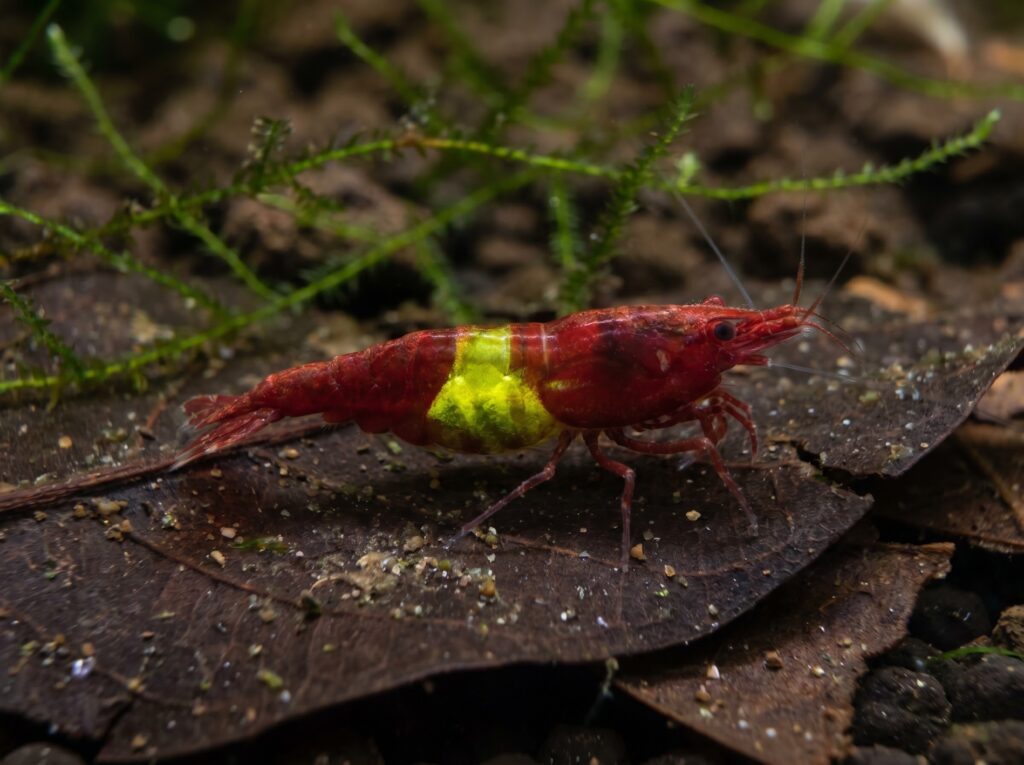
The saddle is a patch of developing eggs sitting inside the female's ovaries. The ovaries run along the top of the cephalothorax (the fused head-and-body section), which is why the saddle appears on the shrimp's back, just behind the eyes and before the tail begins. According to Wikipedia's documented description of Neocaridina davidi, "eggs may be observed developing in the female's ovaries as a green or yellow triangular 'saddle' marking on her back." That triangular shape, straddling both sides of the spine, is exactly where the name comes from.
Color varies by species and individual. In most Neocaridina color lines (cherry, blue dream, yellow, and the rest) the saddle tends to be yellow to lime green. In Caridina such as crystal reds and Taiwan bees it often appears similar, though the smaller body makes it harder to spot. The intensity of the color is not a reliable health indicator; a pale saddle on a well-fed female in stable water is perfectly normal.
A visible saddle means the female is sexually mature. Males in the tank will register this through water chemistry, not yet through pheromones. The pheromone signal comes later, at molting.
The molt, the mating swarm, and how a berried shrimp happens
This is the sequence breeders watch for, and understanding it explains almost every question beginners ask about reproduction.
When a saddled female is ready to spawn, she molts. The soft, fresh exoskeleton is the cue. As Wikipedia notes, "when she is ready to lay the eggs, which occurs after molting, she releases pheromones into the water to signal her availability to males." Those pheromones disperse through the tank in seconds. Males stop whatever they are doing and begin a frenzied swimming pattern - darting up, across, and through every plant and crevice. New keepers often think something is very wrong. Nothing is wrong. This is the mating swarm, and it is one of the most reliable signs your colony is healthy.
The actual mating lasts only a few seconds per pairing. Fertilization in Neocaridina is external: during that brief contact the male deposits a sperm packet near the female's gonopore on her underside. As she then expels her eggs from the ovaries, they pass over the deposited sperm at the body surface, where fertilization takes place - outside the reproductive tract, not inside it. She fans the newly fertilized eggs onto her pleopods (the small paddle-like limbs also called swimmerets), securing them there to brood. Within an hour the saddle spot on her back is noticeably lighter or empty, and the underside of her tail carries a tightly packed cluster of eggs. She is now berried.
That word comes from the obvious resemblance: the egg cluster looks like a bunch of tiny grapes or fish roe, and the University of Florida IFAS Extension's fact sheet on Neocaridina davidi confirms: "in the aquarium trade, the female shrimp that are carrying eggs are referred to as berried."
Saddle vs berried at a glance
| Feature | Saddle | Berried |
|---|---|---|
| Location on the shrimp | Back, behind the eyes, on top of cephalothorax | Underside of the abdomen, clipped to the swimmerets |
| Fertilization status | Unfertilized eggs (in the ovaries) | Fertilized eggs being actively brooded |
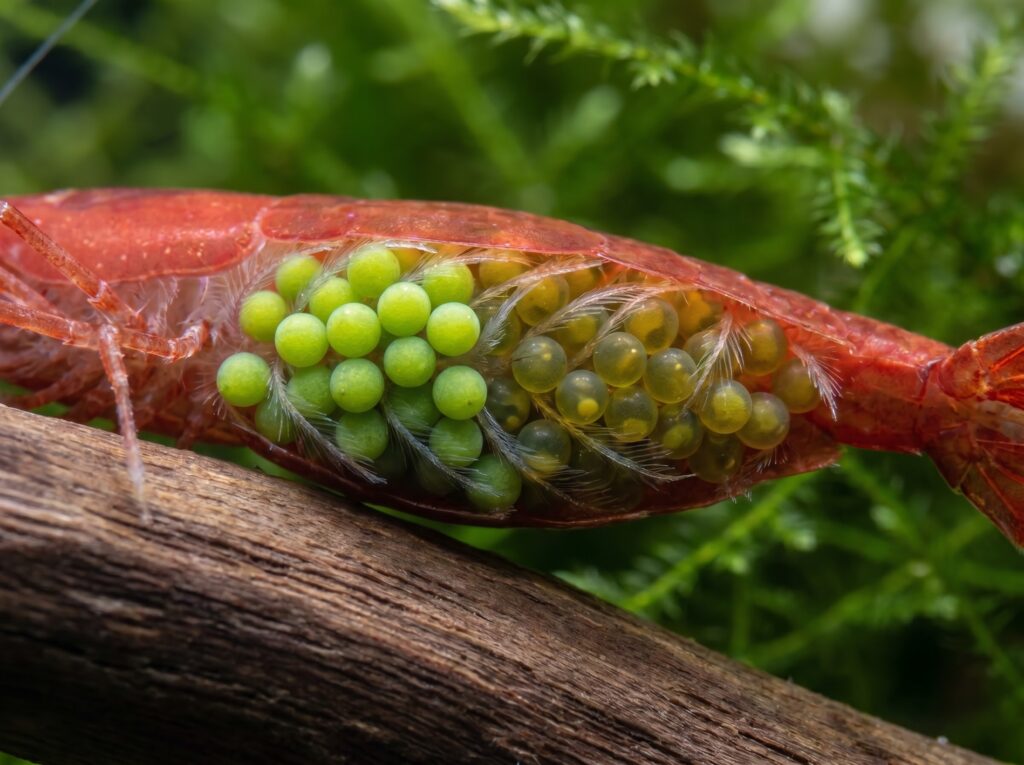
| Color (Neocaridina) | Yellow to lime green patch | Yellow, green, or grey-tan; becomes more translucent and shifts toward grey-tan as embryos develop |
| Visible movement | None - static under the shell | Female fans continuously with swimmerets |
| What happens next | Female molts, mates, and becomes berried | Eggs develop 18-25 days at hobby-typical 22-25°C (shorter at warmer temps), then hatch as miniature shrimp |
| Action required | None - maintain stable parameters | None - maintain stable parameters, avoid stress |
| Males present needed? | Yes, for the next step | Already done - males not needed now |
How long the eggs take to hatch
Temperature is the main variable. A peer-reviewed study published on PubMed Central, examining reproductive temperature effects in Neocaridina, measured incubation at several temperatures - but note that at 32°C the same study found all ovigerous females lost their eggs before hatching, making that temperature pathologically stressful rather than a useful upper bound for keepers. The practical minimum for successful hatching is closer to 16-18 days at around 28°C. For the hobby-typical range of 22-25°C (72-77°F) for Neocaridina, most keepers see hatching 18-25 days after a female becomes berried. The UF/IFAS Extension fact sheet gives 16-19 days as its reference range, which aligns with the warmer end of normal hobby temperatures.
Those numbers reconcile simply: warmer water shortens the count, cooler water extends it. A tank sitting at 24°C (75°F) will be toward the longer end; a tank at 28°C (82°F) will be at the short end. Both outcomes are normal. Egg color is a rough guide: freshly fertilized eggs are bright and opaque; as development progresses they become more translucent - often shifting toward a grey-tan tone - and you may be able to see tiny black dots (the eyes of developing embryos) about a week before hatch.
The clutch size the UF/IFAS Extension records for N. davidi is 43-60 eggs per female. Not all of those will hatch, and not all shrimplets will survive the first days; the surviving-to-adulthood number is typically lower. That is normal colony arithmetic, not a problem with your tank.
When the eggs finally hatch, the shrimplets emerge as fully formed miniature shrimp around 1-2 mm long. As UF/IFAS notes, this species "does not have a larval stage" - unlike most crustaceans, the young skip the planktonic phase entirely. A shrimplet that hatches today already looks exactly like its parents. It just needs to find biofilm and fine particles to graze on, which a well-established tank already provides.
For a full walkthrough of what to do (and not do) once your tank has babies, see our guide to how to breed cherry shrimp.
Why a berried shrimp might drop her eggs
Egg dropping is the highest-frequency concern breeders report with berried shrimp. The causes fall into two categories: stress and biology.
Stress causes. The most common trigger is a sudden water-parameter shift. A large water change, a spike in ammonia or nitrite, or a temperature jump can prompt a berried female to release her eggs before they hatch. The same PubMed Central study found "all the growth-phase ovigerous females at 32°C lost their eggs, indicating a potentially stressful effect of high temperature on ovarian maturation." That is a controlled-experiment finding at an extreme temperature, but the principle scales down: even a few degrees above your female's comfort zone raises the risk. Keep changes small and slow. For Neocaridina, the usual safe range for water changes is 10-15% at a time with temperature-matched water. For Caridina on active substrate, even smaller changes are safer.
Copper. Worth naming directly because it is lethal to shrimp and is present in some fertilizers and copper-based medications. Even trace amounts can trigger immediate stress responses including egg dropping, followed by death. If you dose any plant fertilizer, check the label for copper content. If you have old copper plumbing, let the tap run briefly before filling your buckets.
First-time females. A female carrying her first clutch sometimes drops the eggs partway through incubation. This is a widely observed hobby pattern. The same female will usually carry subsequent clutches to term without issue. It does not mean your water is wrong; it is more a behavioral learning curve.
Unfertilized eggs. If a saddled female has no males available, she will still molt and move eggs to her swimmerets, but those eggs will never develop and she will eventually drop them. If you see a female "berried" in a male-free tank, that is what is happening.
We cover this topic in more detail, including what to watch for in the days after egg loss, in our article on why berried shrimp drop their eggs.
What you can actually do to help
Mostly: nothing active. The single most useful thing you can do for a berried female is leave her alone and keep the water stable. No large water changes, no new tankmates, no rearranging decor, no temperature swings. A sponge filter keeps the water oxygenated without the suction risk that a hang-on-back or canister presents to shrimplets.
For Neocaridina, target GH 6-8 dGH, KH 1-4, TDS around 150-250 ppm, pH 6.5-7.5, and temperature 22-25°C (72-77°F). For Caridina, the tighter parameters are GH 4-6, KH 0-1, TDS 100-150 ppm, pH 5.8-6.4, and temperature 20-24°C (68-75°F). What matters is that whichever number your tank sits at today is the same number it sits at when the eggs hatch three weeks from now.
Feed lightly. Overfeeding raises ammonia, which stresses the female and can destabilize the tank's nitrogen cycle. A small amount of quality food every other day is plenty while she is brooding; she will graze the biofilm in between. See our guide on sexing shrimp if you want to confirm you have a balanced male-to-female ratio before the next breeding cycle begins.
Frequently asked questions
Can a saddled shrimp get berried without males?
She can move eggs to her swimmerets without mating, but they will not be fertilized. Unfertilized eggs look similar to fertilized ones for the first day or two, but they will not develop and the female will drop them within a week or so. If you want breeding, you need at least a few males in the tank.
How often will the same female get berried?
Based on widely reported hobbyist experience, a healthy Neocaridina female typically cycles again within roughly 4-8 weeks after her eggs hatch - from an empty saddle back to a visible saddle and then to berried again when conditions are right. This inter-clutch figure is a hobbyist consensus rather than a figure from a controlled study, so individual variation is real. Water temperature, food quality, and stability all influence the pace. Colony size grows quickly once you have several mature females cycling at different times.
My shrimp has a saddle but no eggs under her tail - should I be worried?
No. A saddle simply means she is mature and her ovaries are loaded. She will not become berried until she molts and mates. If there are males in the tank and conditions are stable, that molt usually comes within a few weeks. If she has been saddled for more than a month without berrying, check water parameters and make sure males are present and not being harassed.
The eggs under the tail are green. Is that normal?
Yes, for most Neocaridina strains. Egg color can range from bright yellow to lime green to olive, depending on the female and the species. Color shifts toward more translucent and greyish as the embryos mature. As long as the female is actively fanning and the eggs look dense and clustered (not loose or scattered), development is progressing normally.