Something is wrong with one of your shrimp. You can see it clearly, but you do not yet know what it is. That is the right moment to use this guide: start with what the shrimp looks like right now, match it to one of the five visible patterns below, and follow the link to the full treatment page. Misidentification is the most common reason a problem spreads before anyone acts.
The five patterns covered here account for the vast majority of visible abnormalities in freshwater dwarf shrimp tanks. Each has a distinct appearance and a distinct cause. A white cottony fuzz on the abdomen and a crown of thin white worms on the head can both be described as "white stuff on the shrimp," but they are completely different organisms in different locations, requiring different responses. The table at the bottom of this page is designed to make that split-second call easier.
How to look at a sick shrimp
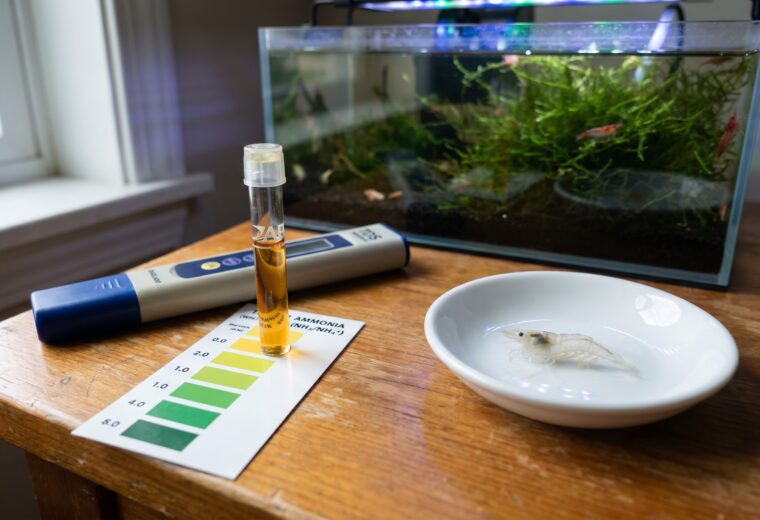
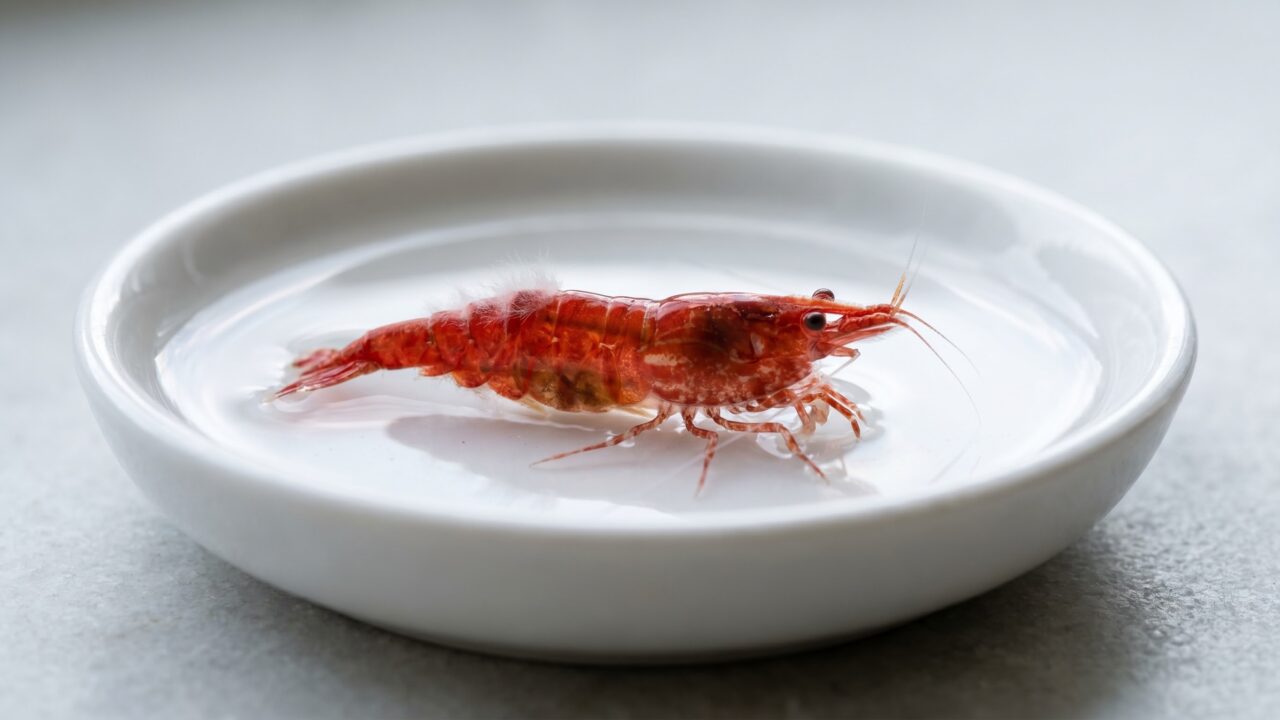
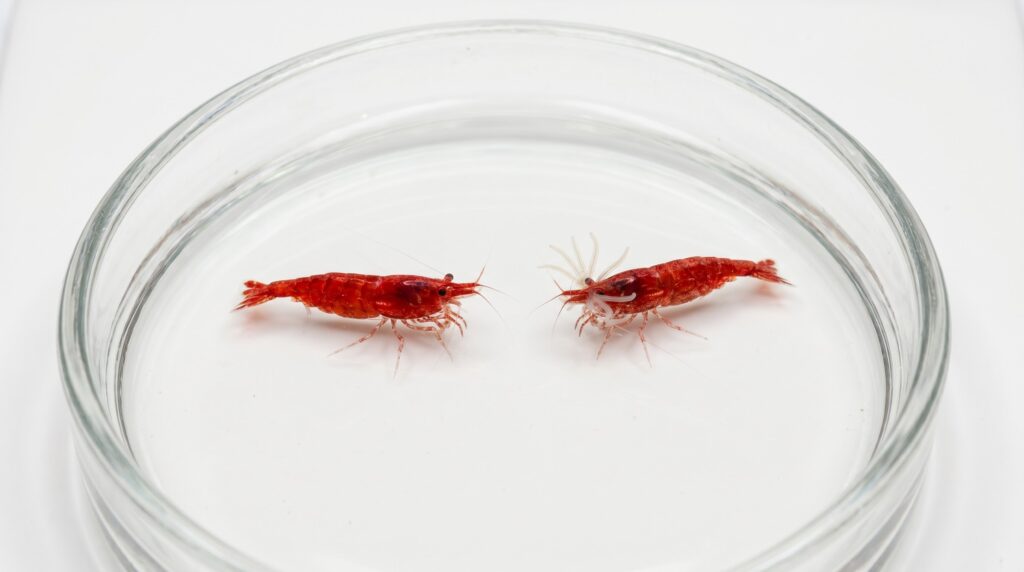
Before matching a symptom, give yourself the best possible view. Put the shrimp in a white bowl or a clear container against a white background, in good natural or bright LED light. The difference between a milky tail and a normal translucent one is easy to miss under a dim hood light. If you have a loupe or a 10x jeweler's magnifier, use it: the difference between Vorticella (single bell-shaped cells on stalks) and Scutariella (flat worms with visible movement) becomes immediately obvious at even low magnification.
Check a second shrimp from the same tank. A single shrimp showing a symptom is often a different problem from five shrimp all showing the same symptom. Colony-wide presentation points toward a water quality or infectious cause; a single affected animal is more likely a localized epibiont or a molt injury.
The five visible patterns and what they mean
1. White fuzz or cottony growth, usually on the abdomen
This is almost always Vorticella. These are peritrich ciliates, bell-shaped single-celled organisms that attach to the shrimp via a thin stalk. In a 2018 paper published in the International Journal for Parasitology: Parasites and Wildlife, Liao et al. identified Vorticella on freshwater atyid shrimp and reported that the study specimens measured 48-63 µm in length and 29-37 µm in width, with stalks up to 90 µm in height. The same paper specifically records that "Vorticella sp. was observed forming cluster structures on the 5th abdominal segment of the freshwater shrimps." At aquarium scale, they appear as a fine white cottony or fuzzy coating, concentrated on the abdomen rather than the head.
The paper also notes that "the symptoms of infected freshwater shrimps include loss of appetite and excessive stress or even death," and that "high levels of infection can affect breathing and can be fatal." In a clean, low-organic-load tank a very light coating rarely causes serious harm. In an overfed or poorly maintained tank the colony of ciliates can expand rapidly, covering the gills and suffocating the shrimp. The trigger is almost always excess dissolved organics giving the ciliates a food supply.
Key tell: the fuzz does not move visibly to the naked eye, and it tends to be densest on the abdominal segments rather than the rostrum or head. This is the main visual feature that separates Vorticella from Scutariella, which attaches to the rostrum. See the full diagnosis and treatment page: Vorticella on shrimp.
2. White worms or a "crown" on top of the head
Scutariella japonica is the culprit here. Unlike Vorticella, these are flatworms, classified within the Platyhelminthes (order Rhabdocoela, family Temnocephalidae). They attach to the shrimp's rostrum and move: you will see slow undulation when you look closely. Liao et al. (2018) noted these organisms on "the mantle, rostrum, and antenna" of freshwater shrimp alongside Vorticella, but the two are visually distinct once you know what to look for.
Each worm measures 1-2 mm and appears as a thin white or translucent stick. When a large number are present on the rostrum, the effect is that the shrimp looks like it is wearing a tiny crown or mohawk. Research from Southeastern China found Scutariella affecting 25.2 to 100 percent of wild Neocaridina populations across collection sites, so this organism is common and travels easily on new arrivals. The worms also lay rows of white eggs in the gill chamber, which can look like white dots just behind the head.
Heavy infestations restrict gill function and impair breeding, growth, and molting. Light infestations on a single shrimp may be noticed only by chance. The full treatment page covers salt dips and other options: Scutariella on shrimp.
3. A visible white line or ring around the body
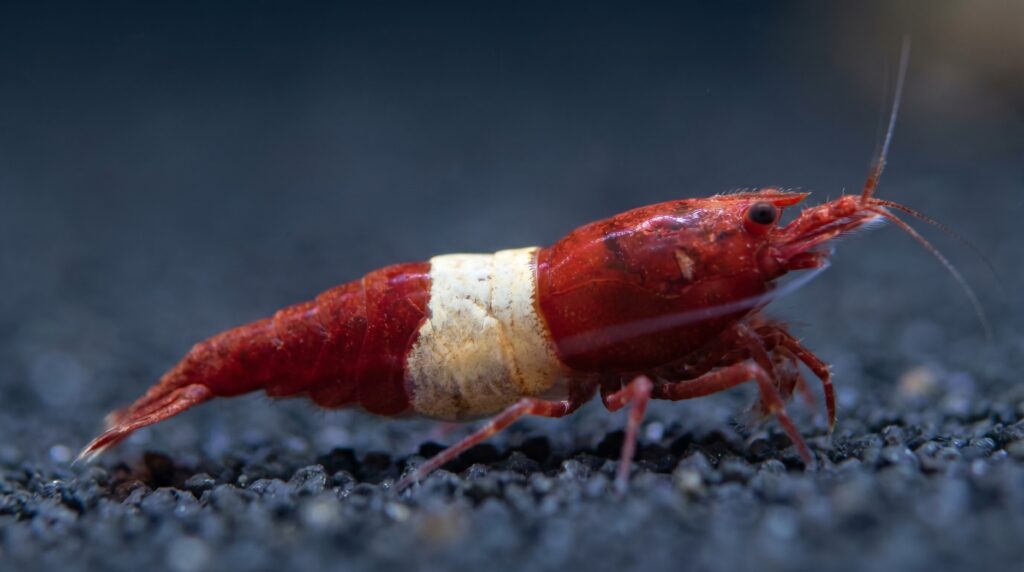
A distinct white ring encircling the shrimp's body, usually between the carapace and the abdomen, is a failed molt event known in the hobby as the white ring of death. It is not a disease or a parasite. The ring forms when the old exoskeleton ruptures all the way around the body rather than splitting neatly at the top, which is the normal exit point. Once the ring appears, the shrimp cannot complete the molt and will die. There is no intervention that works at that stage.
The cause is almost always a mineral deficit. Shrimp exoskeletons are built primarily from calcium carbonate deposited within a chitin-protein matrix, and research on crustacean mineralization (Luquet, 2012, ZooKeys) confirms that magnesium ions help stabilize the amorphous calcium carbonate precursor phase that eventually hardens into the new shell. If GH is too low, the new shell does not mineralize fully and the molt fails. For Neocaridina, the target GH range is 6-8 dGH. For Caridina, it is 4-6 dGH. Sudden parameter swings before a molt are a second common trigger, as osmotic instability disrupts the reabsorption of calcium from the old shell in the pre-molt phase.
The white ring is the shrimp hobby's most-cited "preventable tragedy." It is entirely avoidable with correct, stable water chemistry. The cuttlebone myth is worth naming directly: dropping a piece of cuttlebone into the tank does not reliably fix low GH in time to prevent a failed molt, because GH is best corrected through a proper remineralizer before the shrimp is already at risk. Full coverage: white ring of death.
4. Opaque, milky, or orange-tinged body tissue
A normally translucent or colored shrimp that starts looking milky, cloudy, or orange in the muscle tissue is showing signs of internal tissue stress or infection. Two overlapping causes share this presentation.
Muscular necrosis produces a milky-white opacity in the abdomen and tail muscle. In commercial penaeid shrimp research, muscle necrosis is associated with bacterial infiltration of muscle tissue, hemocyte invasion, and fiber breakdown. The same process can occur in dwarf shrimp under severe stress, very poor water quality, or following physical injury. The Bassleer Biofish reference notes that "a pale shrimp may be stressed by poor water quality, weakened by bacterial infection, or nearing a failed molt" - meaning opacity alone is not conclusive.
A warm orange or rusty-orange tint to the body can indicate a bacterial shell infection, sometimes called rust disease, caused by chitinolytic bacteria attacking the cuticle. This often appears as irregular blotchy patches rather than uniform opacity. Early stages look like faint discoloration; late stages show tissue breakdown under the shell.
In both cases, water quality is the first thing to address. Improve filtration, reduce feeding, and do small, careful water changes (10-15% with temperature-matched water). A shrimp that is the only affected individual in a tank with good parameters often recovers on its own. Multiple animals declining together suggests a systemic problem that needs diagnosis. More on bacterial causes: bacterial infection in shrimp. If a whole tank is declining: why are my shrimp dying.
5. Green growth on or under the body
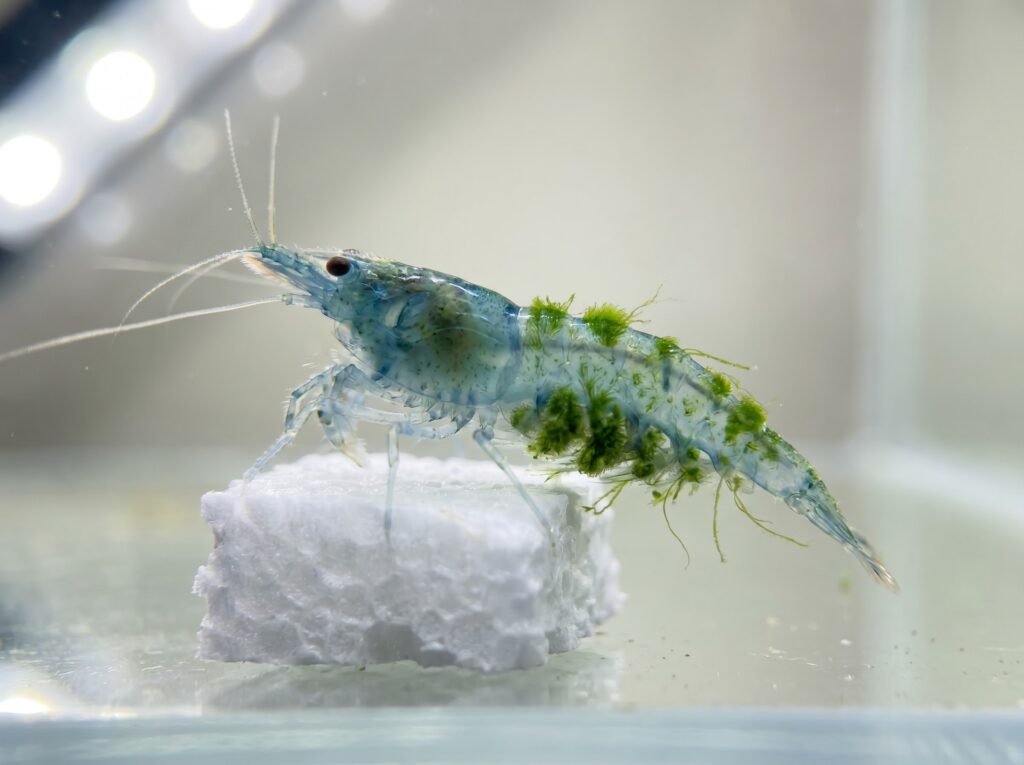
A green patch or tuft growing on the underside of the shrimp's body or inside the muscle tissue is the least common of the five patterns, and the most misidentified. It is widely called "green fungus" or labeled "Ellobiopsidae" in hobby discussions, but the correct identification - established in a 1971 Japanese study by Hirose and Akiyama - is Cladogonium ogishimae, an ectoparasitic green alga classified in the order Cladophorales. True Ellobiopsidae are a marine parasite family and do not infect freshwater shrimp.
The confusion about color is real: the vegetative cells of Cladogonium are themselves colorless and contain no chlorophyll, but the zoospores that spread the infection do carry green chloroplasts, giving the visible growth its characteristic green appearance. The alga grows on and into the muscle tissue along the underside of the shrimp. Infected females frequently abort eggs, and the prognosis for heavily infected individuals is poor.
There is no reliably effective treatment for established Cladogonium infections; no standalone treatment page exists for this condition because the options are limited. The management approach covers three actions: (1) Remove every visibly infected animal from the tank immediately and do not return them. (2) Quarantine all new arrivals for 2-4 weeks in a separate tank with separate equipment before any contact with your colony; Cladogonium spreads via free-swimming zoospores carried on new shrimp. (3) Avoid sharing equipment, plants, or water between tanks once an outbreak has been confirmed. There is currently no chemical or salt treatment shown to clear the infection once it has penetrated muscle tissue.
Quick reference: symptom to cause
Use this table when you need to narrow down quickly. It covers the distinguishing features that separate look-alike presentations. The "urgency" column reflects how fast the situation typically deteriorates if left alone in a moderately maintained tank.
| What you see | Most likely cause | Key distinguishing detail | Urgency | Article |
|---|---|---|---|---|
| White cottony fuzz on abdomen, no visible movement | Vorticella (peritrich ciliate) | No individual worms visible; fuzz is dense and static; concentrated on abdominal segments, not the rostrum or head | Moderate; escalates fast in overfed tanks | Vorticella on shrimp |
| White stick-like worms on head, visible slow movement | Scutariella japonica (flatworm) | Individual worms 1-2 mm visible; "crown" appearance on rostrum; white egg rows behind head | Moderate; treat before eggs hatch and spread | Scutariella on shrimp |
| White ring encircling the body (between carapace and abdomen) | Failed molt (white ring of death) | Ring is at the body junction; shrimp is alive but cannot complete molt; fatal | Terminal. Animal will not recover; address GH and stability for the rest of the colony | White ring of death |
| Milky, cloudy, or orange-tinted body tissue | Bacterial infection or muscular necrosis | Opacity in tail/abdomen muscles; may accompany lethargy or refusal to eat | High if multiple animals affected; check water quality immediately | Bacterial infection in shrimp |
| Green growth under or on the body | Cladogonium ogishimae (parasitic green alga) | Green color from zoospores; grows along underside; females often drop eggs | High; no reliable treatment. Quarantine and remove affected animals | This page (see section above) |
Three things that look like disease but are not
Before you treat anything, rule out these common false alarms.
A shrimp sitting very still in the open for several hours is not necessarily ill. Shrimp often go still in the 12-24 hours before a molt, becoming sluggish and retreating from food. If the shrimp is otherwise normally colored and you see the old shell nearby the next day, the "illness" was a normal molt cycle.
White stringy matter trailing from a shrimp is often a fecal string or a piece of biofilm, not a parasite. It will detach on its own. Vorticella, by contrast, attaches to the shrimp's body surface and does not trail freely.
Saddle marking visible through the carapace on a female shrimp is the ovary, not a parasite or infection. It is a sign of a healthy reproductive female. The saddle is typically yellow, orange, or greenish and sits behind the head in the upper part of the body. Similarly, a berried female carrying eggs under her tail is healthy; the eggs should look round and uniform, not fuzzy or discolored.
If none of the five patterns above match what you see, and multiple shrimp are declining without a visible external cause, the problem is likely water chemistry or a cycling issue rather than any visible pathogen. A tank that is not fully cycled will kill shrimp through ammonia and nitrite exposure with no visible "disease" symptom at all. Why are my shrimp dying covers that broader diagnostic path.
The one mistake that makes all of this harder
Skipping quarantine for new arrivals is the single most common way that Scutariella, Vorticella, and Cladogonium enter a healthy tank. All three organisms travel on shrimp purchased from other keepers or shops. A 2-4 week quarantine in a separate tank with no shared equipment lets you observe new animals carefully before they contact your colony. Research on wild Neocaridina populations found Scutariella present in up to 100 percent of animals at some collection sites - meaning buying from a reputable source reduces risk but does not eliminate it. Quarantine does.
Copper is one more silent factor worth checking before any treatment: copper-based medications or fertilizers can kill shrimp at doses that would not register as a concern for fish. If you have recently added any aquarium product to the tank, check its ingredient list before adding anything else. Old copper plumbing can also leach copper into the first draw of tap water; if you use tap water, let it run for 30-60 seconds before collection and test with a copper test kit if you are in doubt.