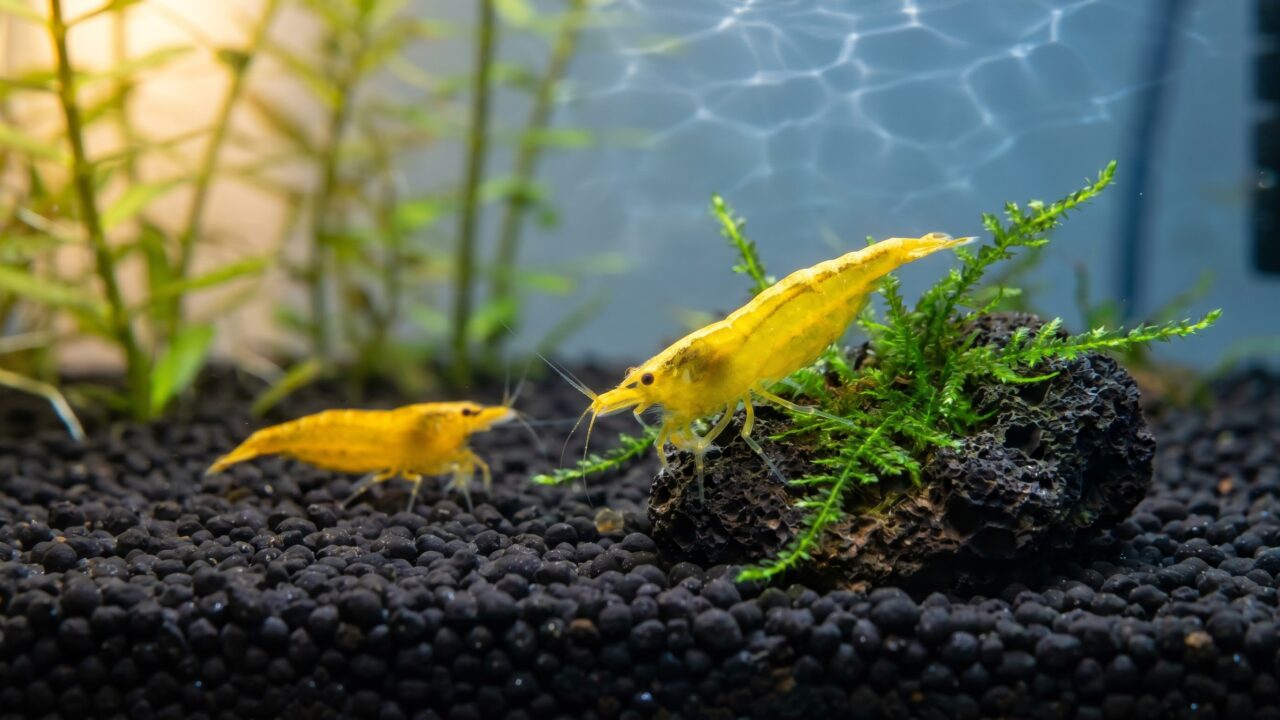
Yellow shrimp (Neocaridina davidi var. "Yellow") sit at an interesting point in the hobby: they are as easy to keep as red cherry shrimp, they breed just as willingly, and yet a colony of top-grade specimens under a good light looks genuinely striking. The catch is that the yellow pigment is more diet-sensitive than red. Get the food right and you get vivid, punchy color. Feed carelessly and the same shrimp will slowly go the color of weak tea.
This guide covers everything a beginner needs: the two main yellow strains and how they differ, the water parameters that keep yellows healthy, exactly why color fades and how to reverse it through diet, and how to get a colony breeding and growing reliably.
Golden Back vs Neon Yellow: what actually separates them
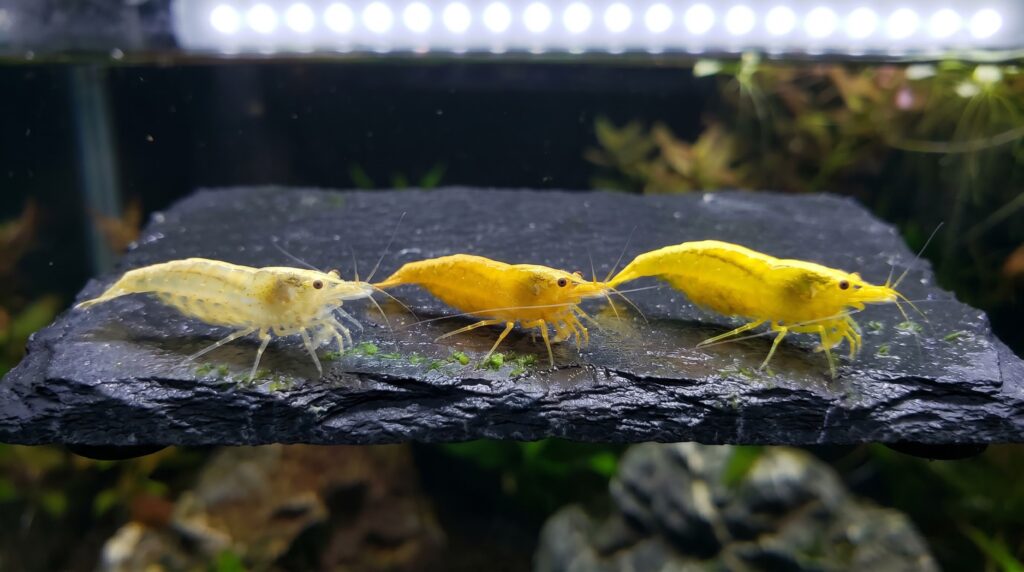
Both names refer to color-selected forms of the same species, Neocaridina davidi, and both share identical care requirements. The difference is entirely in what the breeder selected for.
A Neon Yellow (sometimes sold as "Yellow" or "Lemon Yellow") is selected for a solid, even yellow body - the goal is uniform coverage with no patterning. A good specimen looks like a piece of amber glass; a poor one looks washed-out and translucent. There is no stripe.
A Golden Back (also called Yellow Goldenback, 24K Golden Back, or sometimes Super Yellow) carries that same yellow base but is selected for a clearly intensified gold dorsal stripe running from the base of the head to the tail tip. The best grades show a two-tone effect: a moderately yellow body with a noticeably brighter, more opaque band along the spine. Lower-grade Golden Backs have a stripe that is barely distinguishable from the body; the grading system rewards both stripe clarity and body depth together.
Wikipedia notes that N. davidi has also been selected for a "Super Yellow" cultivar, which sits at the top end of solid-yellow opaqueness. Whatever the marketing name, if the shrimp has no dorsal stripe, it belongs to the solid-yellow line; if it has a clearly defined brighter stripe, it is a Golden Back type. Do not house the two lines together long-term if you want to preserve the stripe pattern - they will interbreed and offspring grade down toward a muddy middle.
For a deeper look at how Neocaridina color morphs are graded and what separates hobby grades, see our guide to Neocaridina grading.
Water parameters: the numbers that matter
Yellow shrimp are Neocaridina, which means they are the forgiving side of dwarf shrimp keeping. They do not need an active buffering substrate or distilled water. They tolerate ordinary tap water (once treated and tested) better than any Caridina species. That said, stability is what keeps a colony healthy long-term - an unstable parameter kills more shrimp than a slightly imperfect one.
| Parameter | Target range | Why it matters |
|---|---|---|
| Temperature | 18-26°C (64-79°F) | Below 18°C growth slows dramatically; above 26°C accelerates aging and reduces dissolved oxygen |
| pH | 6.5-7.5 | Drives buffering capacity; outside this range molting problems increase |
| GH (general hardness) | 6-8 dGH | Calcium and magnesium supply the minerals for exoskeleton formation at each molt |
| KH (carbonate hardness) | 2-4 dKH | Stabilizes pH; very low KH lets pH swing overnight as CO2 cycles |
| TDS | 150-250 ppm | Proxy for total mineral load; sudden TDS jumps during water changes cause osmotic shock |
| Ammonia / Nitrite | 0 ppm each | Any detectable level stresses or kills shrimp; tank must be fully cycled first |
| Nitrate | Under 20 ppm | Low chronic nitrate keeps immune function up; weekly partial water changes control it |
If you are using RO or rain water, you need to remineralize before adding shrimp. SaltyShrimp Mineral GH/KH+ is the standard choice for Neocaridina: the manufacturer specifies approximately 2 g per 10 litres to reach about 6 dGH and a conductance of roughly 300 µS. That puts you in the safe zone for yellows without over-mineralizing.
When using tap water, run it through a basic dechlorinator that also handles heavy metals. Seachem Prime (5 mL per 200 L) detoxifies chlorine, chloramine, and "heavy metals found in the tap water at typical concentration levels," per the manufacturer. This matters particularly for copper - more on that below.
Keep water changes small and consistent: 10-15% weekly is a workable rhythm. Yellows rarely crash from a small, regular water change but they do crash from a sudden large one if the replacement water is a different temperature or TDS. Match both before it goes in.
For a complete breakdown of GH and KH for all Neocaridina, including how to adjust each separately, see our articles on GH for shrimp and KH for shrimp.
The silent killers: copper, cycling, and osmotic shock
These three account for the vast majority of unexpected deaths in otherwise well-kept tanks. They deserve direct attention.
Copper
Copper is lethal to shrimp at concentrations that would not register as dangerous for most fish. The toxicity mechanism is more nuanced than the common "disrupts gills" shorthand: peer-reviewed transcriptomic research on Neocaridina-related species shows that free copper primarily damages the hepatopancreas (the shrimp's combined liver-and-kidney organ) and triggers oxidative stress cascades. Shrimp do use hemocyanin, a copper-containing protein, as their oxygen carrier - but hemocyanin circulates in the hemolymph, not gill tissue, and research indicates it is upregulated as a partial detoxification response rather than being directly disrupted by copper exposure. The practical upshot is that shrimp have an extremely narrow margin between the copper required for normal hemocyanin function and the free-copper concentrations that cause hepatopancreatic damage. Research on shrimp coloration has also confirmed that heavy metals, copper specifically, are among the environmental factors that affect pigmentation - so copper stress shows up in fading color before it shows up as deaths.
The sources to watch: copper-based medications (widely used in fish-only tanks), some liquid fertilizers for planted tanks (check the label), and old copper plumbing (run the tap for 30 seconds and discard first-draw water before filling the tank). If you have ever treated a tank with a copper medication, do not add shrimp until you have done a full water test and several water changes - copper bonds to substrate and hardscape and leaches back slowly.
Use a water conditioner that handles heavy metals on every tap water change. Test with a copper test kit if you have any doubt.
An uncycled tank
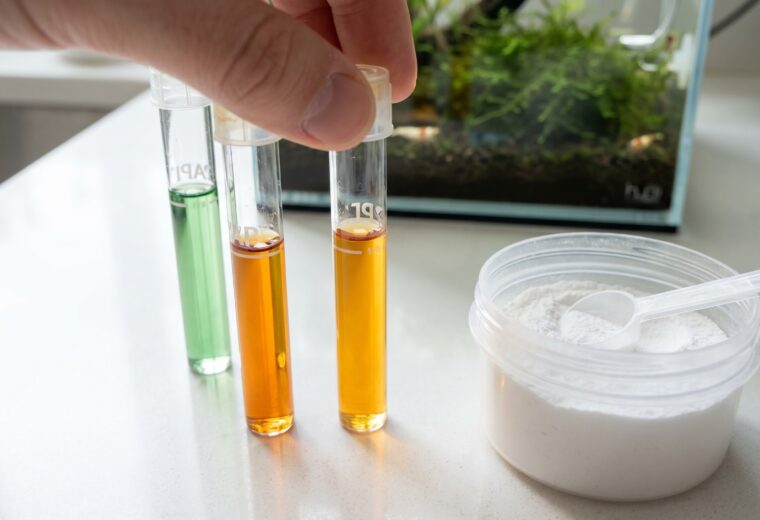
Ammonia and nitrite must read 0 ppm before any shrimp go in. Fully cycling a new tank takes roughly 4-6 weeks from a cold start, depending on temperature and ammonia source. The tank is done cycling when it converts a dose of ammonia to 0 ppm ammonia and 0 ppm nitrite within 24 hours on two consecutive tests. Do not shortcut this. Shrimp added to an uncycled or partially cycled tank will die - there is no recovery once they have been exposed to a spike. An API Freshwater Master Test Kit (measuring pH, ammonia, nitrite, and nitrate) is the standard tool for tracking the cycle.
Osmotic shock
Shrimp regulate their internal mineral balance against the water around them. A sudden shift in TDS or temperature stresses that system hard enough to kill within hours. This hits in two scenarios: bringing new shrimp home and dropping them straight into the tank, and doing a large water change with poorly matched replacement water.
For new arrivals, slow acclimation over 1-2 hours is the standard method. Feed a length of airline tubing from the display tank down into the transport bag or a small container, restrict the flow to roughly one to two drops per second with a loose knot or airline valve, and let tank water drip in until the container volume has roughly doubled. Lift the shrimp out with a net and move them directly to the tank; pour the container water away rather than adding it. Floating the bag alone is not adequate.
For water changes, always match temperature and TDS within a close margin before adding replacement water. A 5 ppm TDS difference is fine; a 50 ppm swing is not.
Failed molts
Shrimp grow by molting their exoskeleton, and they need enough calcium and magnesium in the water (measured as GH) to build the new shell cleanly. When GH drops too low, the shrimp cannot generate the leverage to escape the old shell properly. The result is the white ring of death: the old exoskeleton splits at the junction but the shrimp cannot pull free, leaving a pale gap that marks an almost certain fatality. Cuttlebone added afterward does not fix it. The only reliable response is prevention, which means keeping GH in the 6-8 dGH range consistently rather than scrambling once the ring appears.
Our full article on the white ring of death covers the mechanism in more detail.
Why yellow shrimp fade, and what you can do about it
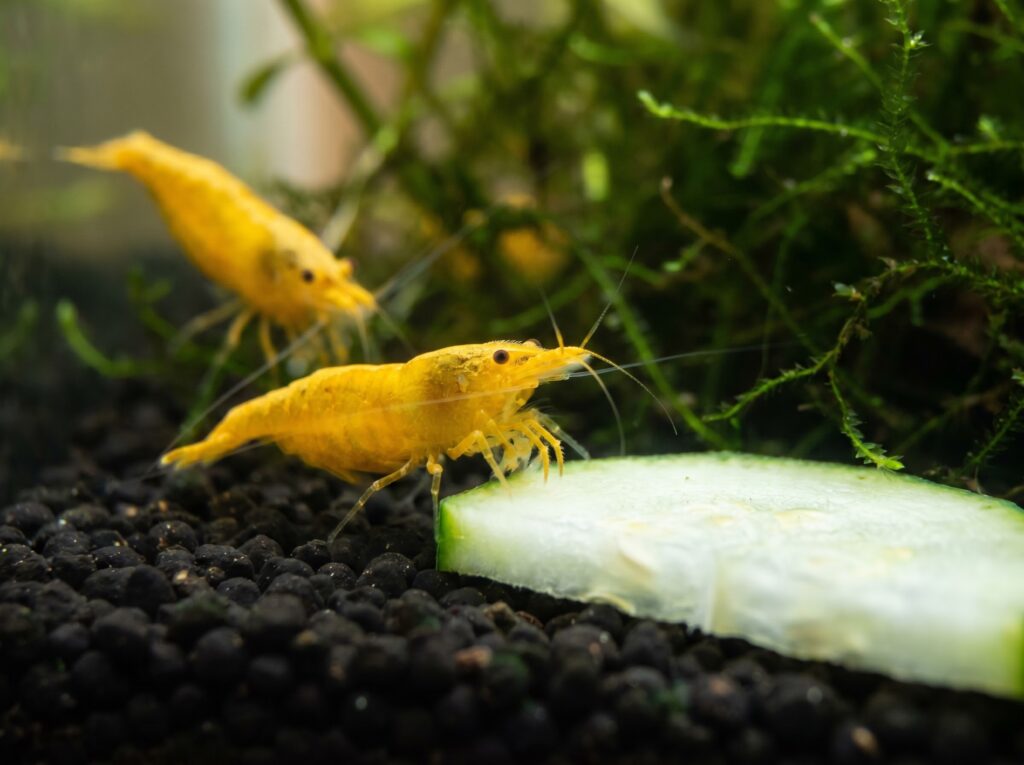
This is the most common complaint from yellow shrimp keepers and the most fixable problem.
Yellow color in Neocaridina davidi is produced by xanthophores, chromatophore cells that contain carotenoid-class yellow pigments. The critical fact is that shrimp cannot manufacture carotenoids internally - they must get them from food. Research on crustacean pigmentation has confirmed that "marine crustaceans do not synthesize carotenoids de novo," instead accumulating them from dietary sources. That principle applies directly to freshwater dwarf shrimp. When the diet supplies enough carotenoids, the xanthophores are well-stocked and color is vivid. When food is carotenoid-poor - as many flake foods are - the pigment gradually depletes and the shrimp pale out.
There is a second mechanism too. The study on Neocaridina color preferences found that "changes in shrimp colouration depend on physiological (chromatophore distribution) and morphological (pigment amount) changes." The physiological shift happens in minutes (stress causes chromatophores to contract, making a shrimp look washed-out almost instantly) while the morphological change - actual pigment depletion - takes days to weeks. So a shrimp that looks pale right after being added to a new tank may simply be stressed; one that slowly fades over two months is losing pigment from a poor diet.
A feeding trial on red cherry shrimp (Neocaridina heteropoda) demonstrated this directly: shrimp fed 160 mg/kg of synthetic carotenoid showed more significant color improvement after 8 weeks than lower-dose groups, and natural carotenoid from marigold petals at 200 mg/kg produced the most enhancement including the highest survival rate (99%) of all tested groups. That trial focused on red pigment (redness values in erythrophores), and no equivalent controlled trial for yellow xanthophores has been published in the peer-reviewed literature. The mechanism, however, is the same across chromatophore types: carotenoids are dietary, they bioaccumulate in pigment cells, and depletion causes fading regardless of which color the chromatophore expresses.
What this means practically:
- Feed a quality shrimp-specific food as the staple. GlasGarten Shrimp Dinner and similar products are formulated to include plant matter and carotenoid sources. Check the ingredient list for spirulina, astaxanthin, paprika, marigold, or similar pigment carriers.
- Supplement 2-3 times per week with blanched vegetables high in carotenoids: thin slices of blanched zucchini, a small piece of blanched carrot (beta-carotene is a carotenoid precursor), or blanched spinach (iron and other micronutrients alongside carotenoids). Remove uneaten vegetables after 12-24 hours to avoid fouling the water.
- Dark substrate helps: the 2021 Neocaridina substrate preference study found that "shrimp preferred dark backgrounds over light ones irrespective of their own colouration." On a pale substrate, shrimp physiologically adjust their chromatophore dispersion and appear lighter. Dark gravel or black soil pulls the best color out of any yellow shrimp.
- Avoid chronic stress - overcrowded tanks, bullying tank mates, or frequent large water changes all cause the temporary chromatophore contraction response. Over time, chronic stress also suppresses normal feeding behavior, reducing carotenoid intake.
For more on the physiology behind color loss and how to diagnose it, see our article on why shrimp lose color.
Tank setup and compatible tank mates
A 10-liter (roughly 2.5 US gallon) tank can hold a starter colony of 10-15 yellow shrimp, but 20-30 liters is a more forgiving size for beginners - more water volume means parameters change more slowly after a feeding or water change. A 40-liter planted tank can comfortably support 50-80 adults once the colony establishes.
Use a sponge filter or a power filter with a pre-filter sponge over the intake. An unguarded HOB or canister intake will kill shrimplets and sometimes adults. Sponge filters are the standard choice for breeding colonies because they also grow a biofilm layer that young shrimp graze on continuously.
Java moss, christmas moss, and other fine-leaved plants are worth including - they trap fine particulates and organic matter that shrimp pick through for hours. Floating plants reduce light intensity and provide cover, which lowers stress particularly in new setups.
Yellow shrimp are peaceful and slow-moving. Any fish large enough to fit a shrimp in its mouth will eat them, including fish commonly marketed as "peaceful" community species. The safest companions in a larger tank are true nano fish that stay under 2.5-3 cm: chili rasboras (Boraras brigittae), ember tetras (Hyphessobrycon amandae), and celestial pearl danios (Danio margaritatus, also called CPDs or galaxy rasboras) are the most commonly used and reliably safe choices. Otocinclus catfish work well as algae crew alongside shrimp. Neon tetras are a borderline case - some keepers report no issues, others lose shrimplets consistently. Play it safe and give yellows a shrimp-only tank if the primary goal is breeding and colony growth.
Breeding yellow shrimp: what you actually need to do
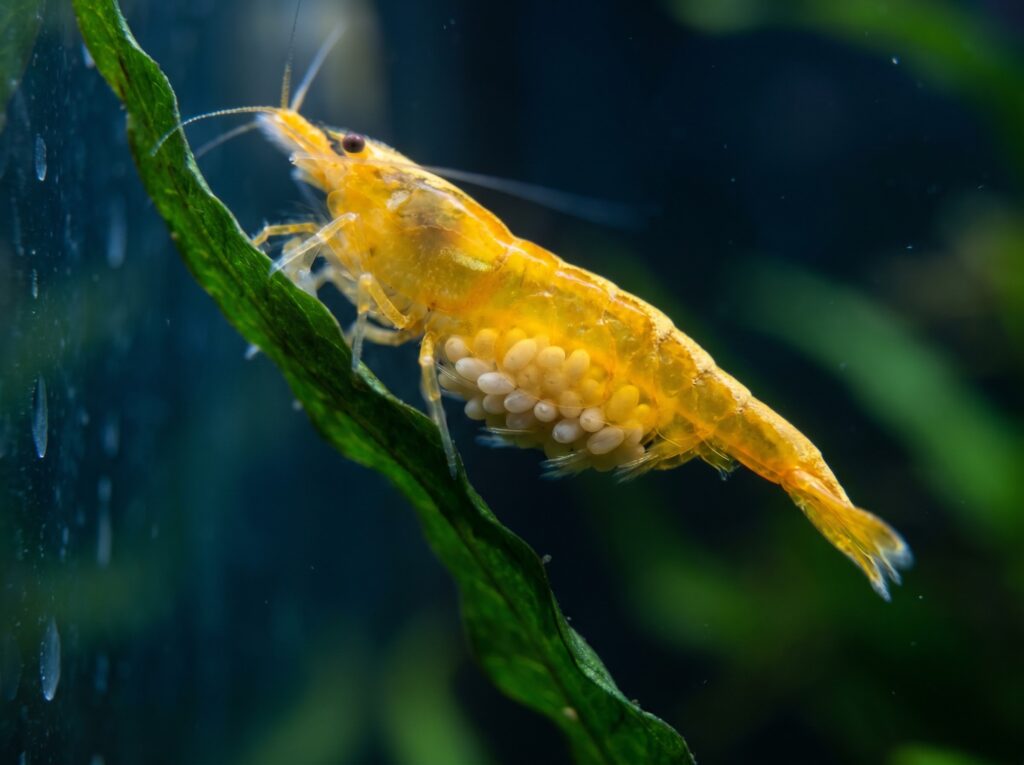
Yellow shrimp breed with very little intervention once the tank is stable and the colony has enough adults. The main requirements are a cycled, stable tank with good GH, a ratio of roughly one male to two or three females, and enough biofilm and food to support the extra population. Most retailers sell yellows unsexed, so achieving a specific ratio at purchase is difficult - the practical answer is to buy a larger group of 15-20 rather than 6-8: with enough individuals, the odds of a reasonable sex balance are good. If you can sex them before buying, look for females with a visible saddle behind the head and a fuller, rounder underside; males are slimmer and more active swimmers. Ask the seller to pack a mix if possible.
Females reach sexual maturity faster than many keepers expect. Wikipedia cites approximately two months, but the UF/IFAS Extension peer-reviewed fact sheet (EENY-751/IN1301) puts it at approximately 30 days, and experimental data - one study recorded 29.0 plus or minus 0.89 days - aligns with that figure. In practice, count on 4-6 weeks under optimal conditions (22-24°C, good food supply); colonies that seem slow to reproduce are usually being kept cool or underfed rather than genuinely immature. You can identify a mature female by her rounder, deeper abdomen compared to the slimmer, straighter male body, and by the presence of a saddle - a yellow-tinted patch visible through the shell in the dorsal area behind the head, where eggs develop before fertilization. When a female is ready to spawn, males actively swim around the tank searching for her (the classic "mating swarm" behavior). After mating, she moves the eggs from the saddle into her swimmerets and fans them constantly to oxygenate them.
Egg incubation runs 16-21 days depending on temperature. Peer-reviewed data from Pantaleão et al. (2017, Aquaculture Research) gives 16-19 days at 25°C; at 24°C, one study reports around 21 days, and at 28°C roughly 12 days. The commonly cited "2-3 weeks" figure is still broadly accurate at the upper end, but keepers should not expect hatching after just 14 days at normal hobby temperatures - the lower bound of two weeks is not well-supported by measured data. Plan for three weeks if your tank runs at 22-24°C; you may get a pleasant surprise if it runs warmer. A berried female should not be disturbed or netted if you can avoid it - stress can cause her to drop the eggs.
Hatchlings emerge as fully formed miniature shrimp about 1mm long. They do not have a larval stage and they do not need special food, but fine powdered foods or GlasGarten Bacter AE (which grows biofilm microorganisms) significantly improves shrimplet survival by ensuring food is available at the right particle size around the clock. Start a colony from at least 10 adults (a mix of males and females) to give the genetics enough variety and to ensure you actually have both sexes in the initial group.
Keep yellow shrimp separate from all other Neocaridina color lines. Every color morph of N. davidi will interbreed readily, and offspring revert toward the wild-type mottled brown over successive generations. Mix your yellows with blue dreams or cherry shrimp and within two or three generations the colony will be a brown-and-beige muddle. The color lines are not different species - they share identical genetics except for the chromatophore selection - so there is no behavioral or instinctive barrier to crossing.
For the full picture on Neocaridina breeding and colony management, see our Neocaridina shrimp guide.
Yellow shrimp quick-care card
| Category | Detail |
|---|---|
| Species | Neocaridina davidi var. "Yellow" |
| Difficulty | Beginner - same hardiness as cherry shrimp |
| Adult size | approximately 3-4 cm; females toward the upper end, males noticeably smaller |
| Lifespan | 1-2 years |
| Temperature | 18-26°C (64-79°F); 22-24°C ideal for breeding |
| pH | 6.5-7.5 |
| GH | 6-8 dGH (do not drop below 6 - molt failures increase) |
| KH | 2-4 dKH |
| TDS | 150-250 ppm |
| Ammonia / Nitrite | 0 ppm (tank must be fully cycled before stocking) |
| Nitrate | Under 20 ppm; weekly 10-15% water changes |
| Minimum colony start | 10 individuals (mixed sex) |
| Eggs per clutch | 20-60 eggs (hobby reports 20-30; controlled studies report 43-60); incubation 16-21 days at 22-25°C |
| Filter type | Sponge filter or power filter with pre-filter sponge |
| Substrate for color | Dark substrate strongly recommended |
| Color diet tip | Carotenoid-rich foods: spirulina, blanched carrot, zucchini, quality shrimp staple |
| Keep separate from | All other Neocaridina color lines (crossbreed to wild brown) |
| Copper | Fatal - avoid copper medications, copper fertilizers, first-draw tap water |
| Acclimation | Drip acclimate 1-2 hours; never pour straight from bag |
| Golden Back vs Neon Yellow | Golden Back: yellow body + distinct dorsal stripe. Neon Yellow: solid, even yellow with no stripe |