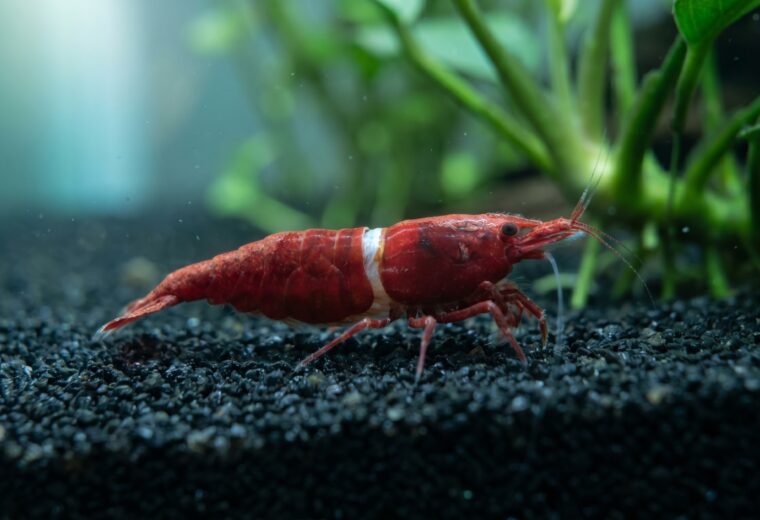
Every time a shrimp molts, it rebuilds its entire exoskeleton from scratch. The raw materials for that shell come straight from the water. GH - general hardness - is the number that tells you whether enough of those materials are available. Get it right and molts go smoothly. Let it slip too low and you will start finding shrimp with a white ring behind their head, which is a failed molt that is always fatal.
This article covers exactly what GH measures, why it matters so much to molting, the right targets for Neocaridina and Caridina, how to read a test kit, and how to raise GH safely with a remineralizer.
What GH actually measures
GH stands for general hardness. It measures the concentration of two dissolved ions in your water: calcium (Ca2+) and magnesium (Mg2+). The unit used in the hobby is degrees of German hardness, written dGH or °dH. One degree equals 10 milligrams of calcium oxide per litre, which works out to roughly 17.9 ppm as calcium carbonate equivalents.
Those two ions - calcium and magnesium - are not interchangeable. Calcium is the primary structural mineral in crustacean exoskeletons; research on crustaceans shows that more than 80% of the calcium in their body is deposited in the exoskeleton. Magnesium plays a supporting role: it helps the animal absorb and incorporate calcium into the new shell. A study on Chinese mitten crab demonstrated this directly - increasing magnesium in the diet raised exoskeletal calcium content from 217 to 361 mg/kg. That finding is from a crab, not a dwarf shrimp, but the underlying mineral physiology of crustaceans is shared, and hobbyist experience across thousands of tanks is consistent with it.
GH tells you how much of both minerals is dissolved and available. KH (carbonate hardness) is a separate measurement that describes buffering capacity and pH stability. TDS (total dissolved solids) is broader still. All three matter for shrimp keeping, and you can read about the full picture in our shrimp water parameters guide.
Why GH drives the molt cycle
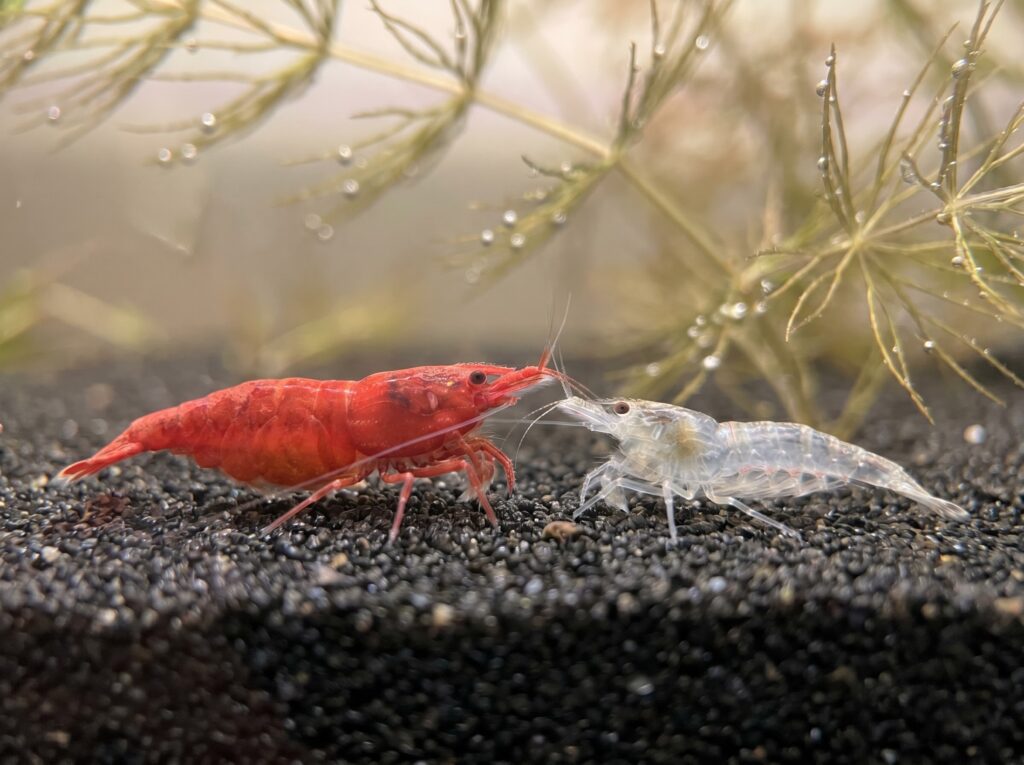
Shrimp cannot grow continuously. Their exoskeleton is rigid, so they must shed it periodically and build a larger one. This process - ecdysis, or molting - has four stages: premolt, the molt itself, postmolt, and intermolt.
In premolt, the shrimp begins reabsorbing some minerals from the old shell to kick-start the new one forming beneath. At the moment of molting, it takes in water rapidly, swells, splits the old shell, and pulls free. Then comes the critical window: the new shell is completely soft. The shrimp hides and absorbs calcium and magnesium directly from the surrounding water - typically 48 hours or more, depending on species and how much mineral is available - while the shell hardens through biomineralization. Only after that does it re-emerge.
If GH is too low during that postmolt window, there simply are not enough minerals in the water to finish the shell. The shrimp comes out soft, vulnerable to being eaten by tankmates (including other shrimp), and unable to harden properly. If the molt itself goes wrong - if the animal gets stuck or the shell splits in the wrong place - the visible result is the white ring of death. You can read the full breakdown of why that happens and what to watch for in our article on the white ring of death.
What a normal postmolt sequence looks like in practice: in the first hour or two after emerging from the old shell the shrimp stays completely still, usually tucked into a moss clump or behind a rock with its antennae folded flat. Around hours three to six it may move slowly to graze on the nearest surface, but it will retreat at the slightest disturbance. By the following morning - roughly 18 to 24 hours out - its movement looks nearly normal, though experienced keepers often notice the gait is still slightly stiff. Full, confident activity typically returns within two days when GH is in range. When GH is too low, the shrimp stays sluggish and tucked away well past that window, which is the clearest behavioral tell before any visible soft-shell problem appears.
GH that is too high causes the opposite problem. The old shell becomes unusually rigid and difficult to shed, which can also result in a stuck molt. There is a real target range, not just a floor.
GH targets: Neocaridina vs Caridina
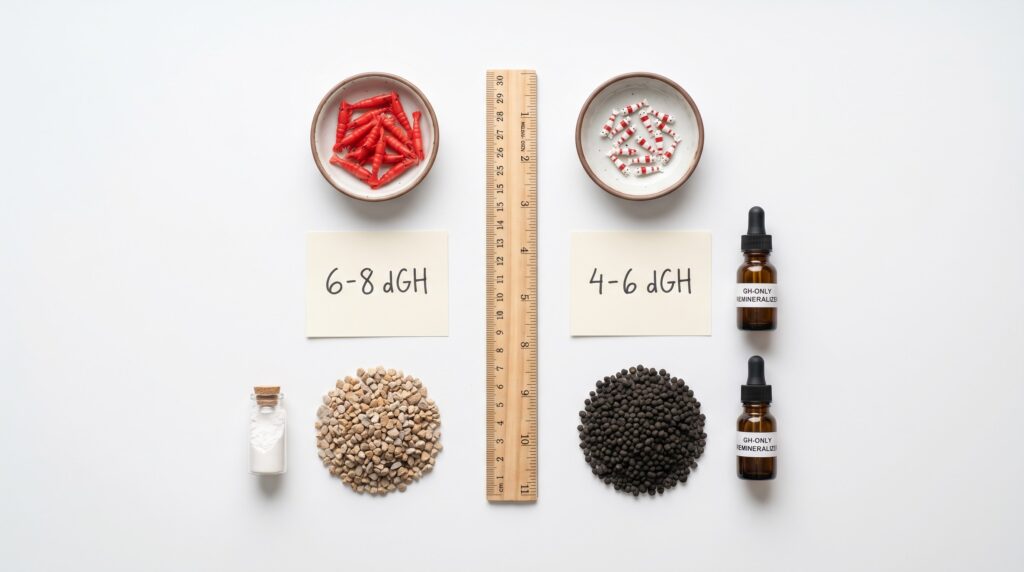
The two main groups of dwarf shrimp sold in the hobby come from different natural habitats and need different water chemistry.
| Parameter | Neocaridina (cherry shrimp and color variants) | Caridina (crystal red, Taiwan bee) |
|---|---|---|
| GH (dGH) | 6-8 | 4-6 |
| KH (dKH) | 1-4 | 0-1 |
| TDS (ppm) | 150-250 | 100-150 |
| pH | 6.5-7.5 | 5.8-6.4 |
| Temperature (°C / °F) | 18-26 / 64-79 | 20-24 / 68-75 |
| Remineralizer type | GH/KH+ (raises both) | GH+ only (no KH raise) |
| Substrate | Inert acceptable | Active buffering substrate required |
Neocaridina are the hardier group. They tolerate a wider range of conditions and recover more easily from brief parameter swings. Still, GH below 5 will cause molting problems even for cherry shrimp. The 6-8 dGH target gives a comfortable margin above the danger threshold.
Caridina shrimp come from soft, very slightly acidic water in habitats like the streams of southern China and Taiwan. Their sweet spot for GH is narrower: 4-6 dGH. Above 7 and you risk exoskeleton stiffening and difficult molts. Below 4 and mineral deficiency becomes the immediate threat. Caridina also need KH kept near zero so their active buffering substrate can hold pH below 6.5 - a GH/KH+ product would undermine that by also raising KH, which is why Caridina keepers use a GH-only remineralizer.
One principle applies to both groups: stability matters as much as the number itself. A colony living comfortably at 7 dGH for months is far healthier than one bouncing between 5 and 9 dGH because of inconsistent water-change routines. Shrimp can handle a reasonable parameter range, but they struggle to cope with rapid swings. Our guide to Neocaridina vs Caridina water requirements goes deeper on why the two groups should never share a tank.
GH-to-molting cause map
The table below maps GH levels to what you will observe in your shrimp, and what to do. Every value in this table is consistent with the targets stated above.
| GH reading (dGH) | What you typically see | Likely cause | Action |
|---|---|---|---|
| Below 3 | Multiple failed molts, white rings, shrimp dying within days of molting | Severe mineral deficiency; new shell cannot harden | Raise GH immediately using remineralizer mixed into replacement water; do not dump into tank directly |
| 3-5 (for Neocaridina) | Occasional failed molts, soft shells, shrimp hiding longer after molting | GH below species minimum; borderline mineral availability | Raise GH to 6-8 dGH with each water change; retest before adding replacement water |
| 6-8 (Neocaridina target) | Clean, regular molts; shells left behind intact; active, colourful shrimp | Parameters correct | Maintain; test weekly during first month, then monthly once stable |
| 4-6 (Caridina target) | Clean molts; shrimp graze and breed normally | Parameters correct | Maintain; use GH-only remineralizer; monitor TDS alongside GH |
| Above 9 (Neocaridina) or above 7 (Caridina) | Shrimp struggling to exit old shell; molt takes unusually long; occasional deaths during molt | GH too high; shell rigidity making ecdysis difficult | Dilute with RO or distilled water in next water change; retest |
How to test GH
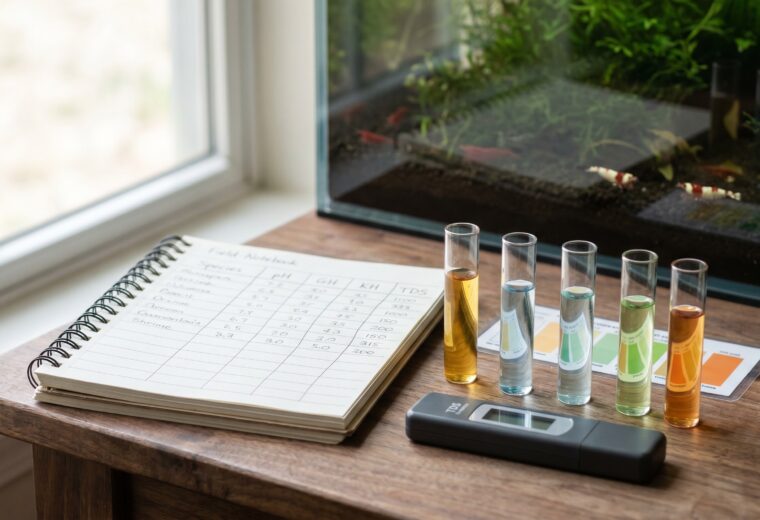
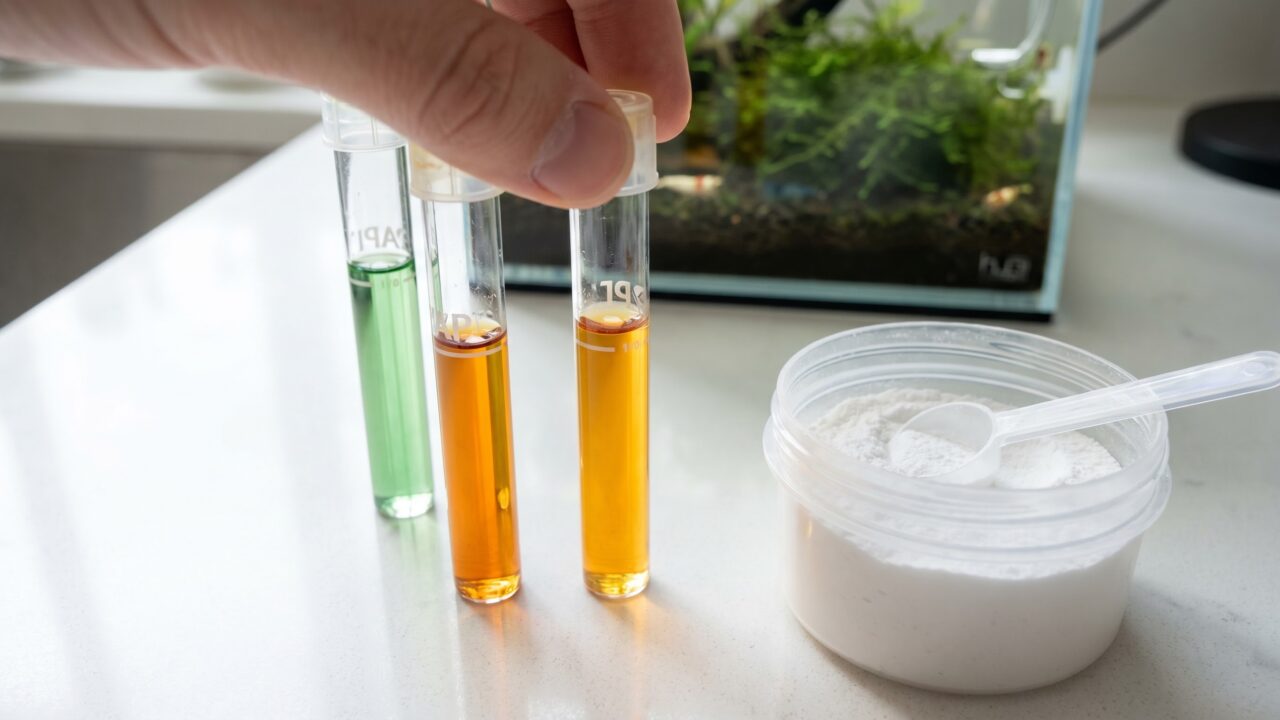
The API GH and KH test kit is the most widely available option and the one most shrimp keepers start with. It uses a drop-count method: you add one drop of test solution at a time to a 5 ml water sample, cap and invert the tube after each drop, and count until the colour shifts from orange to green. Each drop that caused the colour change equals 1 dGH. Add five drops, get a green result, and your GH is 5 dGH.
A few practical notes on getting an accurate reading:
- Swirl the tube gently after each drop and wait a full 10 seconds before adding the next. Rushing causes overshoot.
- View the colour in natural light or daylight-balanced light. Warm incandescent bulbs shift the orange tone and make the endpoint harder to read.
- Test your replacement water in a separate container before the water change, not the tank water after mixing. You want to know what you are adding, not what the tank already contains.
- Rinse the test tube with tank water before filling to the line - residual tap water can skew the result.
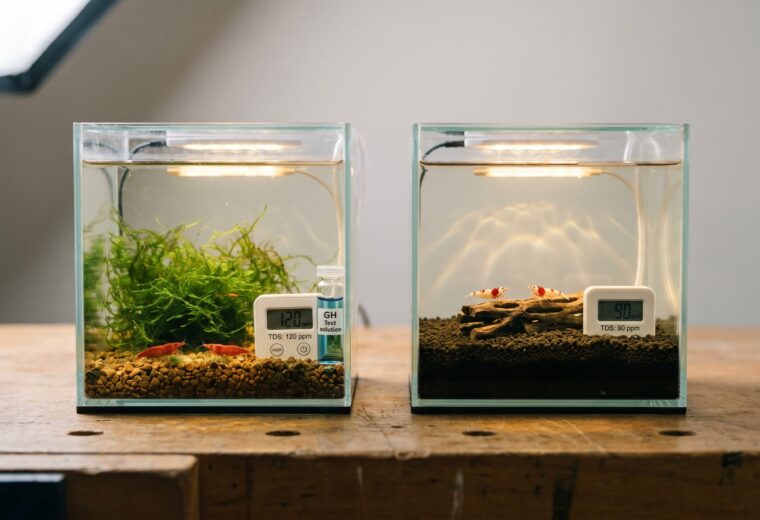
Digital TDS meters give a quick check of total dissolved solids, which correlates loosely with GH when you are using a shrimp-specific remineralizer. But TDS can be elevated by organics, nitrates, and other compounds that have nothing to do with calcium or magnesium, so TDS is never a substitute for an actual GH test. Use TDS as a quick sanity check between proper tests, not instead of them.
How to raise GH with a remineralizer
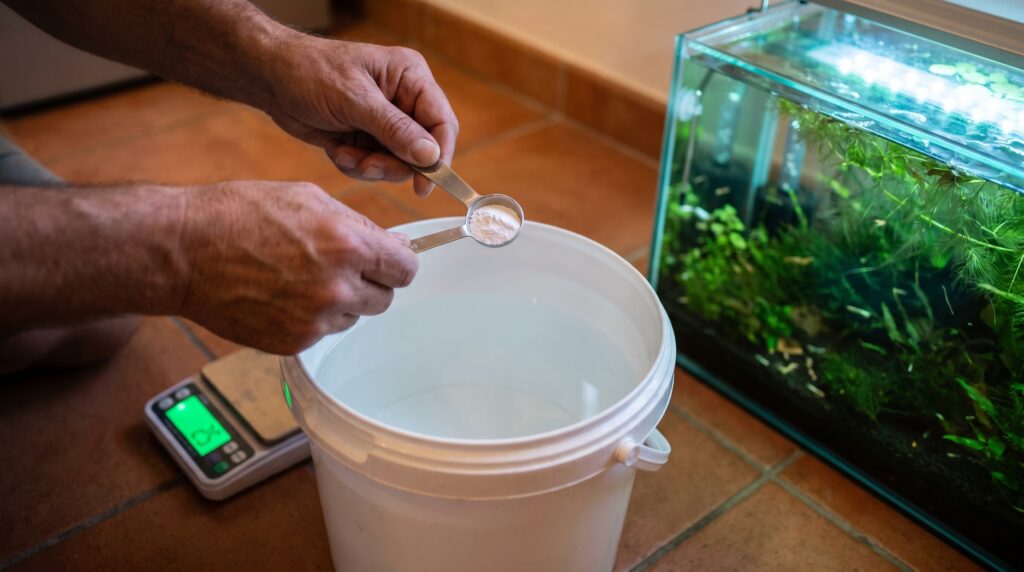
If your GH is below target, the fix is a shrimp-specific remineralizer added to your replacement water before the water change. Never pour a concentrated dose directly into the tank - a sudden mineral spike stresses shrimp just as a drop does.
There are two product formats. Powder remineralizers are more economical for regular use. Liquid remineralizers are easier to dose precisely for small tanks. Both work; the method below applies to either.
- Fill your water-change bucket with RO water, distilled water, or soft tap water.
- Add the remineralizer according to its instructions. For SaltyShrimp Shrimp Mineral GH/KH+ (the Neocaridina product), the manufacturer specifies approximately 2 g per 10 litres to reach roughly 6 dGH and 300 µS conductance.
- Stir or swirl until fully dissolved.
- Test GH of the bucket water. Adjust the dose up or down, then retest.
- Match the temperature of the bucket to the tank within about 1-2°C before adding.
- Add the replacement water slowly - drip it in or pour in small increments over 15-20 minutes. Keep water changes to 10-20% of tank volume per session.
For Caridina shrimp, use a GH-only product such as SaltyShrimp Bee Shrimp Mineral GH+. This product raises GH without affecting KH, keeping the buffering capacity low so the active substrate can do its job holding pH acidic. The manufacturer's dosage guide puts approximately 3 g per 20 litres at roughly 6 dGH and 200 µS.
Seachem Equilibrium is another widely available option for Neocaridina tanks, particularly in planted setups. The manufacturer's dosing is 16 g per 80 litres (20 US gallons) to raise GH by 3 dH (50 ppm). It is derived from potassium sulfate, calcium sulfate, magnesium sulfate, ferric sulfate, and manganese sulfate, with no sodium or chloride. Note that it does not raise KH, so it pairs with a KH booster or buffer if you also need carbonate hardness.
A full walkthrough for remineralizing from scratch is in our how to remineralize RO water for shrimp guide, and if you want more detail on the raise-GH process when your existing tank is already set up, see how to raise GH in a shrimp tank.
Two things that do not fix low GH (and one silent killer)
Cuttlebone is a calcium source sold for birds, and some keepers drop a piece into their shrimp tank hoping it will solve molting problems. It does release calcium carbonate slowly, but it does not contribute magnesium, does not raise GH in a controlled way, and will also raise KH and pH in an unpredictable manner - a serious problem for Caridina tanks and not harmless for Neocaridina either. If your GH is genuinely low, a proper remineralizer is the right tool.
Large water changes done quickly are the second common mistake. Replacing 40% of the tank water in one go can shift GH, pH, and temperature faster than shrimp can handle. A shrimp mid-molt when the parameters shift dramatically is in serious danger. Stick to gradual, small changes - 10-20% at a time, temperature-matched, and dripped in slowly.
The silent killer worth naming here is copper. It is lethal to shrimp at the concentrations used in fish medications, and some plant fertilizers contain trace copper that accumulates in the substrate over time. Always check fertilizer labels for copper content and treat sick fish in a separate quarantine tank, never in a shrimp tank. Old copper plumbing can also leach copper into the first draw of tap water - let your tap run for 30-60 seconds before filling your water-change bucket if you are on an old supply line. No amount of correct GH compensates for copper contamination. Our guide to copper and shrimp covers every source and how to test for it.
Starting a colony and keeping it stable
A single shrimp cannot tell you whether your parameters are working. Ten or more shrimp give you a population large enough to show patterns. If one shrimp fails a molt, that can be bad luck. If three fail in a week, test your GH first.
Once parameters are dialled in, the enemy is drift, not imprecision. A colony that has lived at 7 dGH for six months has calibrated every molt cycle to that number. Disrupting it with erratic water changes does more damage than being a point off the textbook target ever would. A fixed water-change routine, same day each week, same percentage, same remineralizer dose, closes off the slow creep that causes trouble. Test monthly when things are stable, and always test replacement water before a change, not after.
When you add new shrimp, float the bag for ten minutes to equalise temperature, then transfer the shrimp and their bag water into a container. Run an airline with a loose knot or a valve dripping tank water in until the volume has roughly doubled, which typically takes 45 to 90 minutes. Discard the container water and lower the shrimp into the tank. GH differences between source and destination are often the real stress factor, and this gradual mixing lets the shrimp adjust to the new mineral level before they hit your water. More on safe acclimation practice is in our shrimp water parameters overview.