Pick up a pack of cherry shrimp and a pack of crystal reds, and you are looking at two animals that want fundamentally different water. Put them in the same chemistry and one group will slowly decline. Get the numbers right but swing them by 30 ppm TDS every water change, and both groups will suffer regardless of what the test kit says. This guide gives you the target ranges for each group in a single reference table, explains what each parameter actually does, and makes the case for why a stable 5.5 GH beats a perfect 6.0 GH that bounces.
Before mineral balance: the parameters that actually kill shrimp
GH, KH, and TDS get all the attention, but two things kill far more shrimp than a mineral reading that is a point off: an uncycled tank and copper in the water. Get these two right before you fuss over the exact dGH.
Ammonia, nitrite, and cycling come first
The single most important parameter is not on the species table because it is identical for every shrimp: ammonia 0 ppm and nitrite 0 ppm, always. Both are acutely toxic to invertebrates. Ammonia burns gills and nervous tissue at levels as low as 0.25 ppm, and nitrite blocks oxygen transport in the blood. A tank only holds those two at zero once it is fully cycled, meaning the nitrifying bacteria are established and converting ammonia to nitrite to nitrate fast enough to keep up with the bioload. Run the tank fishless until a dose of ammonia clears to 0 ppm ammonia and 0 ppm nitrite within 24 hours, then add shrimp, not before. After that, keep nitrate low (under about 20 ppm) with water changes. More new-tank shrimp die from being added to an uncycled tank than from any mineral imbalance. The full process is in our guide to cycling a shrimp tank.
Copper: the deadliest contaminant, and it is not on any test strip
Copper is lethal to dwarf shrimp at a fraction of a part per million, well below the levels that fish shrug off. The danger is that the common sources are things keepers add on purpose:
- Copper-based fish and snail medications and algaecides. Treatments for ich, flukes, or pest snails are dosed at concentrations that are routine for fish and fatal for invertebrates. Never use a copper medication in a shrimp tank, and quarantine new plants, which are sometimes dipped in copper to kill snails.
- Plant fertilizers that use copper as a micronutrient. Reputable shrimp-safe fertilizers carry copper in tiny chelated amounts that are fine at the labeled dose. The risk is overdosing or using a high-copper planted-tank line. Dose conservatively and pick a shrimp-safe product.
- Old plumbing and tap water. Copper pipes and water heaters can leach measurable copper, especially into water that has sat in the lines overnight. Run the tap for a minute or two before filling, or use RO.
- Some dechlorinators. Heavy-metal binders like Seachem Prime detoxify the trace copper in ordinary tap water, but they do not neutralize the copper load from a medication dose. Do not rely on a dechlorinator to make a copper-treated tank safe.
If you suspect copper exposure, a large RO-based water change and fresh carbon are your first moves. The full breakdown of sources, safe products, and what to do after exposure is in our guide to copper and shrimp.
The master parameter table
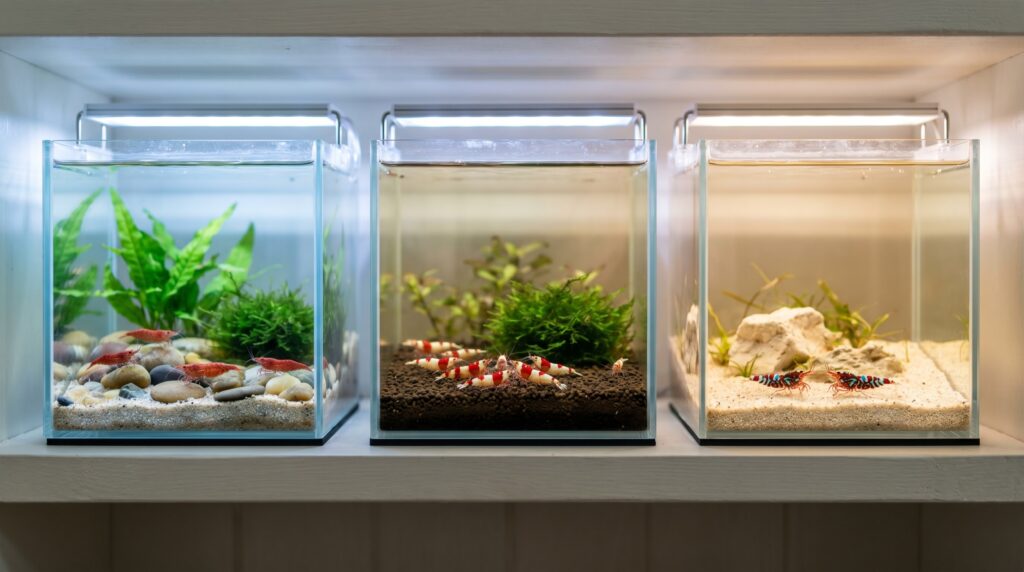
This is the reference to bookmark. It covers the three groups you will meet in the hobby: Neocaridina (cherry shrimp and every color variant), Caridina bee and Taiwan bee types, and Sulawesi shrimp. Each column is its own chemistry world. The ranges reflect well-documented keeper practice and the manufacturer specs of the remineralizers built for each group.
| Parameter | Neocaridina (cherry, color variants) | Caridina (bee, Taiwan bee, crystal) | Sulawesi (cardinal, harlequin) |
|---|---|---|---|
| GH (dGH) | 6-8 | 4-6 | 4-6 |
| KH (dKH) | 1-4 | 0-1 | 3-8 |
| TDS (ppm) | 150-250 | 100-150 | 120-140 |
| pH | 6.5-7.5 | 5.8-6.4 (active soil required) | 7.5-8.5 |
| Temperature | 18-26°C (64-79°F) | 20-24°C (68-75°F) | 26-30°C (79-86°F) |
| Substrate | Inert or active; tap water often fine | Active buffering soil required | Inert; alkaline buffer needed |
| Water source | Tap or RO remineralized | RO + GH-only remineralizer | RO + Sulawesi-specific buffer |
| Difficulty | Beginner | Intermediate to advanced | Advanced |
Notice that Caridina and Neocaridina share no overlap in pH, the TDS bands barely touch, and Sulawesi want warm alkaline water that would stress either of the others. That is exactly why keeping Neocaridina and Caridina in the same tank compromises both. No single chemistry serves both well.
What each parameter actually controls
GH - general hardness
GH measures the dissolved calcium and magnesium ions in your water, expressed in degrees of general hardness (dGH). For shrimp, these minerals are not optional extras. Calcium and magnesium are structural components of the exoskeleton, and shrimp must absorb them from the water column with every molt. At GH below 4, molting becomes risky; at GH above 10 or 12, some breeders report reduced breeding rates and sluggish behavior. The range of 4-8 dGH covers all three groups, though each sits in a different part of that band.
GH is also where the most common molting death comes from. When GH is too low, or when it drops suddenly, a shrimp can build a new shell that will not separate cleanly from the old one and gets stuck part-way out of its old exoskeleton. Keepers see this as the white ring of death: a visible white gap or band at the seam between the head section and the body, where the molt failed to release. A shrimp showing that ring rarely survives. The fix is not to react after the fact but to keep GH both sufficient and stable, which means a remineralizer that sets a known GH, not a cuttlebone tossed in the tank. Cuttlebone and similar calcium blocks dissolve far too slowly to raise GH on a useful timescale or to hold it steady, so leaning on one as your GH strategy is a myth worth dropping. We cover the diagnosis and prevention in detail in our white ring of death guide.
Full detail on what GH means, how to measure it, and how to adjust it is in our GH guide for shrimp tanks.
KH - carbonate hardness
KH is your water's resistance to pH change. High KH locks pH in place; near-zero KH lets pH drift. For Neocaridina, a KH of 1-4 dKH provides useful stability without pushing pH too high. For Caridina, you want KH as close to zero as possible so that an active buffering substrate can do its job, because KH above 2 will overwhelm the soil's acidifying capacity and prevent it from holding pH in the 5.8-6.4 window these shrimp need. Sulawesi shrimp need elevated KH (3-8 dKH) to maintain their alkaline pH. Read the full breakdown at our KH guide for shrimp tanks.
TDS - total dissolved solids
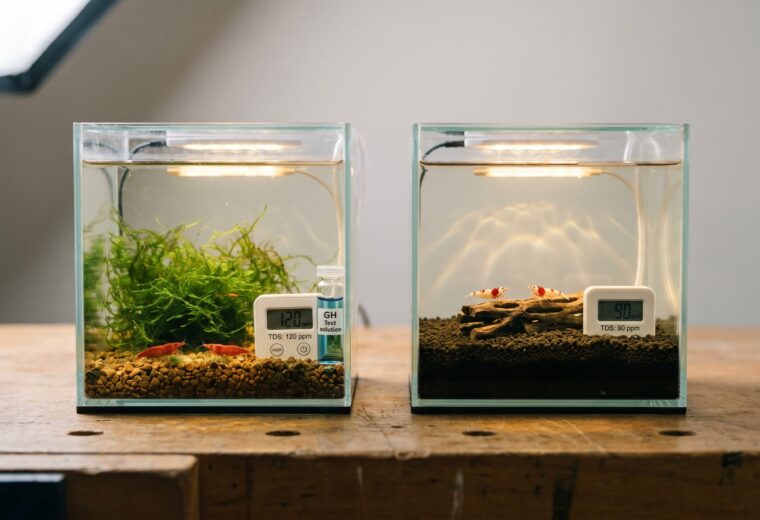
TDS is the sum of everything dissolved in your water, measured in parts per million. A higher TDS reading means more dissolved material. TDS does not tell you what is in the water, only how much. Two tanks can share the same TDS and have very different chemistry. That said, TDS is still a useful daily check because it changes predictably with evaporation and water changes, so a sudden jump or drop warns you something shifted before you even pull out a GH test kit. Target ranges are covered fully in our TDS guide for shrimp tanks.
pH
pH determines whether your water is acidic or alkaline on a scale of 0 to 14, with 7.0 being neutral. Neocaridina are comfortable anywhere from mildly acidic to mildly alkaline (6.5-7.5). Caridina need distinctly acidic water (5.8-6.4) that requires an active buffering substrate to maintain reliably. Sulawesi shrimp come from ancient lakes with steady alkaline chemistry (7.5-8.5) and react badly to acid water. What matters in practice is that pH is stable within the appropriate band for your species. See our pH guide for shrimp tanks for how to adjust safely.
Temperature
Neocaridina are the most temperature-tolerant of the three groups. They breed actively between 20-24°C and handle short excursions outside the 18-26°C band with no lasting harm. Caridina prefer the cooler end, and most breeders aim for 21-23°C. Wikipedia's Caridina cantonensis entry cites a slightly warmer 24-25°C as good for breeding development, and the two reconcile cleanly in practice: a brief peak at 24-25°C does no harm and may help breeding, but holding the tank above 25°C raises bacterial risk and the chance of stress molts. Keep the daily average below 24°C and treat brief 25°C excursions as tolerable rather than safe targets. Sulawesi shrimp are the opposite: they need warmth at 26-30°C, and dropping below 25°C causes noticeable stress. A heater with a reliable thermostat is not optional for a Sulawesi tank.
Why stability beats chasing a number
The single most common reason a healthy colony starts dropping shrimp is not a parameter that is slightly off. It is a parameter that moves. When the water around them changes, shrimp have to run their osmoregulatory machinery harder to keep their internal chemistry constant, and that work costs energy the animal would otherwise spend on growth, breeding, and fighting off infection. How expensive that gets depends on how big the gradient is: under acute salinity stress, where a freshwater animal faces a large osmotic gradient, osmoregulation can consume an estimated 20-50% of its total energy budget. The drift you see in a freshwater tank is nowhere near that severe, but it sits on the same curve, and a colony forced to pay that tax every water change has less left over for everything that makes a tank thrive.
In practical terms: a colony living at GH 5.5 in perfectly consistent water will outbreed a colony living at GH 6.5 with weekly swings of 1 dGH and 40 ppm TDS. Shrimp adapt to stable conditions that sit slightly outside the textbook ideal far better than they adapt to daily turbulence that averages out to the right number.
The same logic governs how you introduce new shrimp. The water in the bag almost never matches your tank, and dropping a shrimp straight into a different TDS is the osmotic gradient at its most abrupt. Drip-acclimate every dwarf shrimp over 1-2 hours so the change happens gradually, and stretch that longer when the TDS or pH gap is wide. Sulawesi shrimp, with the least tolerance of any group, get a two-hour minimum as the stricter case, not the general rule. Our drip-acclimation guide walks through the setup drop by drop.
The most common source of instability is the water change. Topping off with water that is not matched to your tank TDS, or doing large water changes with slightly cooler or differently mineralized water, creates exactly the kind of swing that pushes shrimp into stressed molts. Small, frequent changes with water that matches your tank parameters closely are far less disruptive than one large weekly change. A related trap covered in the Common Mistakes section below: evaporation concentrates dissolved solids and raises TDS, so always top off evaporation with pure RO or distilled water rather than remineralized water. Our guide to remineralizing RO water covers how to prepare consistent replacement water every time.
Neocaridina in depth
Neocaridina davidi and its cultivated color strains (red cherry, blue dream, bloody mary, yellow, green jade, and dozens more) originate from inland waters across Taiwan, China, and the Korean Peninsula. Wild populations have been documented thriving in rivers, reservoirs, and even thermally altered urban waterways, which reflects genuine environmental flexibility. That flexibility is why they are the beginner's shrimp.
Whatever the chemistry, start with a real group. Dwarf shrimp are colonial, social animals, and a population needs numbers to settle in and breed reliably. Begin with around ten or more rather than two or three; lone shrimp and tiny groups hide constantly, breed slowly if at all, and a single loss can stall the whole colony. A starting group of ten-plus gives you the genetic spread and the security-in-numbers behavior that turns a handful of shrimp into a self-sustaining colony. This holds for all three groups, not just Neocaridina.
For most tap water in the US, UK, and Western Europe, Neocaridina will breed without remineralization at all, provided the municipal supply is not excessively hard or soft. Measure your tap GH before buying a remineralizer. If it reads 5-9 dGH and pH is between 6.8 and 7.5, your tap water may need only dechlorination and temperature matching. If your tap water is very soft (GH below 4) or very hard (GH above 12), start with RO and rebuild with SaltyShrimp Shrimp Mineral GH/KH+, which the manufacturer specifies at approximately 2 g per 10 litres to reach 6 dGH and a conductance of 300 µS, both squarely in the Neocaridina sweet spot.
Color lines of Neocaridina must be kept separate. When two different color strains interbreed, offspring revert toward the wild brown-and-clear coloration within two or three generations. Our Neocaridina vs. Caridina water guide covers the water-chemistry side of keeping the two groups apart in a shared fish room.
Caridina in depth
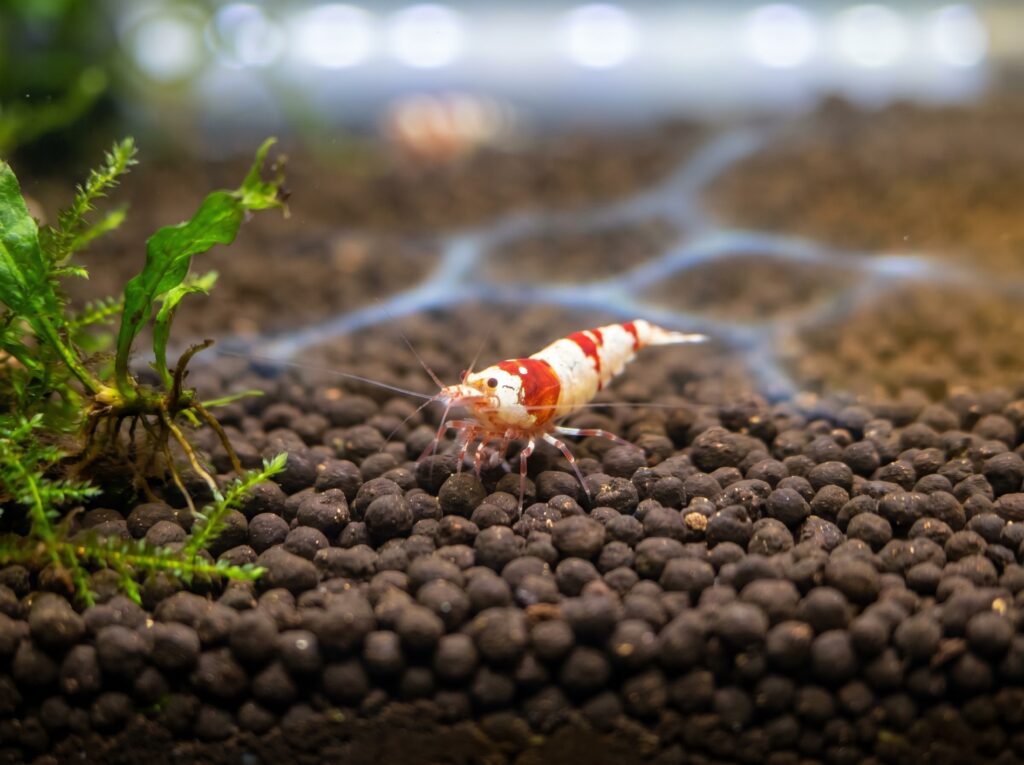
Crystal red, crystal black, bee shrimp, and Taiwan bee variants (red bolt, black king kong, panda, and their relatives) belong to Caridina cantonensis and its close relatives. Their native streams in highland Taiwan and southern China are soft, cool, and acidic: low mineral content, near-zero carbonate hardness, and a pH in the fives or low sixes. Replicating that chemistry in captivity requires two things: an active buffering substrate and RO water remineralized with a GH-only product.
The active substrate does the pH work. It releases organic acids that drive pH down and absorb whatever carbonate hardness enters the tank, keeping KH near zero. This only functions correctly if the replacement water coming in carries no KH. RO water plus a Caridina-specific remineralizer like SaltyShrimp Bee Shrimp Mineral GH+ (no KH contribution) is the standard approach. Using a GH/KH+ product here defeats the substrate's buffering mechanism entirely.
Most active substrates buffer reliably for 12-18 months before their capacity is exhausted, after which pH will begin to rise toward neutral. Breeders watch for this as a sign the substrate needs replacing.
Caridina shrimp do not tolerate parameter fluctuations. Swings in temperature, pH, or TDS can force a premature molt, and a shrimp that molts under stress is at serious risk of a failed molt. Keep water changes small and consistent, and always match replacement water TDS to within 10-15 ppm of the tank reading.
Sulawesi shrimp in depth
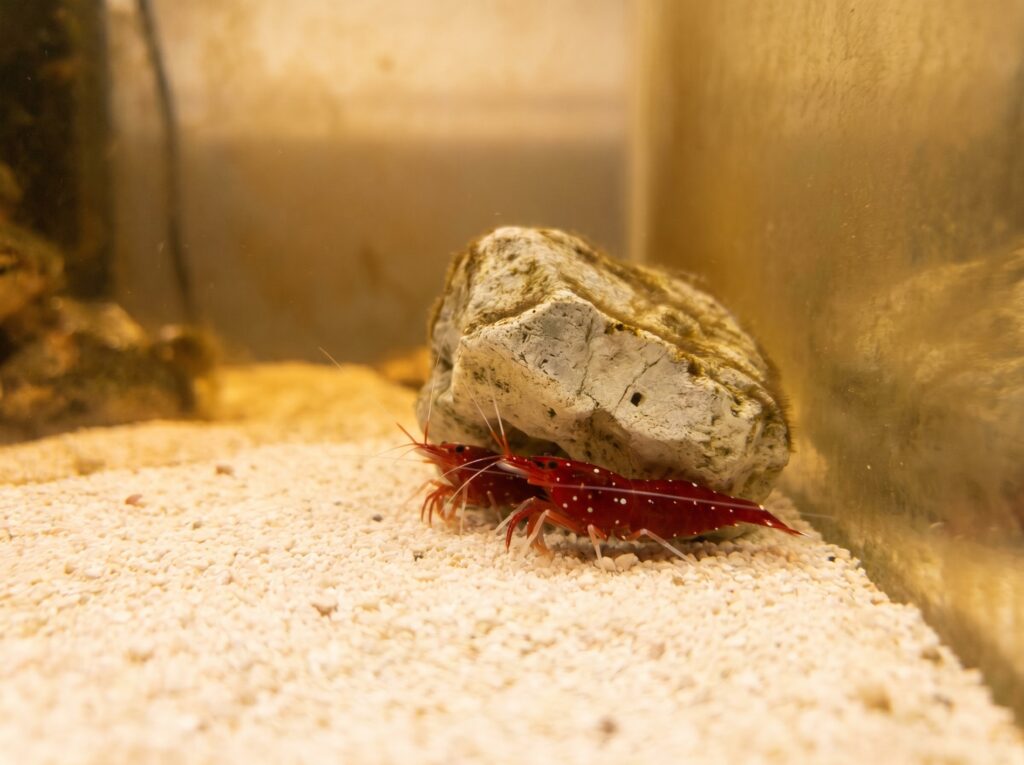
Cardinal shrimp (Caridina dennerli), harlequin shrimp, and their relatives come from ancient crater lakes in Sulawesi, Indonesia. Cardinal shrimp are endemic to Lake Matano specifically; harlequin shrimp (Caridina woltereckae) are native to Lake Towuti, and orchid shrimp and related species come from Lake Poso. These lakes are geologically isolated, warm, clear, and alkaline, with stable mineral chemistry that has barely changed for millions of years. The shrimp that evolved there have almost no physiological buffer against change. A pH drop of half a point, a temperature swing of 2°C, or a TDS shift of 20 ppm is enough to trigger stress behavior.
Documented keeper parameters for established Sulawesi tanks cluster around 28°C, pH 8.0-8.2, KH 4, GH 4-6, and conductivity around 300 µS. The alkaline pH requires a different approach from either Neocaridina or Caridina: RO water rebuilt with a Sulawesi-specific buffer product that includes the carbonate fraction to stabilize pH well above 7.0. Inert substrate is used rather than active soil, since active soil would pull pH in the wrong direction entirely.
Sulawesi shrimp are not a beginner's animal. Even experienced keepers who nail the chemistry report losses during the first weeks as the tank biology stabilizes. Start with a deep biofilm base, run the tank fishless for at least six weeks before adding shrimp, and drip-acclimate for two hours minimum when they arrive.
Common mistakes with parameters
- Matching TDS without checking GH and KH separately. TDS alone does not tell you whether the mineral balance is right. Two tanks at 180 ppm can have completely different GH and KH profiles. Always test GH and KH directly.
- Using a GH/KH+ remineralizer for Caridina. Adding KH to a Caridina tank raises carbonate hardness, which battles the active substrate and causes pH to climb out of range. Use a GH-only product for Caridina.
- Large water changes with temperature-mismatched water. Even if the TDS is correct, pouring water 3-4°C cooler than the tank is enough to shock shrimp into premature molting. Let replacement water reach tank temperature before adding it.
- Chasing pH directly without addressing KH. If KH is high, lowering pH with acids is fighting the buffer. The change will not hold, or it will crash suddenly when the buffer is overwhelmed. Fix KH first by switching to lower-KH source water.
- Ignoring parameter drift over time. Evaporation concentrates dissolved solids and raises TDS. Top off with pure RO or distilled water (not remineralized water) to replace evaporation losses, and save remineralized water for true water changes.
- Letting copper into the tank. A copper fish or snail medication, a copper-dipped plant, or water sat overnight in copper pipes can wipe a colony in a day while the GH and TDS read perfect. Quarantine new plants, never dose copper, and run the tap before filling. See copper and shrimp.
- Adding shrimp to an uncycled tank. If ammonia or nitrite reads anything above 0 ppm, the tank is not ready, no matter how good the mineral numbers look. Cycle first.
- Skipping or rushing acclimation. Dropping shrimp straight into a different TDS is osmotic shock. Drip-acclimate every group over 1-2 hours, longer for a wide TDS gap.
If your parameters look correct but shrimp are still dying, the water chemistry is often not the culprit. See our guide on parameters fine but shrimp dying for the next set of things to check.