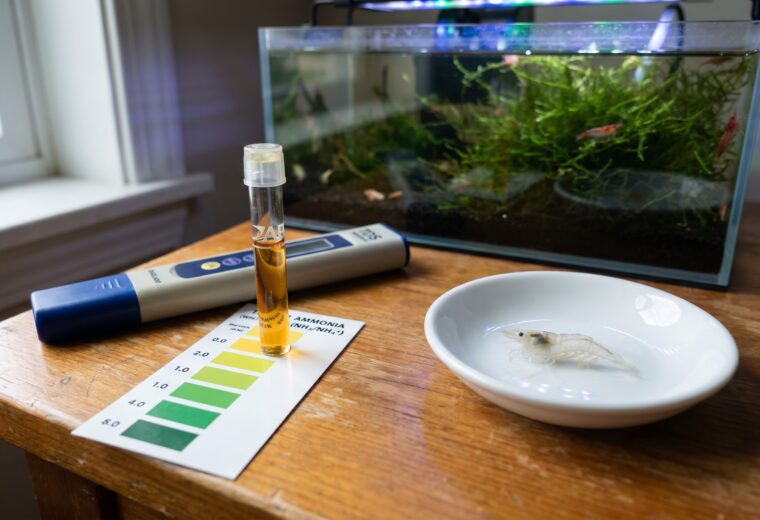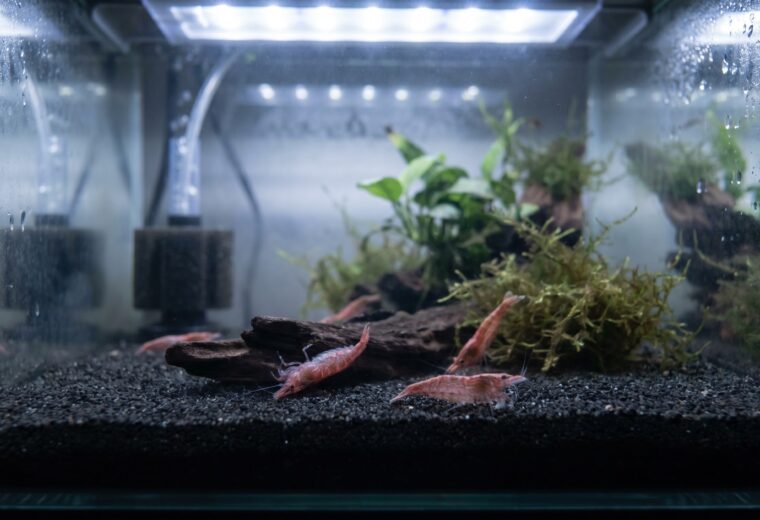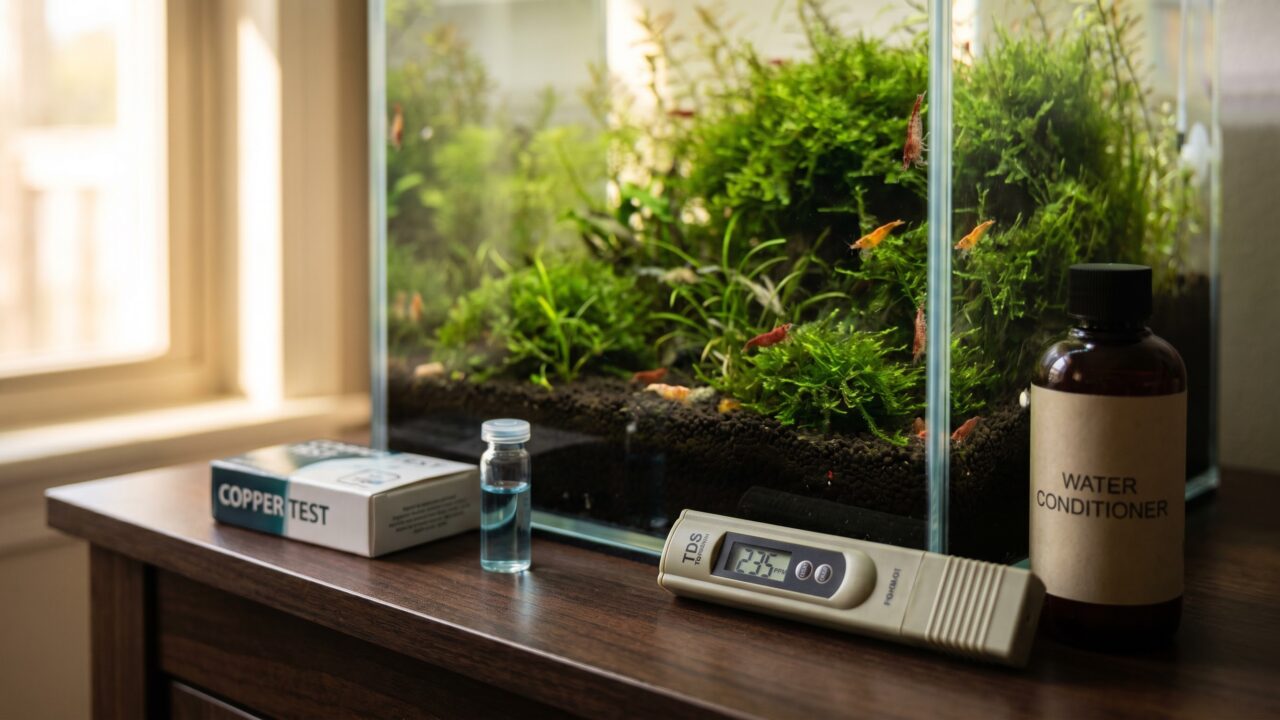
Your ammonia reads zero. Nitrite reads zero. Nitrate is low, pH looks right, and the thermometer says 24°C. And yet a shrimp died this morning, and two more are sitting on the bottom looking wrong. This is one of the most frustrating situations in the hobby - and it happens because the standard five-parameter test kit was designed to catch a cycling tank, not a contaminated or drifting one.
The tests that read "fine" are necessary but not sufficient. There is a whole category of causes your basic kit will never catch: slow TDS creep from evaporation, a buffering substrate that silently stopped working months ago, a trace of copper from a new fertilizer or old plumbing, chloramine that your dechlorinator did not fully break down, and temperature swings the thermometer missed. Each of these kills shrimp while every standard reading looks clean. Working through them in order is how you find the real cause.
TDS drift: the number your ammonia kit cannot see
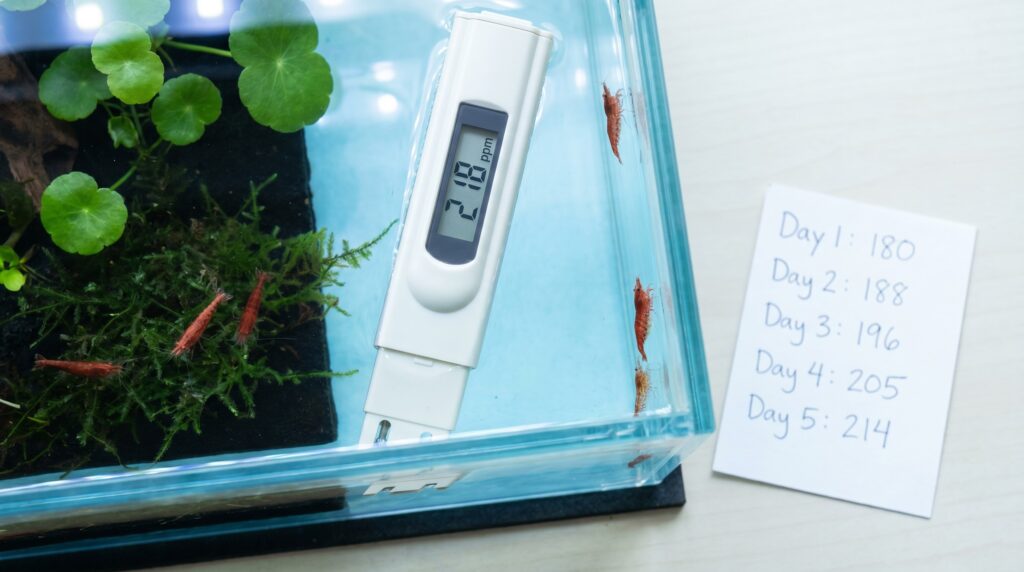
A TDS (total dissolved solids) meter measures the combined concentration of everything dissolved in your water - minerals, salts, trace metals, organic waste - and expresses it as a single parts-per-million figure. Your ammonia test tells you nothing about it.
The mechanics of TDS creep are straightforward. Water evaporates; the minerals it contained do not. Every day your tank loses volume to evaporation, the remaining water gets proportionally more concentrated. A Neocaridina tank that starts a week at 180 ppm after a water change can sit at 220 ppm or higher by the following Friday if you are not topping off with pure RO or distilled water. For Caridina, which needs TDS in the 100-150 ppm range, the margins are even tighter.
Shrimp are osmoregulators: they actively manage the fluid balance inside their bodies against the surrounding water. When TDS climbs too fast, or sits significantly above their target range, they have to work harder to maintain that balance. Research on freshwater crustaceans shows that sustained osmotic stress redirects energy away from reproduction and growth into regulation - and that larvae and juveniles, with immature osmoregulatory systems, are the most vulnerable. A slow dieoff of young shrimp while adults appear fine is a classic TDS-creep pattern.
Equally dangerous is a sudden TDS drop - topping off with a large volume of pure water instead of small daily amounts, or doing a water change with water that is significantly lower in TDS than the tank. Osmotic shock from a sudden large drop can trigger a molt before the shrimp is ready, which often produces a failed molt.
Test TDS daily for a week and log the numbers. If you see more than a 20-30 ppm rise between water changes, adjust your top-off routine: use only pure RO or distilled water for evaporation replacement, and premix your water-change water to match your tank's target TDS before it goes in. Our guide to TDS for shrimp tanks covers the full measurement and correction workflow.
The substrate that silently stopped buffering
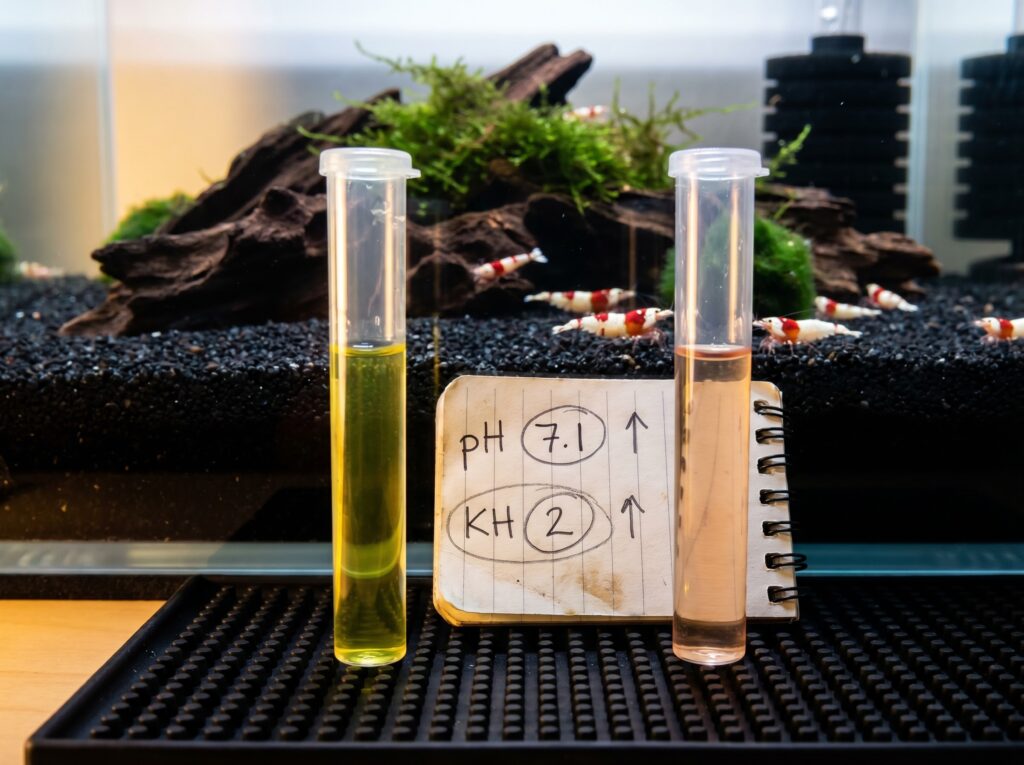
This cause is almost entirely invisible to a basic test kit - until it has already been killing your shrimp for weeks.
Active substrates (aqua soils) used in Caridina tanks work by ion exchange: they trade hydrogen ions into the water in exchange for carbonate hardness ions, which drives pH down and keeps KH near zero. That capacity is finite. According to RareShrimp's documented guidance on substrate replacement, most quality active soils begin losing their buffering capacity after approximately 8-12 months of use, at which point "the soil is considered 'expired' and will no longer effectively acidify and soften the water to the optimal pH and hardness levels caridina shrimp require."
The failure mode is slow and easily missed. As the substrate exhausts, pH climbs a fraction each week - from 6.2 to 6.4, then 6.6, then creeping past 7.0. KH rises at the same time. A keeper testing only occasionally might see a reading of 6.8 and think "a bit high but okay," not realizing it was 6.2 two months ago and is still climbing. Caridina kept in creeping-pH water show signs of stress over weeks: reduced breeding, reluctance to molt, and eventually slow deaths - while ammonia and nitrite stay at zero.
GlasGarten's Environment Soil, for example, stabilizes pH to approximately 5.5-6.5 depending on source water - but that stabilization is active only while the substrate retains buffering capacity. Once exhausted, it becomes inert gravel.
Check substrate age against purchase date. If it is past 12 months, start testing pH and KH daily for a week. A rising pH trend (not just a single reading) is the diagnostic signal. For the full picture on what active substrate does and when to replace it, see our article on active substrate for shrimp.
One additional check: if you are using an active substrate and your KH is not sitting near zero, something is adding carbonate hardness to the tank (tap water used for top-offs, a piece of coral rock, aragonite, or crushed coral substrate mixed in). Every unit of KH your source water brings in accelerates substrate exhaustion. Caridina keepers use RO water precisely to protect substrate longevity.
The hidden cause checklist: what your kit misses
The table below is the structured diagnostic you reach for when every standard reading looks acceptable. Work through it top to bottom - not all at once, but in order of likelihood for your specific setup.
| Suspected cause | What to test or check | What "problem" looks like | Fix |
|---|---|---|---|
| TDS creep (evaporation) | TDS meter, daily for 7 days | TDS rising more than 20-30 ppm between water changes; gap between post-change TDS and end-of-week TDS | Top off daily with pure RO/distilled water; match water-change water to tank TDS before adding |
| Active substrate exhaustion (Caridina) | pH and KH trend over 7-14 days; substrate purchase date | pH rising above 7.0, GH rising above 5; substrate older than 12 months | Plan a tank reset with fresh substrate; hold water changes small and frequent to slow drift while planning |
| Copper - fertilizer | Read label of every liquid plant fertilizer; copper test kit if available | Any fertilizer added recently; label shows Cu above trace (Seachem Flourish lists Cu at 0.0001%; Flourish Trace lists Cu at 0.0032% - use the Comprehensive, not Trace, in shrimp tanks) | Stop dosing; do a 20-30% water change with dechlorinated water; do not resume the product |
| Copper - plumbing | Run tap 2-3 minutes before collecting water; use a copper test kit on first-draw water | First-draw tap water from copper pipes can reach several mg/L Cu; the NIH-cited safe threshold for aquatic use is well below 0.003 mg/L | Always flush the tap 2-3 minutes before collecting; use a conditioner that explicitly neutralizes heavy metals (Seachem Prime does) |
| Copper - medications or treatments | Audit every product added to the tank in the past 4 weeks | Any "anti-parasitic" or "anti-fungal" medication containing copper sulfate; "blue" treatments | Discontinue immediately; large water change; activated carbon for 48-72 hours to pull residual copper |
| Chloramine (not fully neutralized) | Call your water utility or check their annual water quality report for chloramine use; verify your dechlorinator handles chloramine | Using sodium thiosulfate only (it neutralizes chlorine but leaves free ammonia from broken chloramine bonds); or using standard dechlorinator in an area served by chloramine | Switch to a dechlorinator that explicitly handles chloramine AND binds the residual ammonia - Seachem Prime treats up to 4 mg/L chloramine per standard dose (5 mL per 200 L) |
| Temperature instability | Log temperature at lights-on, midday, and lights-out for 3-5 days; check heater function with a calibrated thermometer | Swings larger than 2-3°C within a day; heater cycling widely or failing to hold set point; summer ambient temperature spikes | Upgrade to a reliable controller-type heater; consider a fan for summer cooling; verify heater wattage is appropriate for tank volume |
| New addition shock (chemical transfer) | Review everything added in the past 2-4 weeks: new shrimp, plants, decor, wood, rocks | Deaths started within days or a week of adding something new; shrimp from a different tank may carry pathogens or hitchhiker chemicals | Quarantine all new additions for 2-4 weeks; rinse new decor; do not add bag water to your tank when introducing new shrimp |
Copper: the fastest killer in the list
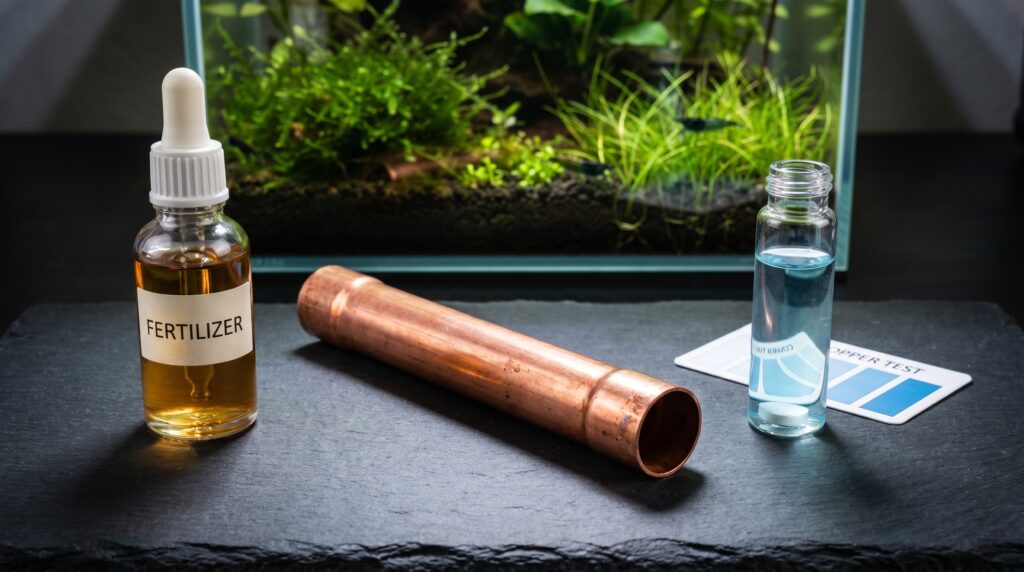
Copper deserves its own section because it acts at concentrations so low that standard test kits do not catch them, and because it keeps entering tanks through routes keepers do not always suspect.
Research published in PMC (Wang et al., 2014) measured the 96-hour LC50 of copper for the oriental river prawn (Macrobrachium nipponense) at just 0.0313 mg/L - meaning half a test population died at roughly 31 parts per billion. The authors proposed a biologically safe threshold of 0.003 mg/L, or about 3 parts per billion. Note that M. nipponense is a larger commercial prawn species, not a dwarf aquarium shrimp; Neocaridina and Caridina are likely equally or more sensitive to copper, making these thresholds a conservative lower bound rather than a safe ceiling. To put that in perspective: the EPA's maximum contaminant level goal for copper in drinking water is 1.3 mg/L - a figure set for human health, not shrimp. Water that is perfectly safe to drink can still contain enough copper to stress or kill dwarf shrimp.
The three sources to audit immediately:
- Liquid plant fertilizers. Many multi-nutrient fertilizers contain trace copper. Seachem Flourish Comprehensive lists copper at 0.0001% - a small amount that at standard dosing is generally considered tolerable. Seachem Flourish Trace lists copper at 0.0032% - a much higher concentration that many keepers consider risky in sensitive shrimp tanks. Read every label before dosing. When in doubt, choose a fertilizer marketed as copper-free.
- First-draw tap water from copper plumbing. Water that sits overnight in copper pipes leaches copper. NIH documentation of drinking water chemistry confirms that "the concentration of copper is much higher in first-draw water than in water after the tap has been flushed" and that stagnation can raise levels to several mg/L. If your home has copper plumbing, run the tap for at least two to three minutes before collecting water for the tank, every time.
- Medications. Any copper sulfate-based treatment - used in the tank or a connected system - will spike copper immediately and lethally. This includes some common ich and velvet treatments. Never use copper medications in a shrimp tank or in equipment shared with one.
A dedicated copper test kit (liquid reagent type, not a strip) will detect copper at the ppm level. If you suspect copper but cannot test immediately, a 25-30% water change with conditioned water and 48 hours of activated carbon running in the filter is the emergency response. For more on this, our article on copper and shrimp goes into the full picture.
Chloramine: the dechlorinator gap
A significant share of water utilities use chloramine (chlorine bonded to ammonia) rather than plain chlorine as a disinfectant, because chloramine persists longer in distribution pipes. According to EPA data, roughly 20-33% of US public water systems use chloramine as their secondary disinfectant - a substantial minority, not a majority, but large enough that you cannot assume your supply uses only plain chlorine without checking. The problem for shrimp keepers: standard sodium thiosulfate-based dechlorinators break the chlorine-nitrogen bond and neutralize the chlorine portion - but they release the ammonia half as free ammonia into your tank water.
Your ammonia test may not catch this immediately. The ammonia is released in the bucket or tank as you add the water, then processed by your biofilter. But if the biofilter is not fully mature, or if you are doing a large water change, the spike can be enough to stress or kill shrimp. Meanwhile, your ammonia reading taken an hour later looks fine.
Seachem Prime's product documentation states it "removes chlorine, chloramine and detoxifies ammonia" and specifies it "removes approximately 1 mg/L ammonia, 4 mg/L chloramine, or 5 mg/L chlorine" per standard dose of 5 mL per 200 L. It handles both the chlorine and the ammonia that chloramine releases, binding the ammonia into a non-toxic form the biofilter can still process. If you live in an area served by chloramine and are currently using plain sodium thiosulfate, switching to a full conditioner like Prime is the fix.
To check whether your utility uses chloramine: most water providers publish an annual water quality report, searchable by zip code or postal code on the utility's website. Look for "chloramine" or "monochloramine" in the disinfectant section.
Temperature instability: the one the thermometer lies about
A digital thermometer gives you a snapshot - the temperature right now. It tells you nothing about what happened at 2 a.m. when the ambient room temperature dropped, or at 3 p.m. yesterday when afternoon sun hit the tank through a window.
Physiological research on shrimp (Litopenaeus vannamei) found that temperature fluctuation activates the unfolded protein response across multiple cellular pathways and triggers hepatopancreas stress. The study noted that shrimp "can adapt to a certain level of temperature fluctuation by self-regulation" - but that adaptation has limits, and the energy cost is real. In dwarf shrimp, temperature swings of 3°C or more within a single day are widely cited by experienced hobbyists as a threshold associated with failed molts and immune stress, even when the average temperature looks acceptable; treat this as an established hobby guideline rather than a figure from the cited paper, which studied a marine species under different conditions.
The diagnostic approach is to log temperature three times a day - at lights-on, midday, and just before lights-off - for at least three to five days. If you see swings larger than 2-3°C, the heater is likely undersized or malfunctioning, or ambient room temperature is creating swings the heater cannot compensate for. Summer is the season most keeper losses cluster around, because cooling is harder than heating. A small clip-on fan blowing across the water surface can drop temperature by 2-3°C through evaporative cooling (and will increase TDS creep, so compensate with more frequent RO top-offs).
A note on new additions
If you added anything to the tank - new shrimp, new plants, a new piece of wood, or new decorations - in the two to four weeks before deaths started, that addition is a prime suspect. New shrimp from a different keeper's system can carry pathogens, parasites, or chemical residues from medications used there. New plants from an aquarium store may have been treated with copper-based algaecides or pesticides that are lethal to shrimp at trace concentrations.
The mitigation is always the same: quarantine new shrimp for two to four weeks in a separate tank before adding them to your main colony. Rinse new hardscape in dechlorinated water. For plants, a short hydrogen peroxide dip (1-3% H2O2 solution for 3-5 minutes, then rinse well) or an alum soak (1 tablespoon of alum per gallon of water for 2-3 days, then rinse) are the standard hobbyist precautions for removing hitchhiker pests and chemical residues. And when introducing new shrimp, never pour the bag water into your tank. See our guides on drip acclimation and quarantining new shrimp for the steps.
One more angle on new additions: if you recently swapped in a new brand of dechlorinator, a new fertilizer, or even new food, that product is worth examining. Check every ingredient list against the copper-free and chloramine-safe checklist above. The deaths in your tank started somewhere - and the audit trail almost always leads to something that changed.
When all of this is clear and you still cannot find the cause, the broader diagnostic guide at why are my shrimp dying covers the full spectrum, including disease, biological causes, and colony dynamics. If the deaths are concentrated in very young shrimp or are happening in clusters after molts, the shrimp colony crash article addresses those patterns specifically.