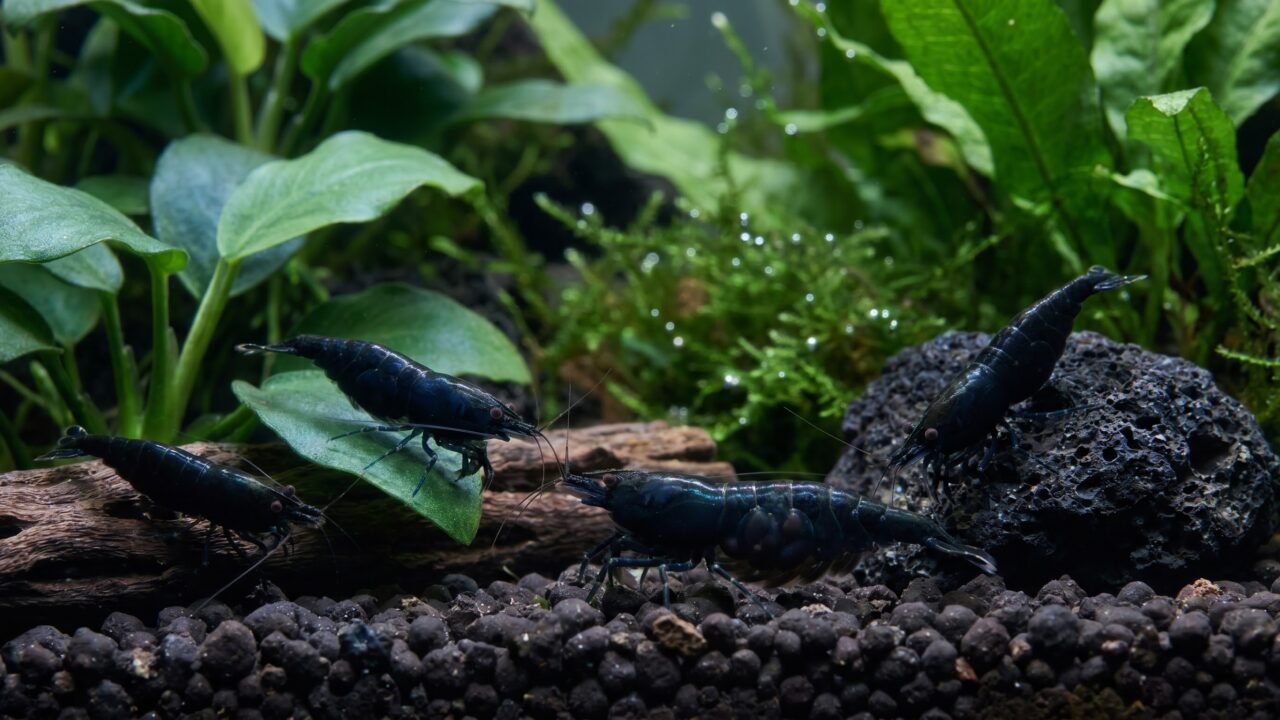
Pick up a high-grade Black Rose shrimp and hold the bag to the light. At its best the animal looks like it was carved from polished obsidian - legs dark, body opaque, no hint of the mottled brown its wild ancestors wore. Getting to that grade, and keeping it consistent across a colony, is the practical challenge this guide addresses.
Black Rose is a selectively bred color line of Neocaridina davidi, the same species as cherry shrimp and every other Neocaridina color in the hobby. It shares their water requirements completely - GH 6-8 dGH, TDS 150-250, pH 6.5-7.5, temperature 18-26°C (64-79°F). What makes the dark lines interesting is everything that happens on top of that foundation: the way substrate color changes how the animals look, why some colonies drift back toward brown, and the relationship between the Black Rose and Chocolate trade names that confuses a lot of new keepers.
Black Rose, Chocolate, and where the names come from
Both names describe the same species producing high concentrations of melanin pigment. Melanophores - the chromatophore cells that make melanin - give Neocaridina its brown and black tones. The wild-type shrimp is already a mottled brown because melanophores are its dominant pigment expression. Selective breeding amplifies that expression and makes it more uniform, pushing animals from patchy brown toward solid brown (Chocolate) and then toward near-opaque black (Black Rose).
The practical difference between the two names is grade, not species. Chocolate shrimp are the mid-tier: rich brown, sometimes edging toward dark umber or burnt cocoa, with some translucency visible in the legs and tail. Black Rose sits above that - the body approaches jet black and the legs darken with it. In practice many sellers use the names loosely, so what matters is assessing the animals themselves rather than trusting the label.
A third name sometimes appears: Black Velvet. This tends to refer to very high-grade Black Rose animals with an especially matte, non-reflective appearance - though the line between Black Velvet and top-grade Black Rose is not a formal distinction. Carbon Rili is a separate pattern: the characteristic rili banding (colored head and tail, transparent midsection) applied to the black line, and it should not be mixed with solid Black Rose stock.
Grading dark Neocaridina: what to look for
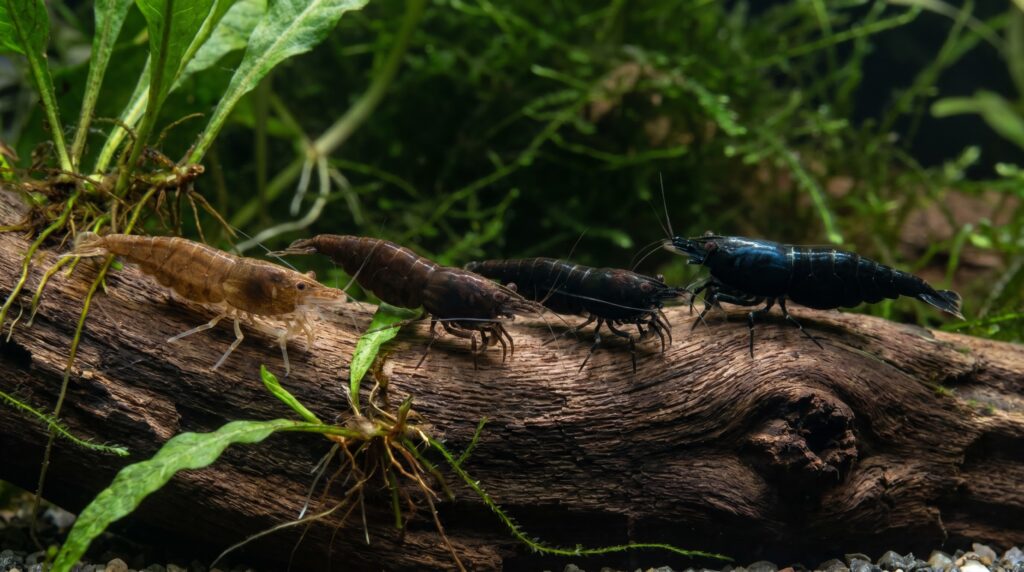
The table below sets out a practical grading ladder for the dark lines. Unlike the red line, which has a formal progression (Cherry, Sakura, Fire Red, Painted Fire Red), the dark lines do not have a widely standardized naming convention. Keepers and breeders tend to work informally from visual opacity. This table is the working framework that makes sense of what you will see at vendors and in breeder listings.
| Grade | Common trade name | Body color | Leg and tail color | Translucency | Breeding value |
|---|---|---|---|---|---|
| Low | Chocolate / Brown | Mid to dark brown, may show warm umber tones | Legs often pale or semi-transparent | Moderate - internal organs visible in bright light | Colony foundation; many offspring will drop in grade |
| Mid | Dark Chocolate / Chocolate Black | Deep brown to near-black; cooler, less warm than Chocolate | Darkening, still some pale sections | Low - only faintly see-through at edges | Good colony shrimp; produces a mix of mid and high offspring |
| High | Black Rose | Near-opaque black; cold blue-black tone in good lighting | Legs dark, matching body closely | Very low - organs not visible under normal light | Keep these; they anchor the colony toward higher grades |
| Top | Black Rose / Black Velvet | Fully opaque black; no visible warm tones | Uniformly dark legs and tail fan | None visible even under strong side-lighting | Priority breeders; cull heavily to select these |
Grade drift is the biggest frustration with the dark lines. A colony started from mid-grade animals will reliably produce some Chocolate offspring in every generation - not because anything went wrong, but because melanin expression varies naturally across individuals and the selection pressure is not uniform. To pull a colony toward the top tier, breeders cull (remove from the main tank) every animal that shows warm brown tones or pale legs. Only the darkest-legged, most opaque animals breed forward. It takes several generations and there are no shortcuts. Our guide to culling shrimp for color covers the mechanics in detail.
How substrate and lighting change the way dark shrimp look
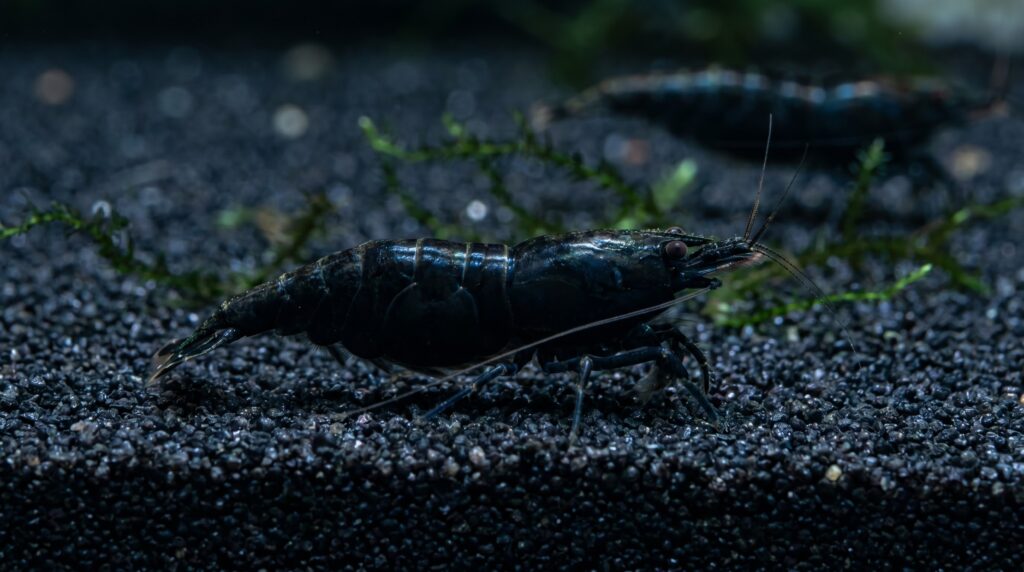
Dark substrate makes Black Rose shrimp look better. A study published in the scientific literature on Neocaridina davidi confirmed that shrimp across all tested color morphs preferred dark backgrounds over light ones irrespective of their own coloration - and that their coloration shifted in response to substrate via both rapid physiological changes (chromatophore adjustment within minutes) and slower morphological changes (pigment changes over days and weeks). Practically, a colony kept over black sand or dark-colored gravel will display richer, more uniform black than the same animals kept over white or beige substrate.
Lighting matters too, but in a different way from substrate. Bright overhead lighting alone does not wash out a well-pigmented Black Rose, but it can make the blue-black iridescent quality of a high-grade animal harder to see. Side or diffuse lighting, the kind that comes from a thickly planted tank with floating plants filtering overhead light, often shows the depth of color better. A clean blue-black tone on a quality Black Rose is partly optical: it comes from the way dense melanin interacts with light, and dimmer, angled light often brings it out.
One thing that does not improve color over the short term: stress. Shrimp that are acclimating, recovering from a parameter swing, or being chased by tankmates will visibly pale as chromatophores retract. A pale animal in an otherwise dark colony is worth watching for 48 hours before assuming it is a low-grade specimen - it may simply be stressed.
For a deeper look at how water conditions interact with color expression in Neocaridina generally, our guide to shrimp losing color covers the most common causes and fixes.
Water parameters and setup
Neocaridina davidi is not a demanding shrimp. The species is native to slow-moving streams, ponds, and lake margins across Taiwan, eastern China, Korea, and Vietnam, and it carries that environmental flexibility into captivity. That said, "hardy" does not mean parameters are unimportant - a colony that holds steady at any point in that range will do better than one whose parameters shift week to week, and the killers for dark Neocaridina are the same as for every other color line.
| Parameter | Target | Notes |
|---|---|---|
| GH (general hardness) | 6-8 dGH | Calcium and magnesium for successful molting. Below 4 dGH failed molts become common. |
| KH (carbonate hardness) | 1-4 dKH | pH buffer. Neocaridina tolerate a wide KH range; aim for stability rather than a specific number. |
| TDS (total dissolved solids) | 150-250 ppm | Breeding colonies are routinely maintained at 150-200 mg/L by keepers working with cherry shrimp lines; hobby consensus across that range. Stability beats precision. |
| pH | 6.5-7.5 | Tolerant species. Swings are more dangerous than the exact number. A stable 7.4 beats a fluctuating 7.0. |
| Temperature | 18-26°C (64-79°F) | Cooler temperatures extend lifespan and slow metabolism; warmer end accelerates breeding. Many breeders work at 22-24°C. |
| Ammonia | 0 ppm | Non-negotiable. Never stock a tank before both ammonia and nitrite read zero on two consecutive tests. |
| Nitrite | 0 ppm | Toxic at any detectable level. Zero before stocking, always. |
| Nitrate | Under 20 ppm | Less acutely toxic but harmful at high levels. Small, regular water changes manage this. |
For tap water with reasonable mineral content, a good dechlorinator and some patience during cycling is often enough to reach these targets. If your tap water is very soft or very hard, remineralizing RO water gives you more control. SaltyShrimp Shrimp Mineral GH/KH+, dosed at approximately 2 g per 10 liters, targets roughly 6 dGH and 300 µS conductance - consistent with the lower end of the 6-8 dGH target range. Increase the dose slightly if you are working toward 7-8 dGH. Full guidance on RO water for shrimp is in our remineralizing RO water guide.
Water changes should be small and gradual. Replacing 10-15% weekly is a sustainable routine for most Neocaridina tanks. The water being added should match the tank's temperature and parameters before it goes in - never pour cold or unconditioned water directly into an active shrimp colony. Sudden TDS swings trigger osmotic stress, and shrimp cannot regulate the shock quickly enough. For more on safe water change technique, see shrimp tank water changes.
Copper: the silent colony killer
Copper kills shrimp at concentrations fish tolerate without issue. The mechanism is direct: copper at acute concentrations causes excess mucous to coat gill tissue, breaking down respiratory function. The practical concern for Neocaridina keepers is that copper can enter a tank from multiple sources you might not think of - copper-based fertilizers for plants, some fish medications (always read the label), and in older buildings, the first draw of hot tap water can carry elevated copper from pipes. Run cold tap water for a minute before using it in a shrimp tank, or use RO water if your plumbing is old. Full details on sources and prevention are in our copper and shrimp guide.
A practical care note for the dark lines
Dark Neocaridina lines are kept exactly like cherry shrimp, but a few details are worth calling out specifically for Black Rose and Chocolate keepers.
Tank size and colony start. Ten shrimp minimum to start. At fewer than 10, genetic bottlenecks and the statistical bad luck of losing a few animals during acclimation can stall a colony before it finds its footing. For a color-selection project with the dark lines, 20-30 founding animals gives you a meaningful starting pool to select from. A standard 20-liter (roughly 5-gallon) tank is workable for a colony of up to about 30 adults, though larger tanks are more forgiving of parameter variation. Many serious Neocaridina breeders run 60-liter (15-gallon) or larger tanks specifically because the larger water volume buffers parameter swings.
Substrate choice. Black sand or dark-colored inert substrate is not required, but it is the single easiest visual upgrade for the dark lines. The scientific evidence confirms that shrimp actively adjust coloration toward their substrate, and the color gains over a dark background can be significant. Avoid active buffering substrates (the kind designed for Caridina and bee shrimp) - they lower pH and KH toward Caridina range, which is outside the Neocaridina optimum. A simple inert black sand works well.
Molting and GH. Successful molting requires adequate calcium and magnesium - exactly what GH measures. A shrimp that fails to exit its old exoskeleton often develops a white ring around the mid-body, a visible circumferential gap between the old and new shell at the thoraco-abdominal junction. This is commonly called the white ring of death, and it is usually fatal. The fix is not cuttlebone placed in the tank after the fact. The fix is maintaining GH consistently in the 6-8 dGH range before the molt happens. Cuttlebone dissolves slowly and unpredictably and does not raise GH reliably enough to rescue an already-failing molt. Our white ring of death guide explains the mechanism and what actually helps.
Cycling before stocking. The tank must be fully cycled before any shrimp go in. Ammonia and nitrite must both read zero, verified on at least two consecutive tests a day apart. Shrimp loaded into an uncycled tank will die within days from ammonia toxicity. There are no exceptions.
Acclimating new shrimp. Give new arrivals a slow introduction: float the bag for 15 minutes to equalize temperature, then drip tank water in via airline tubing at roughly two to three drops per second until the bag volume has doubled. Transfer the shrimp with a net and dispose of the bag water rather than adding it to your tank. This is the single most common week-one kill event for people new to shrimp. The drip method takes patience but it nearly eliminates osmotic shock loss. Full steps are at drip acclimating shrimp.
Tankmates. Black Rose shrimp are safe with small, non-aggressive fish - small livebearers, otocinclus, and ember tetras are broadly compatible. Any fish large enough to eat a shrimp will eat shrimp. If you are running a serious color-selection breeding project, a species-only tank is simpler: no predation risk, and shrimplet survival is higher without fish stirring the substrate and disturbing foraging areas.
Feeding. Biofilm on surfaces is the primary food source in a healthy planted tank, and shrimp spend most of their day grazing it. Supplement with a quality shrimp-specific sinking food two to three times per week. Blanched vegetables (spinach, zucchini, cucumber) offered occasionally are accepted well. Do not overfeed - uneaten food degrades water quality fast in a small tank. A portion the size of a pea, completely consumed within two hours, is a useful guide.
Breeding Black Rose shrimp and keeping color consistent
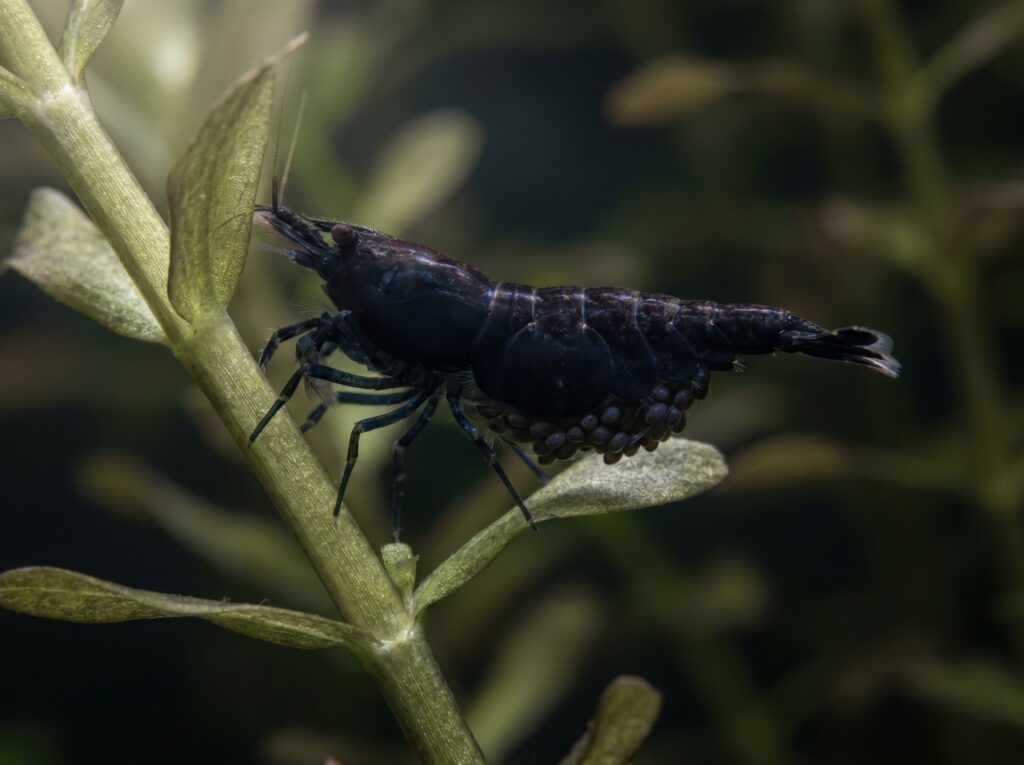
Breeding Neocaridina is straightforward. A healthy colony with stable water, adequate food, and no predators will breed on its own. The harder part with the dark lines is keeping the offspring as dark as the parents.
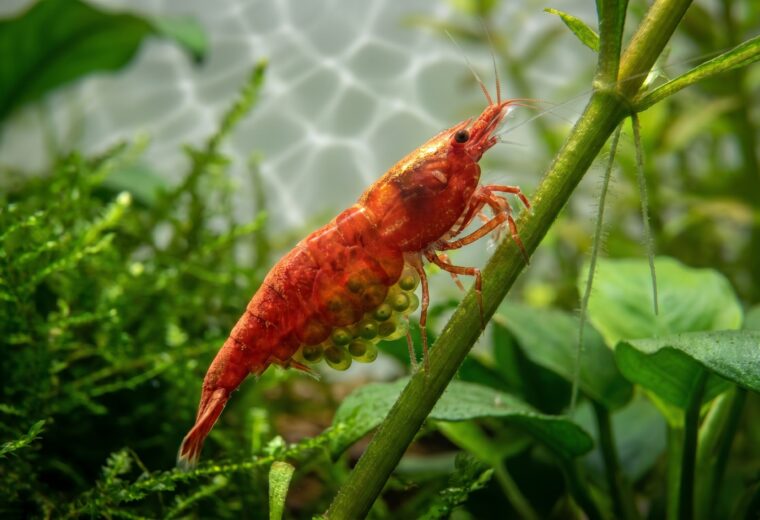
When a female molts and becomes receptive, she displays or releases pheromones - primarily as surface signals on the newly molted exoskeleton rather than broad waterborne chemicals - that trigger males to search actively and swim throughout the tank. Research on caridean shrimp indicates the male response is driven mainly by contact with these pheromones at the female's surface. This "mating frenzy" - small, fast-moving males darting around - is a reliable sign a female is receptive. Within hours to a day of mating, the female moves fertilized eggs under her tail, where she fans them constantly with her swimmeretes. A berried female carrying a healthy clutch is easy to spot: a cluster of oval eggs, dark brown for Black Rose, visible under the abdomen.
A typical clutch runs 20-30 eggs for smaller or younger females and can reach around 60 for larger, mature animals. At 22-24°C the eggs develop for 2-3 weeks. Hatchlings emerge as fully formed tiny shrimp, roughly 1mm, with no larval stage. They hide in the substrate and among plant stems for the first week or two. A heavily planted tank or one with spawning mops gives them the cover they need to survive in a community setting. If you notice shrimplets disappearing, the cause is almost always predation or a filter intake without a pre-filter sponge.
Sexing Black Rose shrimp is straightforward once you know what to look for. Females are noticeably larger than males at maturity, carry a fuller, rounder abdomen, and have a curved underside along the lower tail - that curve is where the eggs will be held. Males are smaller, slimmer, and often more active in their movement around the tank. Being able to sex your animals matters for a color-selection project: you want to identify and retain the darkest females as your primary breeders, since they carry the clutch and pass their grade most reliably. If your colony is heavy with males and you are struggling to find berried females, you likely started with a skewed ratio or lost females early - adding a new group of females from a quality source resolves this quickly.
For color consistency, select your breeding stock ruthlessly. Keep only the darkest, most opaque animals from each generation. Remove Chocolate-grade offspring to a separate tank or sell them rather than letting them breed back into your high-grade stock. Within three to five generations of consistent selection, a colony started from mid-grade animals can shift meaningfully toward higher black opacity. This process mirrors how the Black Rose line was developed from the red and brown Neocaridina population in the first place: sustained, directional selection over many generations.
Crossing Black Rose with any other Neocaridina color line will produce offspring that drift toward wild-type brown - the rate depends on which alleles the parent animals carry, but reversion typically becomes visible within a few generations. Wild-type coloration tends to reassert itself when color-specific selection pressure is removed, because the mottled brown pattern of the ancestral species carries broadly dominant alleles that emerge when deliberate culling stops. Keep your Black Rose colony completely separate from red, blue, yellow, or any other color line. The color genetics article in our Neocaridina guide explains why all Neocaridina strains must be kept in separate tanks, and our Neocaridina grading guide has grading frameworks for other color lines if you are working with multiple strains.
Full detail on breeding mechanics - saddle, berried females, egg development, and shrimplet care - is in our cherry shrimp breeding guide. The biology is identical across all Neocaridina color lines.