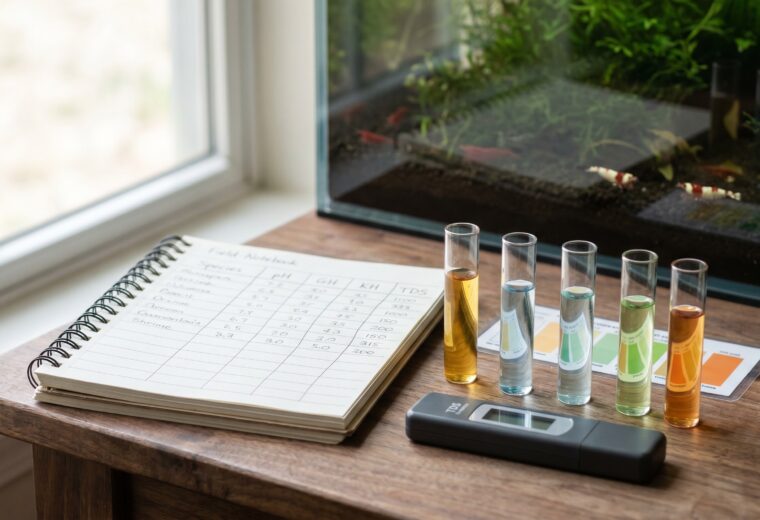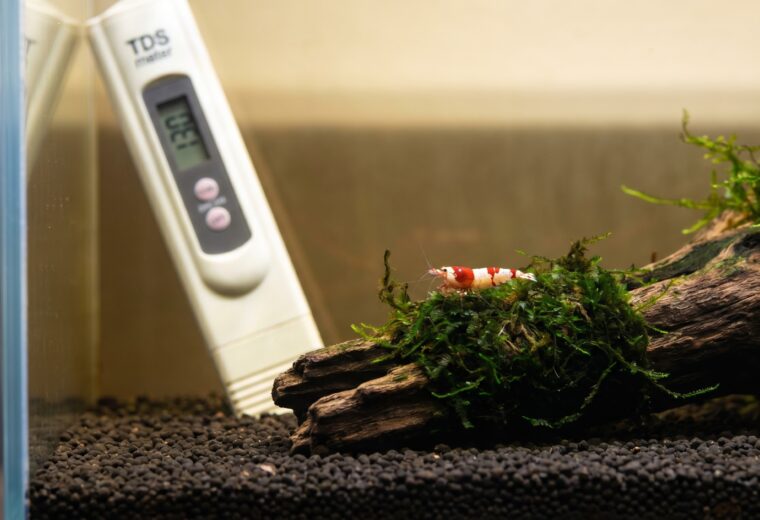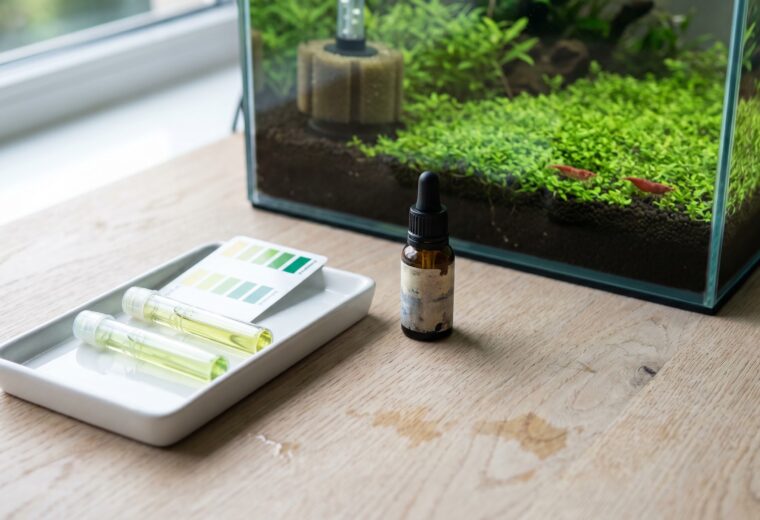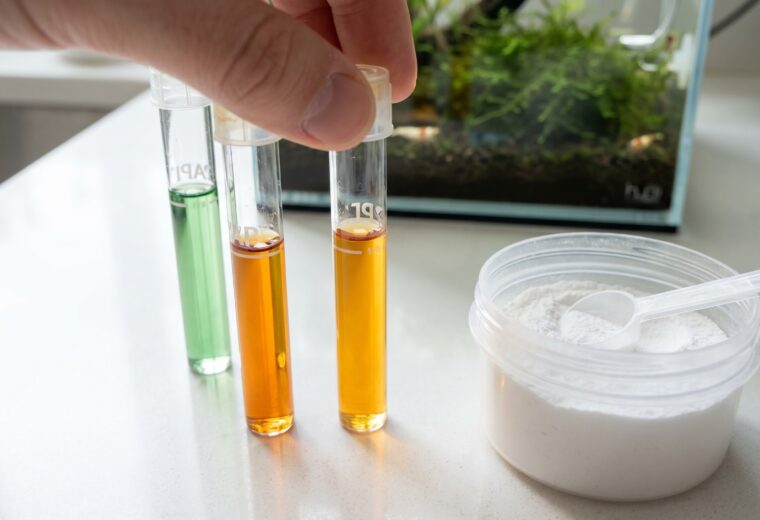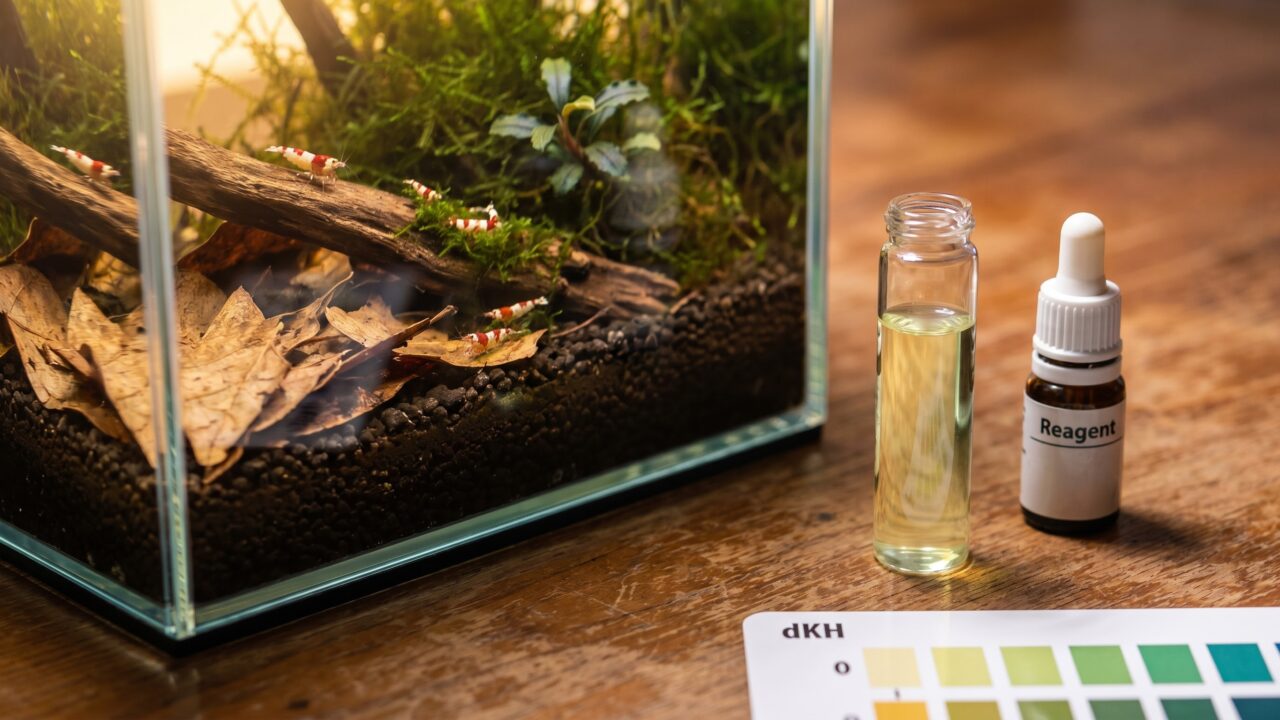
Your test kit shows KH 3 dKH. Is that good or bad? For a Neocaridina tank, it is perfectly fine. For a Caridina tank running an active buffering substrate, adding anything to push KH up to 3 will almost certainly crash your colony. Same number, opposite outcomes - and the reason comes down to how carbonate hardness and active soil actually work together. This article explains the mechanism, not just the number.
KH (carbonate hardness) measures the concentration of carbonate and bicarbonate ions dissolved in your water. It is sometimes called alkalinity. Its job is to act as a chemical buffer: when acids build up in a tank from bacterial processes and fish or shrimp waste, bicarbonate ions neutralize those acids by producing carbon dioxide, which then gasses off from the surface. The higher your KH, the more acid the water can absorb before pH moves. The lower your KH, the less resistance the water has to a pH shift.
One degree of KH (1 dKH) equals 17.848 mg/L (ppm) of calcium carbonate equivalent. Most basic test kits measure in dKH, and that is the unit used throughout this article. The full water parameters guide covers all the parameters side by side if you want the bigger picture.
What Neocaridina need from KH
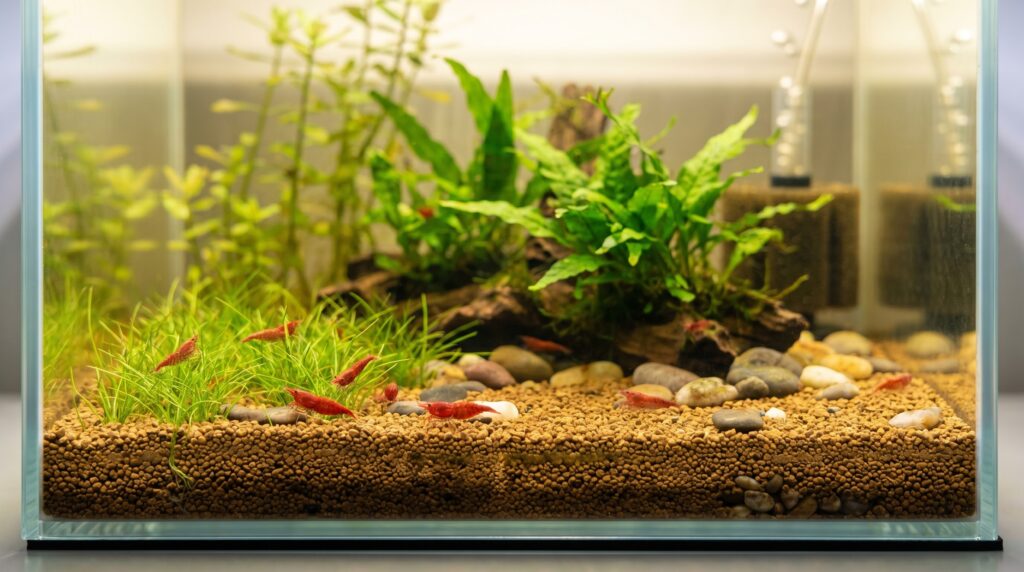
Neocaridina shrimp - cherry shrimp and all their color variants - come from Taiwan, China, Korea, and Vietnam, where they occupy a wide variety of inland waterways. Wikipedia notes that Neocaridina davidi "is also able to tolerate a wide range of environmental conditions," which is exactly what makes them forgiving in the aquarium. Their broad tolerance spans 1-10 dKH, with a commonly recommended range of 2-8 dKH and a sweet spot most breeders target of 1-4 dKH, at a pH of roughly 6.5-7.5.
Within that range, the exact figure is secondary to consistency. A tank that holds KH 1 for months causes far less stress than one that moves between 1 and 4 unpredictably. What you want to avoid is a very sudden drop to near zero without any buffering in place, because then a single bad day - an ammonia spike, a CO2 build-up, a power cut that slows surface gas exchange - can swing pH hard enough to stress or kill shrimp overnight.
KH between 1 and 4 dKH gives a Neocaridina tank a comfortable sweet spot. Breeders running soft tap water often land here naturally. If your tap water produces KH above 8, the shrimp may begin to show reduced breeding rates as pH climbs, but anything within the 2-8 range is generally well tolerated. For remineralizing RO water for Neocaridina, SaltyShrimp's Shrimp Mineral GH/KH+ raises GH and KH at a ratio of 1.0/0.5, so reaching GH 6 also delivers roughly KH 3 - an easy, predictable target.
One thing KH does not do: it does not supply the calcium and magnesium shrimp need for molting. That is the job of GH (general hardness). If you keep KH in range but neglect GH, you can still see failed molts and, in the worst cases, the white ring of death - a nearly always fatal condition where the shrimp gets trapped between its old and new shell. The GH guide covers molting mineral requirements in full.
Why Caridina want KH 0-1 - and why the mechanism matters more than the number
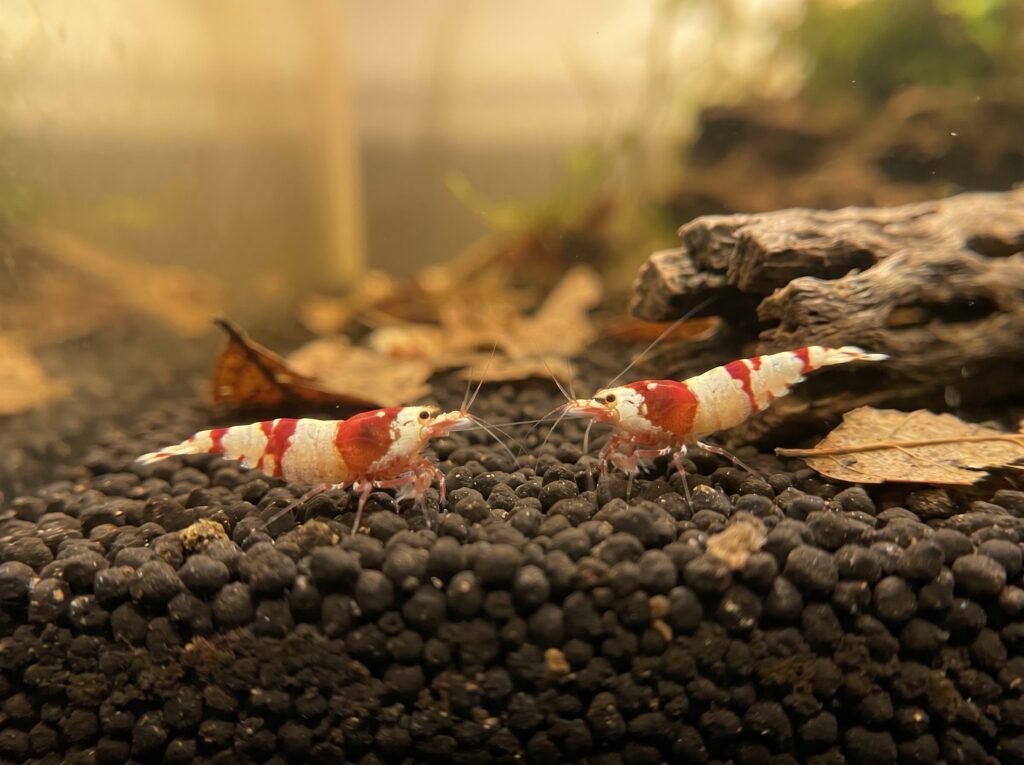
Caridina shrimp - crystal red, crystal black, Taiwan bees - are native to soft, mildly acidic mountain streams. Wikipedia states that their "health depends on being raised in soft water that matches the pH of their native streams." In practice, that means pH 5.8-6.4 and KH within a published tolerance of 0-2 dKH, with most experienced keepers targeting 0-1 dKH as the practical working range. But the reason they need KH that low is not just "they prefer soft water." The reason is that you almost certainly need an active buffering substrate to hold that pH, and KH is what that substrate consumes to do its job.
Here is the mechanism. Active substrates - ion-exchange soils designed to release hydrogen ions and lower pH, such as ADA Amazonia or SL-Aqua Purify - work by releasing those hydrogen ions into the water column. Those hydrogen ions bind to bicarbonate and carbonate - the KH - converting them to CO2 and water. The substrate effectively eats your KH and, in doing so, pulls pH down to the acidic range it produces (typically 5.8-6.5, depending on the brand and water source). Once KH is consumed and stays near zero, pH stays stable at that low level. The substrate is continuously doing this work as long as it has capacity.
Now consider what happens when you add KH to a Caridina tank. You dose sodium bicarbonate, or use a remineralizer that carries KH, and you push KH from 0 up to 2 dKH. The substrate immediately starts consuming those new carbonates to pull pH back down. If the substrate still has capacity, it wins and pH returns to the acidic range - but this tug-of-war burns through buffering life faster. If the substrate is aging and has less capacity, the added KH overwhelms it: KH rises, and pH follows, climbing from 6.0 toward 7.0 or higher. That shift can happen over hours to days. Caridina shrimp are extremely sensitive to pH swings; a rise from 6.0 to 6.8 that happens in a single day causes osmotic stress and can trigger deaths, molting failures, and a slow colony crash.
The Planted Tank community has documented that ADA Amazonia "will usually stabilize the pH for you to around 6.4-6.6 and keep the KH low (usually at 0 or 1)" - and crucially, that "if you choose to use treated tap water, the KH in your water will eventually exhaust the buffering capacity/active ability of the substrate." This is why Caridina keepers almost universally use RO or distilled water remineralized with a KH-free mineral supplement. The active substrate guide goes deeper on substrate selection, lifespan, and when to replace.
The right remineralizer for Caridina reflects this directly. SaltyShrimp Bee Shrimp Mineral GH+ is specifically engineered for bee shrimp with a KH/GH ratio of just 0.06/1.0. In plain terms, adding enough to reach GH 6 and roughly 200 µS adds almost no KH at all. That is intentional: the manufacturer specifies this ratio as "especially important for shrimp originating from softwater habitats." Contrast this with the GH/KH+ variant (ratio 1.0/0.5), which is designed for Neocaridina and neutral-pH tanks that want some KH alongside their GH. Using the wrong product in a Caridina tank will add KH you do not want.
For more on setting up the right water chemistry for each species, see Caridina water parameters.
The KH 0 paradox: when no buffer is safe and when it is not
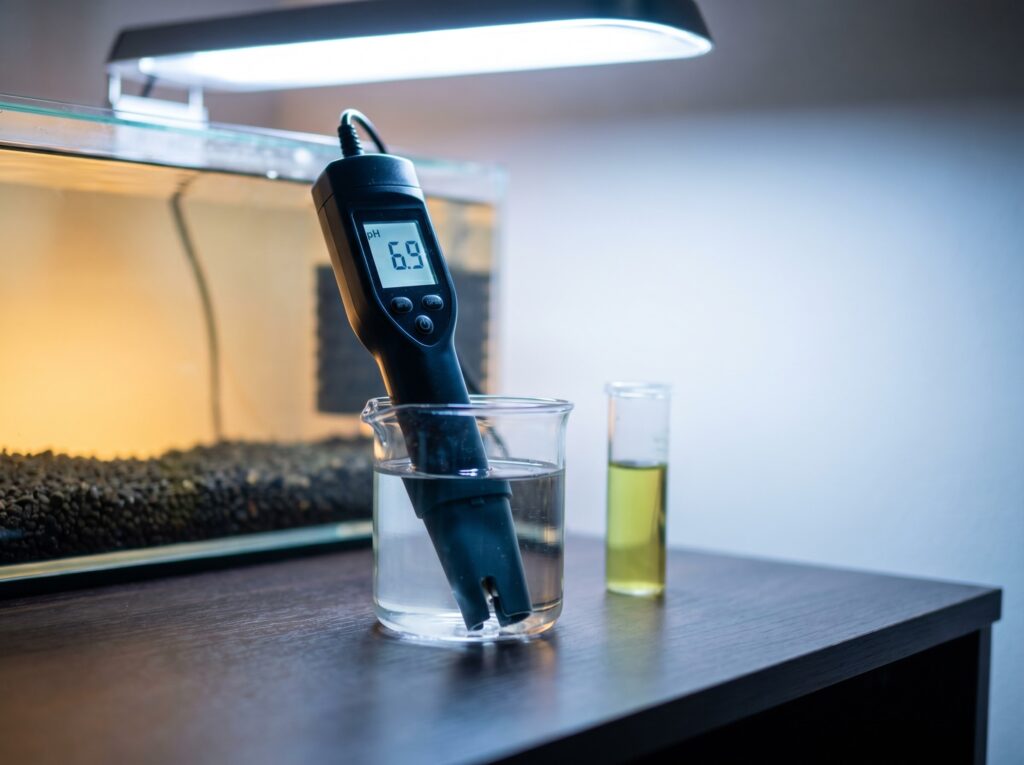
A beginner reading that "KH 0 is safe for Caridina" will sometimes assume KH 0 is fine in any tank. It is not. The safety of KH 0 depends entirely on what is keeping pH stable in its place.
In a Caridina tank with an active buffering substrate, KH 0 is safe because the substrate is acting as the stabilizer. It holds pH in the 5.8-6.4 range continuously. Acids from waste and bacterial processes get neutralized by the substrate's own buffering mechanism, not by carbonates. The substrate is playing the role that KH normally plays - and it does so more predictably in that pH range than bicarbonate would.
In any tank without an active substrate - a bare-bottom tank, a sand tank, a gravel tank - KH 0 removes all pH buffering. The FishLab aquarium chemistry resource puts it plainly: "A KH of 0 removes your tank's ability to buffer acids, leaving the pH vulnerable to sudden, severe crashes." Without the active soil and without KH, any acid input - bacterial waste, CO2 from respiration, a dying plant, even a power outage - can drive pH down by 1 or more units in a single night. That kind of crash kills Neocaridina and Caridina alike.
The table below captures the four meaningful combinations. Every Caridina keeper should know this before they touch a remineralizer bottle.
| Setup | KH level | pH stability | Safe for shrimp? | Why |
|---|---|---|---|---|
| Active substrate (Caridina tank) | 0-1 dKH | Stable, held by substrate | Yes - intended | Substrate acts as the buffer; carbonates would fight it |
| Active substrate + added KH | 2+ dKH | Unstable; tug-of-war | No - causes swings | Substrate consumes carbonates; pH oscillates as substrate ages |
| No active substrate, KH present | 2-4 dKH (Neo) or higher | Stable, held by carbonates | Yes for Neocaridina | Carbonates buffer acid load normally |
| No active substrate, KH 0 | 0 dKH | Unstable; crash risk | No - dangerous | No mechanism holds pH; any acid input causes rapid drop |
How to test KH and what to do with the result
Any carbonate hardness test kit works for shrimp tanks. Titration drop-tests (API KH test kit is widely available) are more accurate at very low values than strip tests, which struggle to differentiate between 0 and 1 dKH reliably. For Caridina tanks where you need to know whether you are at 0 or 1, a drop-test kit is worth the few extra minutes.
Test frequency depends on your setup. For a Neocaridina tank using tap water, test KH monthly; it will be relatively stable unless your municipality changes its treatment. For a Caridina tank on RO and active soil, test KH weekly for the first three months, then monthly once the tank is established. A rising KH reading in a Caridina tank is an early warning: either RO quality has slipped, the substrate is aging, or something carbonates got into the tank (crushed coral decoration, a limestone rock, a bag of mineral that contains carbonates). Find the source before KH climbs past 1 dKH and causes a pH swing.
If KH rises in a Caridina tank, do not dose acid directly to chase pH back down. That creates a different kind of instability. The correct response is to identify and remove the carbonate source, do small water changes with fresh RO water (remineralized with a KH-free product), and wait for the substrate to bring KH back to 0 or 1 on its own over the following days.
For Neocaridina tanks where KH has dropped too low - common after long periods without water changes, or when CO2 injection is used - small, gradual additions of sodium bicarbonate can raise it. One level teaspoon of baking soda (~5 g NaHCO3) raises KH by approximately 1.5-2 dKH in 100 liters of water - not 3-4 as some older guides claim. That figure comes from stoichiometry: raising 1 dKH in 100 L requires about 3.0 g NaHCO3, and a level teaspoon weighs roughly 4.6-6 g. Add it dissolved in tank water, not dry, and never more than 1 dKH per day to avoid shocking shrimp with rapid parameter change. Because even the correct dose of 1.5-2 dKH in one addition exceeds the recommended daily maximum, split any target raise across two or more days.
KH, pH, and the most common beginner mistake
The single highest-frequency mistake around KH is trying to "fix" a Caridina tank's pH by adding a buffer. A keeper sees pH 6.8 on their meter - higher than the target of 6.0-6.2 - and reaches for a buffer product. The buffer contains KH. KH fights the substrate. pH swings. Shrimp die. The fix made the problem worse.
When pH drifts up in a Caridina tank, the correct first question is: why is KH rising? Nine times out of ten, pH drifted because the active substrate is aging and its buffering capacity is reduced. The fix is not adding anything - it is replacing the substrate, or switching the tank to water with genuinely zero KH so the remaining substrate can hold the line. See the pH guide for the full picture on managing pH without introducing instability.
The second-most-common mistake is keeping Neocaridina on bare substrate with very soft tap water that happens to be near KH 0, without realizing the tank has no buffering. Everything looks fine for weeks - until something stresses the tank and pH crashes overnight. If you are on soft tap water, test KH before assuming it is adequate. Anything below 1 dKH without an active substrate is a risk for Neocaridina too.
Two other silent killers worth naming here: copper and drip acclimation. Lab research places the 96-hour LC50 for freshwater shrimp at 0.03-0.05 mg/L, an amount far below therapeutic doses used in fish medication; the mechanism is mucus accumulation on gill surfaces that progressively blocks gas exchange. Never use copper-based medications or fertilizers in a shrimp tank, and be aware that first-draw water from old copper plumbing can carry enough dissolved copper to harm shrimp. Let the tap run for 30 seconds before filling buckets. When transferring Caridina into or between active-soil setups, slow acclimation is essential: a drip line set to roughly 2-4 drops per second, run for at least an hour, lets shrimp adjust gradually to the new KH and pH rather than absorbing the difference all at once.