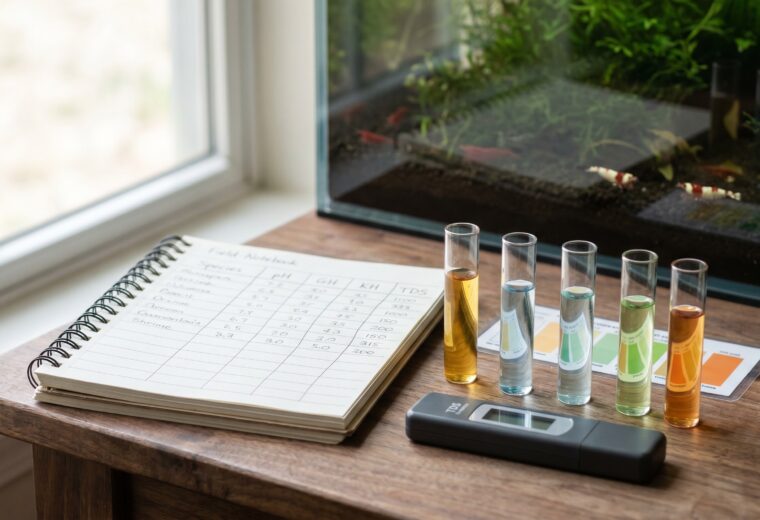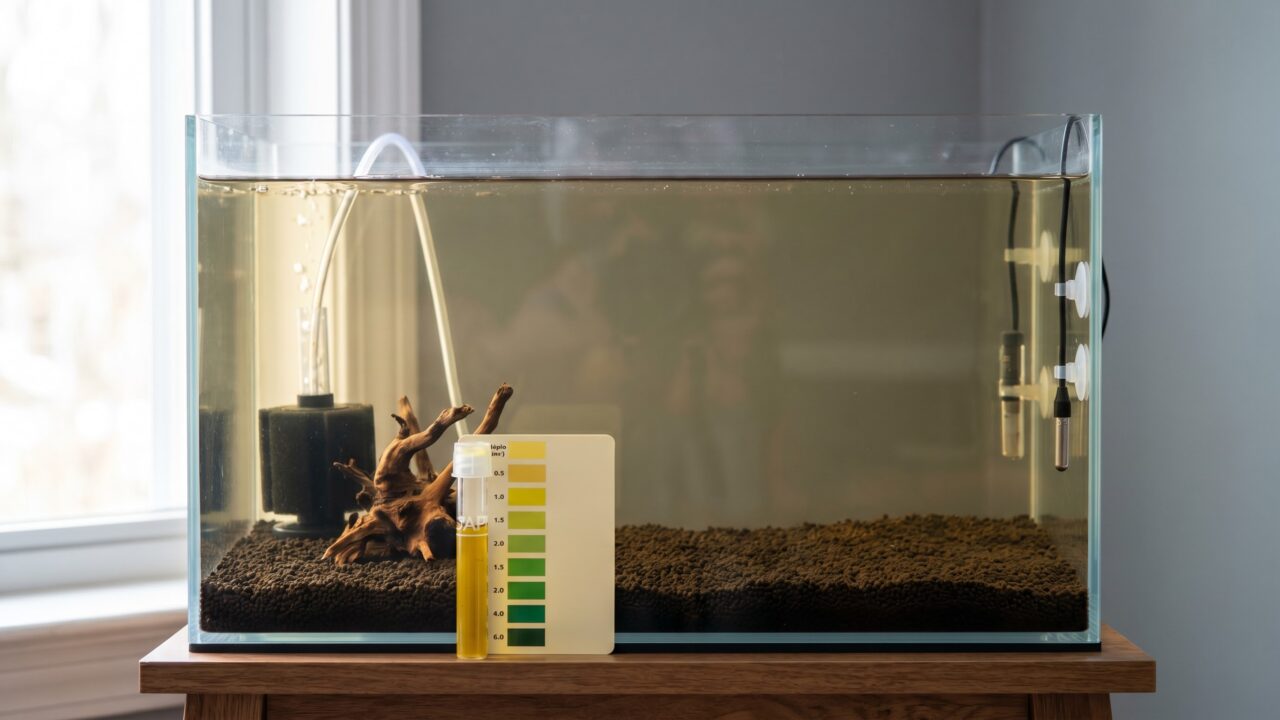
Ammonia kills shrimp fast. A tank that looks clear and smells fine can still be saturated with it, and a batch of cherry shrimp added too early will start dying within 24 hours without any obvious cause. Cycling the tank first is the one step that prevents this, and it is not complicated once you understand what is actually happening in the water.
The short version: run the tank empty for four to six weeks (longer if you are using an active substrate), confirm that ammonia and nitrite both read zero, and then give it two to four more weeks to grow the biofilm and bacterial depth that shrimp need to thrive. What follows is exactly how to do that, in order.
What the nitrogen cycle actually does
When you fill a new tank and plug in the filter, there are no bacteria in it yet. Any ammonia that enters the water - from fish waste, decaying plant matter, or an active substrate off-gassing organic compounds - has nowhere to go. It builds up.
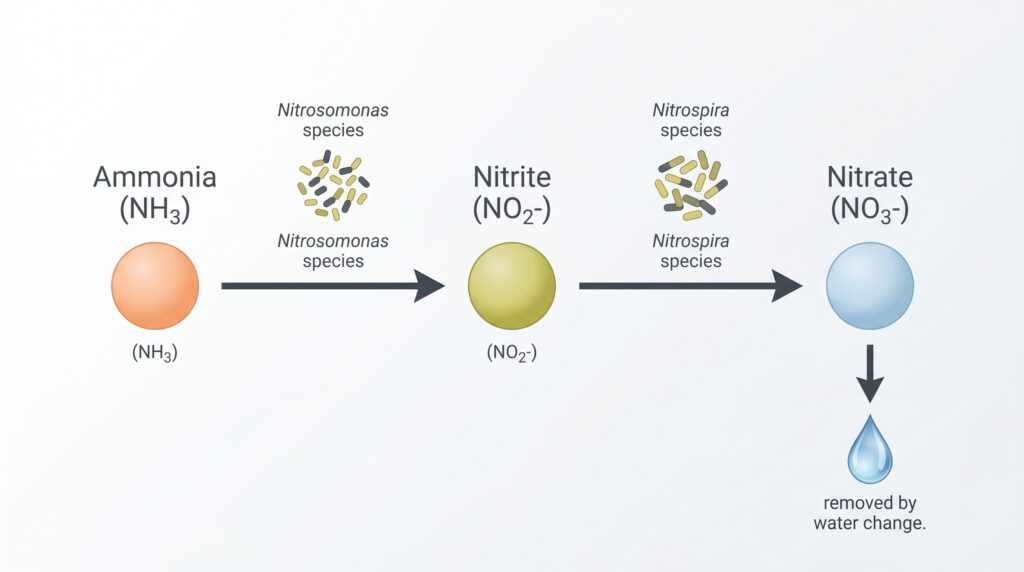
Two groups of bacteria solve this. The first, primarily Nitrosomonas and related ammonia-oxidizing bacteria, colonize the filter media and any porous surface they can find. They consume ammonia and convert it to nitrite. Nitrite is also toxic, but a second group - chiefly Nitrospira species in most freshwater systems - converts that nitrite to nitrate. Nitrospira species are widely studied as nitrite-oxidizers in low-nitrogen freshwater systems, though actual biofilter communities vary - research has found that other genera such as Nitrobacter can dominate in established aquarium filters. The two groups are interdependent: the nitrite-oxidizers keep nitrite from building up to levels that would slow the ammonia-oxidizers down.
Nitrate is the end product. At low concentrations it is harmless, and regular water changes keep it from accumulating. The whole chain - ammonia to nitrite to nitrate - is the nitrogen cycle. Your job during cycling is to give these bacteria time to multiply until they can handle the waste load you will eventually produce.
A standard fishless cycle takes roughly four to six weeks without bacterial starter products, and somewhat faster (sometimes under two weeks) when you seed the filter with a live nitrifying bacteria product from the start. The cycle is complete only when you can add an ammonia dose - typically 2-3 mg/L - and find it reduced to zero overnight with no nitrite present.
The aquasoil ammonia spike: wait it out
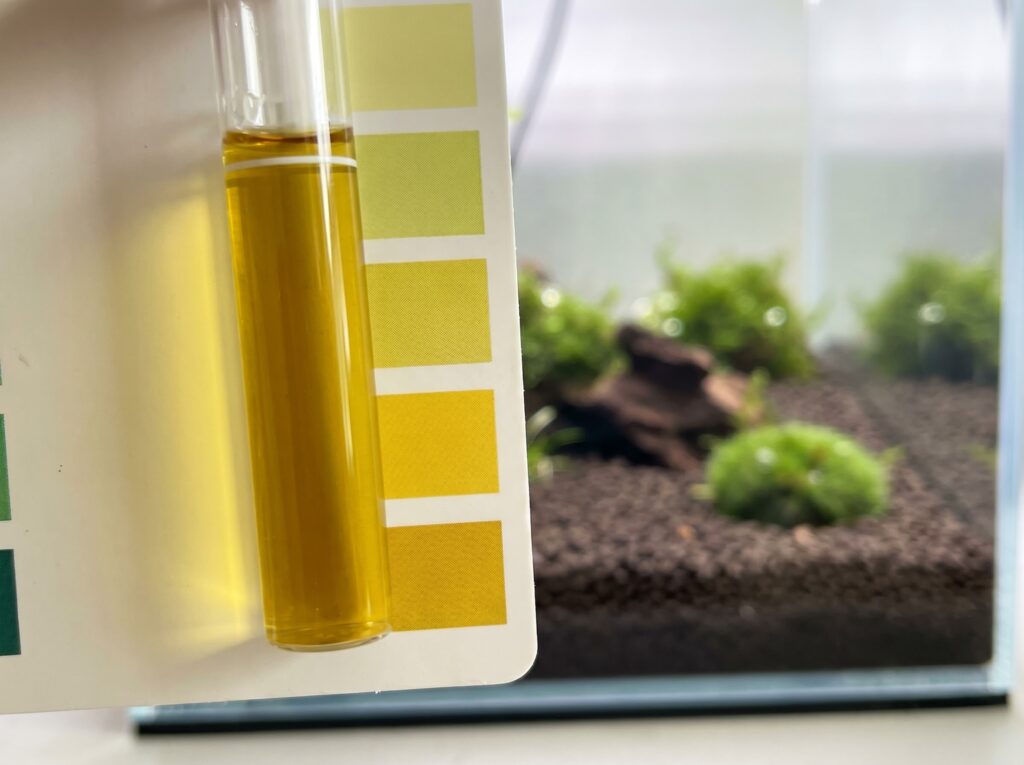
If you are setting up a Caridina tank with an active buffering substrate - ADA Amazonia, GlasGarten Environment Soil, or a similar product - you face a second ammonia source on top of the normal cycle. These soils are made from organic-rich fired clay and similar materials. When they are new, they off-gas ammonia directly into the water - ADA's own water condition data shows NH4 at 5.0 mg/L after two weeks with Amazonia Ver.2, and spikes can be higher in the earliest days depending on water volume and substrate depth. This is not a defect; it is the substrate doing what it is supposed to do.
The good news is that this ammonia feeds the cycling bacteria and actually helps establish the biofilter faster. The frustrating part is that the spike can persist for several weeks, and the substrate will continue releasing smaller amounts for a month or two after that. You cannot rush this by doing large water changes to "clear" the ammonia - aggressive changes slow the bacteria and extend the cycle. The only strategy that works is patience: run the tank with the filter on, dose Seachem Prime at 5 mL per 200 L (50 US gallons) every 24-48 hours if the ammonia exceeds 4 ppm (Prime binds ammonia into a non-toxic form that bacteria can still process), and test every two to three days.
For more on why active substrates are necessary for Caridina and how to choose between them, see our guide to active substrate for shrimp.
The practical rule: with an active substrate, plan for a minimum of eight weeks before adding any shrimp. Six is possible if the spike resolves cleanly and parameters stabilize, but eight is safer and the extra time costs you nothing.
Why a cycled tank is not the same as a mature tank
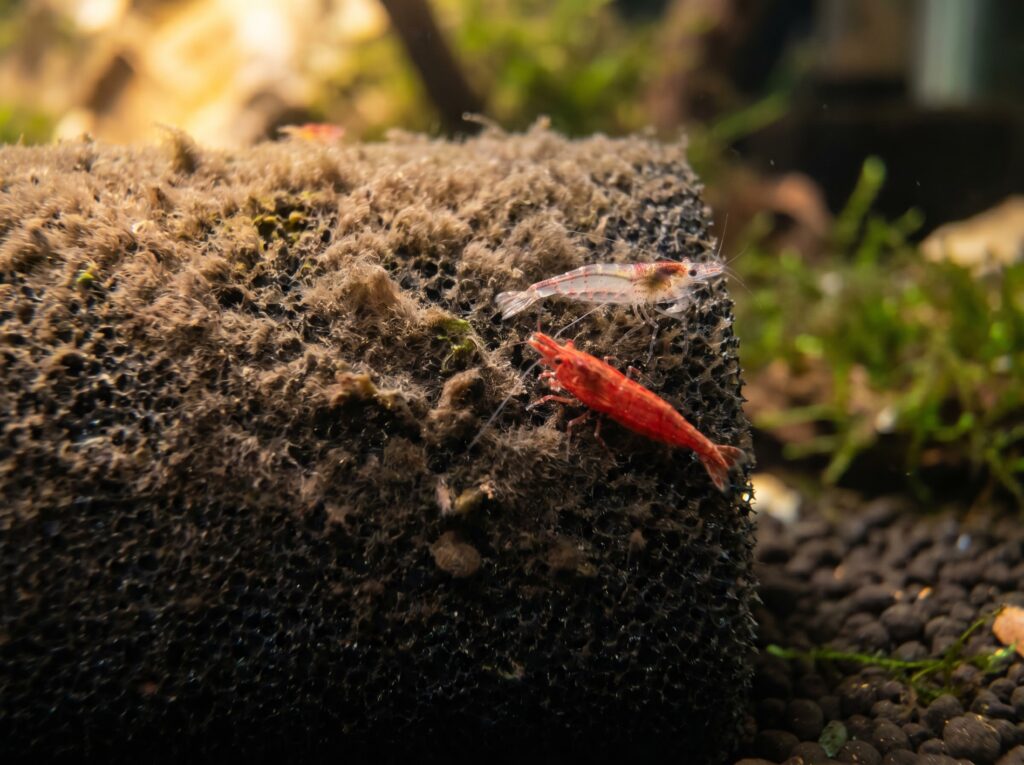
This is the part most beginners miss. A cycled tank - one where ammonia and nitrite read zero - is biologically functional but still young. The bacterial colonies are established but thin. The surfaces are mostly bare. There is no biofilm.
Biofilm is the thin, living layer that coats every submerged surface in an older tank: filter foam, plant stems, driftwood, substrate grains, the glass. It is a matrix of bacteria, fungi, algae, and protozoa, held together by a self-produced extracellular gel. For shrimp it is not decoration - it is food. Neocaridina and Caridina shrimp spend most of their waking time grazing on it, picking microorganisms off every surface they can reach. Shrimplets, the tiny juveniles under 5 mm, depend on it almost entirely for the first weeks of their lives because they cannot compete with adults for prepared food.
A tank that cycled two weeks ago has almost no biofilm. A tank that has been running for six to eight weeks has a visible brown or grey fuzz on the filter sponge and a subtle velvet-like coating on hard surfaces. That is the difference between shrimp that spend their first days stressed and searching for food, and shrimp that start grazing within minutes of entering the water.
Experienced keepers commonly recommend a minimum of two weeks post-cycle maturation before adding shrimp, and many run new tanks for two to three months before stocking them. The longer wait pays back in faster color development, earlier breeding, and higher shrimplet survival.
How to cycle a shrimp tank, step by step
The method below is fishless cycling with a bacterial starter product - the safest and most beginner-friendly approach.
- Set up the full tank. Install the filter, heater, substrate, hardscape, and any plants. Fill with dechlorinated water matched to your target parameters. For Neocaridina, remineralize RO water or treat tap to target GH 6-8 dGH and KH 1-4 - test your tap first; if KH already reads 2-4, no adjustment is needed, and if it exceeds 4, RO blending or full RO remineralization is the cleaner route. For Caridina, use RO water remineralized to GH 4-6, KH 0-1, pH 5.8-6.4. See the nano shrimp tank build guide for the hardware checklist.
- Seed with live bacteria. Add a bacterial starter product on day one. Seachem Stability dosing is 5 mL per 40 L on day one, then 5 mL per 80 L daily for seven days. Keep the filter running 24 hours a day from this point forward. Never switch it off - the bacteria die without constant oxygenated flow.
- Add an ammonia source. The bacteria need ammonia to multiply. Pure unscented household ammonia (check the label: no surfactants, no colorants) or ammonium chloride solution works well. Target 2-3 ppm. With an active substrate, the substrate itself is your ammonia source - you do not need to add more.
- Test every two to three days. Use a liquid test kit (the API Freshwater Master Test Kit measures pH, ammonia, nitrite, and nitrate). Dip tests are not accurate enough for cycling. Record your readings. You are watching for ammonia to peak, then nitrite to peak and fall.
- Manage spikes if needed. If ammonia climbs above 2 ppm and you are worried about stressing future inhabitants, dose Prime at 5 mL per 200 L. It binds ammonia in a non-toxic form for up to 48 hours while leaving it available for bacteria.
- Confirm completion. Add a 2-3 mg/L ammonia dose in the evening. Test the next morning. If both ammonia and nitrite read zero and nitrate has risen, the cycle is complete. Do this confirmation test twice on consecutive days before trusting the result.
- Wait for maturity. Run the empty tank for at least two more weeks, ideally four, before adding shrimp. Feed the bacteria daily with a small pinch of food or continued low-dose ammonia. The biofilm will grow on its own.
One thing to check at water change time: if your tap runs through copper pipes, let the cold tap run for 30 seconds before filling any buckets. First-draw water can carry significantly higher copper concentrations because the metal leaches while water sits stagnant in the pipes. Shrimp are far more sensitive to copper than fish are, and concentrations low enough to leave fish unharmed can still kill a shrimp colony; the metal also builds up with repeated water changes rather than clearing on its own. Cold water only - never use water from a hot water heater, which can have elevated dissolved metals.
Is my tank shrimp-ready? A readiness check
Before buying your first shrimp, run through every item below. All of them should pass. If any row says "not yet," wait and recheck in a week.
| Check | Pass condition | What to do if it fails |
|---|---|---|
| Ammonia (liquid test) | 0 ppm on two consecutive days after a 2 ppm ammonia dose | Continue cycling; dose Prime if above 2 ppm |
| Nitrite (liquid test) | 0 ppm | Continue cycling; bacteria not fully established yet |
| Nitrate (liquid test) | Detectable and rising (above 10 ppm is a reliable marker; planted tanks may read lower due to plant uptake) | Cycle may not be complete; recheck ammonia and nitrite |
| GH (for Neocaridina) | 6-8 dGH | Remineralize; adjust with SaltyShrimp GH/KH+ or equivalent |
| KH (for Neocaridina) | 1-4 dKH | Adjust remineralizer ratio or use a buffered mineral blend |
| GH (for Caridina) | 4-6 dGH | Adjust RO remineralization; check against active substrate |
| KH (for Caridina) | 0-1 dKH | Active substrate should buffer this down; wait longer or check substrate age |
| pH stability | Same reading morning and evening (within 0.2 units) | Large swings suggest CO2 issue or insufficient buffering; investigate before stocking |
| Tank age post-cycle | At least two weeks; four is better | Wait; use the time to grow biofilm |
| Biofilm visible | Brown or grey fuzz on filter sponge; slight velvet texture on hardscape | Wait; add a small pinch of food every two days to feed bacteria |
| Copper sources checked | No copper-based medications, fertilizers, or first-draw tap water used | Do a water change with properly flushed cold tap; switch fertilizers if needed |
| Filter running continuously | Filter has never been switched off for more than a few minutes | If filter was off for hours, re-dose bacteria product and allow extra time |
The most common reason shrimp die after a "cycled" tank
If you searched for this article because shrimp you already added are dying, the readiness check above is a good place to start. The most frequent cause is a tank that tested at zero ammonia on one reading but was not given the two-dose confirmation test. A tank that processes ammonia slowly - say, over 12-24 hours instead of overnight - is not fully cycled. Shrimp will experience ammonia stress that shows up as erratic swimming, sitting on the surface, or a slow dieoff over days.
The second most frequent cause is adding shrimp from a very different water chemistry without a drip acclimation. Even a perfectly cycled tank will kill shrimp if you pour them straight from a bag. The osmotic shock from a sudden TDS or pH shift can be fatal within hours. Give the shrimp at least 60-90 minutes to adjust: clip a length of airline tubing from the tank to the transport container, pinch the flow with a gang valve or knot until you have a slow but steady stream, and keep going until the water in the container has roughly doubled before transferring the shrimp.
For a detailed breakdown of why shrimp die in the first days after being added to a new tank, the article why shrimp keep dying after adding new ones covers parameter mismatch, bag chemistry, and acclimation failures in depth.
A note on cycling shortcuts
Media transfers are the fastest honest shortcut. A sponge or ceramic rings from an established, disease-free tank carry millions of established bacteria. Seed your new filter with this media and you can cut the cycle to one to two weeks. The limitation is that the donor tank must be healthy - you do not want to transfer pathogens or parasites alongside the bacteria.
Bacterial starter products (like Seachem Stability) genuinely help establish the biofilter more quickly, though peer-reviewed testing of specific products shows variable results. A 2022 study by Scagnelli et al. tested five commercial products - API Quick Start, Imagitarium Biological Booster, Tetra SafeStart Plus, Seachem Stability, and Fluval Cycle - and found only Tetra SafeStart Plus showed measurable acceleration over the first 14 days; the remaining four performed no better than no product at all. It is also worth understanding why: spore-based products require germination time and specific conditions before any active cells are present, whereas live-culture products (such as Tetra SafeStart Plus) contain already-active nitrifying bacteria, which is why results differ. The safest approach is to use a live-culture starter product AND a proper ammonia source AND give the tank adequate time regardless.
There is no shortcut to tank maturity. A young biofilter can be established in two weeks; a biofilm-rich mature tank cannot. The two extra weeks of waiting after the cycle completes are not optional if you want shrimplets to survive.