Given a cycled tank, both sexes, and stable water, cherry shrimp will breed without any intervention at all. That sentence covers 90 percent of the question. The other 10 percent is knowing the timeline, understanding why females sometimes stall, and keeping shrimplets alive long enough to grow up. This guide covers all of it.
Neocaridina davidi - the species behind every red cherry, fire red, painted fire red, and sakura color grade - reaches sexual maturity at roughly two months of age, according to Wikipedia's entry on the species (citing peer-reviewed literature). From there, females breed repeatedly throughout their one-to-two-year lifespan. A colony of ten or more shrimp with a decent male-to-female ratio gives you statistically overlapping breeding cycles, which is why a healthy tank seems to breed constantly once it gets going.
The four things your tank actually needs
Breeders boil it down to four conditions. Hit all four and breeding is nearly automatic.
- A fully cycled, mature tank. Zero ammonia, zero nitrite. Nitrates kept as low as practical - general shrimp-keeping guidance treats 20-40 ppm as a working upper limit, with lower always better. A tank needs weeks of cycling before it can safely support shrimp at all, and at least another month of maturity before biofilm builds up enough to feed shrimplets. New tank syndrome - trying to breed in a tank less than two to three months old - is one of the most common reasons colonies stall or crash.
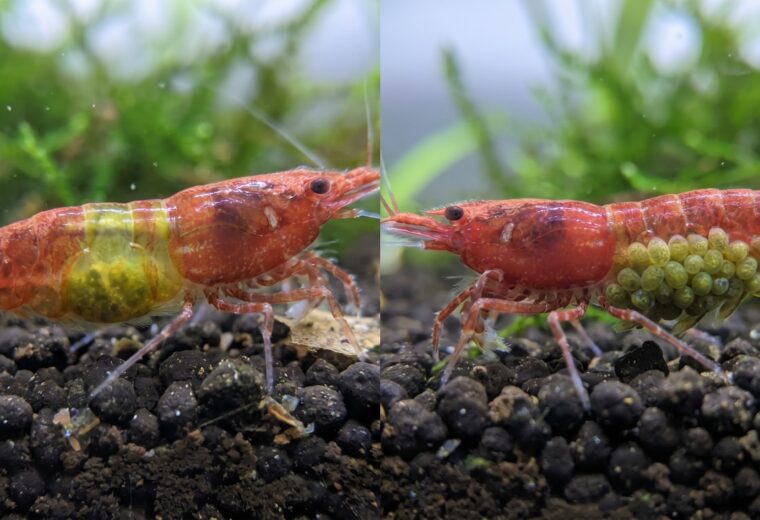
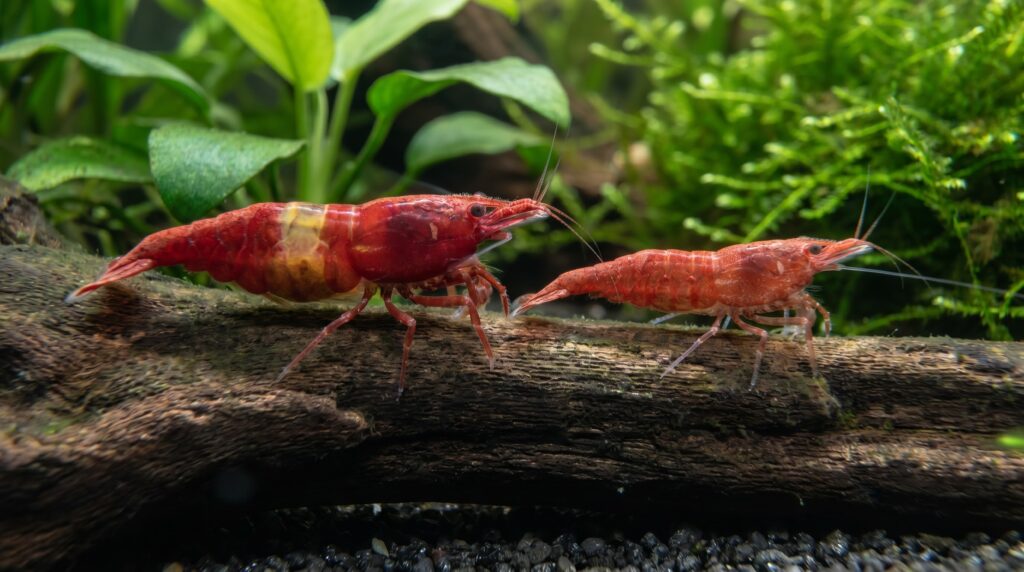
- Both sexes. Females are larger, more colorful, and carry the green-yellow "saddle" of developing eggs behind their head before breeding. Males are slimmer and noticeably smaller. For detailed sexing guidance, see our article on sexing cherry shrimp. Start with ten or more shrimp to guarantee a mix, and to spread genetic variation across the colony.
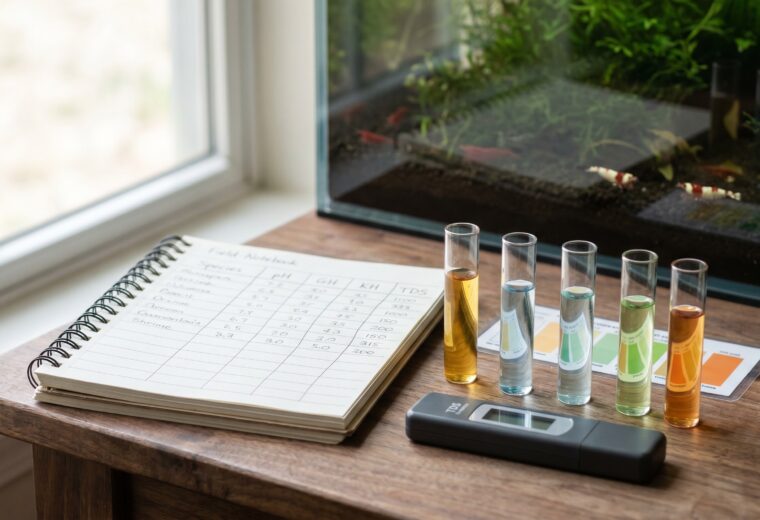
- Stable water in the Neocaridina range. Research (PMC, 2024) confirms N. davidi survives a wide band - temperatures of 21-27 °C (70-80 °F) and pH as low as 6 and as high as 7.5. That is the tolerance range, not the target. For breeding, aim for a pH of about 6.5-7.5, a temperature of 22-24 °C (72-75 °F), GH 6-8 dGH, and TDS 150-250 ppm. Keep KH in the 1-4 range and, above all, keep it steady - KH is what stops your pH from drifting, so a stable low number beats a number that bounces. The critical word throughout is stable: parameter swings matter more than chasing an exact figure. See shrimp water parameters for the full breakdown, plus KH for shrimp and pH for shrimp.
- Biofilm and supplemental food. Biofilm - the thin microbial layer that coats plants, hardscape, and substrate in a mature tank - is the primary food source for both adults and shrimplets. Supplement with a quality powder food or blanched vegetables two to three times per week. Do not overfeed; uneaten food raises nitrates.
The breeding timeline: from saddle to independent juvenile
Here is what actually happens, step by step. This timeline is the practical reference point for knowing whether your colony is on track or behind.
| Stage | Typical duration | What to watch for |
|---|---|---|
| Juvenile hatches | Day 0 | ~1 mm, transparent, immediately grazes on biofilm |
| Color starts showing | Week 2-3 | Faint coloration visible; still tiny and easy to miss |
| Sexual maturity / saddle visible | ~8 weeks (about 2 months) | Females develop the saddle marking; males visible by their slimmer build |
| Female molts, mates | Within hours to days of the molt | Males swim frantically around the tank - the "mating swarm" - searching for the pheromone trail |
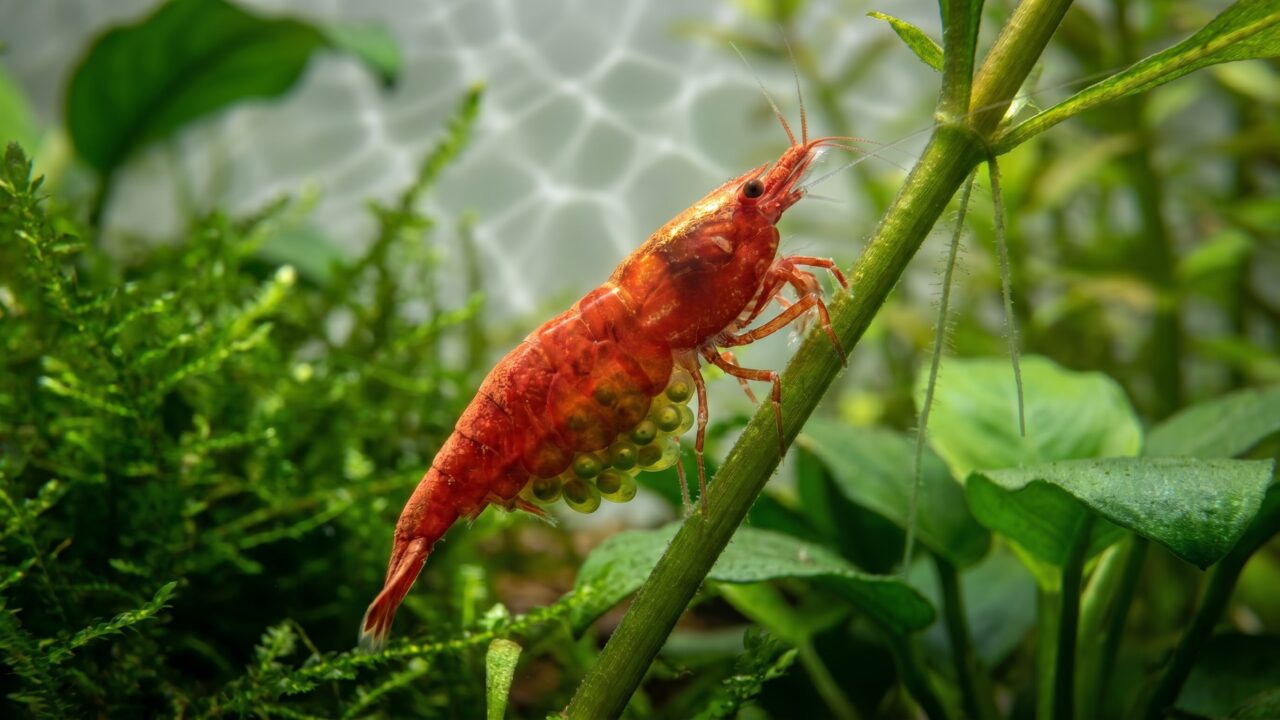
| Berried female (eggs under tail) | Within 24 hours of mating | Visible cluster of 20-30 eggs attached to swimmerettes; female fans them constantly |
| Egg incubation | ~16-21 days at 22-24 °C (about 2-3 weeks) | Eggs visible throughout; color shifts from greenish to more grey-brown as hatch approaches |
| Hatch | Day 16-21 from berrying | Shrimplets emerge fully formed, ~1 mm, miniature adults with no larval stage |
| Next brood begins | Within weeks of hatching | Healthy females cycle through broods repeatedly |
A note on temperature and incubation speed: warmer water within the safe range shortens incubation. Wikipedia and multiple government sources (UF IFAS Extension, USGS NAS) put N. davidi incubation at 16-19 days; a PLOS One study (PMC4359132) measured 20.8 days at 24 °C and 14.6 days at 28 °C. The related species N. denticulata sinensis hatched in 15 days at 27 °C in a controlled study (SciAlert, 2013). All of this confirms the 2-3 week window you should expect at the recommended 22-24 °C. Pushing temperature higher to speed things up is not recommended - published research (PubMed, 2018) found that at 33 °C, no females in the study produced eggs at all, and the effect only reversed after returning to lower temperatures. Stay in the 22-24 °C band.
For more detail on reading a berried female vs. a saddle-stage female, see our article on berried vs. saddle.
Molting: the hinge the whole cycle turns on
Everything above depends on one event that most beginners never think about: the molt. A female can only mate in the brief window right after she sheds her shell, while her new cuticle is still soft. Eggs are not fertilized inside her body - they are fertilized externally as she lays them onto her swimmerettes during that soft post-molt window, which is why every berried female you see has just molted. No molt, no mating, no eggs. If your colony stops producing broods, healthy molting is the first thing to check, not the last.
Molting runs on minerals. A shrimp pulls calcium and magnesium out of the water to build each new shell, so a successful molt requires adequate GH (general hardness) and a stable TDS. When GH or minerals run low, two things go wrong at once: the new shell underneath forms too weak, and the old shell can split in the wrong place. The classic failure is the white ring of death - a chalky white band that encircles the whole body where the tail meets the thorax, breaking the shell into two separate pieces the shrimp cannot wriggle free of. A normal molt cracks at a single hinge point so the shrimp can back out; a white-ring molt breaks the shell into two disconnected halves the shrimp cannot escape, and it is usually fatal within a day or two.
Two things keepers get wrong here. First, you cannot fix a white ring once it appears - tweezers and "assisted molts" almost never end well, and dropping a piece of cuttlebone in the tank does nothing for the shrimp already stuck. Cuttlebone mainly adds carbonate and a little calcium; it does not raise GH in a controlled way and it will not reverse a failed molt in progress. The fix is prevention: keep GH in the 6-8 range with a proper shrimp remineralizer and hold TDS steady so molts go cleanly every time. Second, this is the quiet way breeding colonies bleed out adult females. A female that dies mid-molt simply disappears from the count, and because it happens one shrimp at a time it rarely looks like a "crash" - the colony just slowly stops berrying. For the full picture, see shrimp molting explained and the white ring of death, and GH for shrimp for getting hardness right.
Run cooler if you want more females
Here is a lever almost no beginner guide mentions: water temperature skews the sex of the offspring. In a controlled study of N. davidi (Serezli et al., 2017), broods raised at the cool end of the range came out heavily female, and that ratio flipped toward males as temperature climbed:
| Rearing temperature | Roughly how many offspring came out female |
|---|---|
| 20 °C (68 °F) | About 80% female |
| 23 °C (73 °F) | About 50% female |
| 26 °C (79 °F) | About 18% female |
Why this matters for a breeder: only females carry eggs, so a colony that runs female-heavy produces more berried shrimp and more broods. If you want to grow a colony fast, hold the breeding tank toward the cool end of the band, around 20-22 °C, while shrimplets are growing out. It is the single cheapest way to bias your population toward egg-bearing females.
One honest tradeoff: warmer water shortens incubation, so a cooler tank means you wait a little longer for each batch to hatch. So "cooler" is not strictly better - it trades a bit of speed for a much more favorable sex ratio. For a fast-growing colony, the female bias usually wins; if you are chasing the quickest turnaround from a few prized females, a middle temperature near 22-23 °C is the balanced choice. Either way, stay inside the safe band and never push warm to rush things, since heat above the range shuts down egg production entirely.
Raising shrimplets: the first six weeks
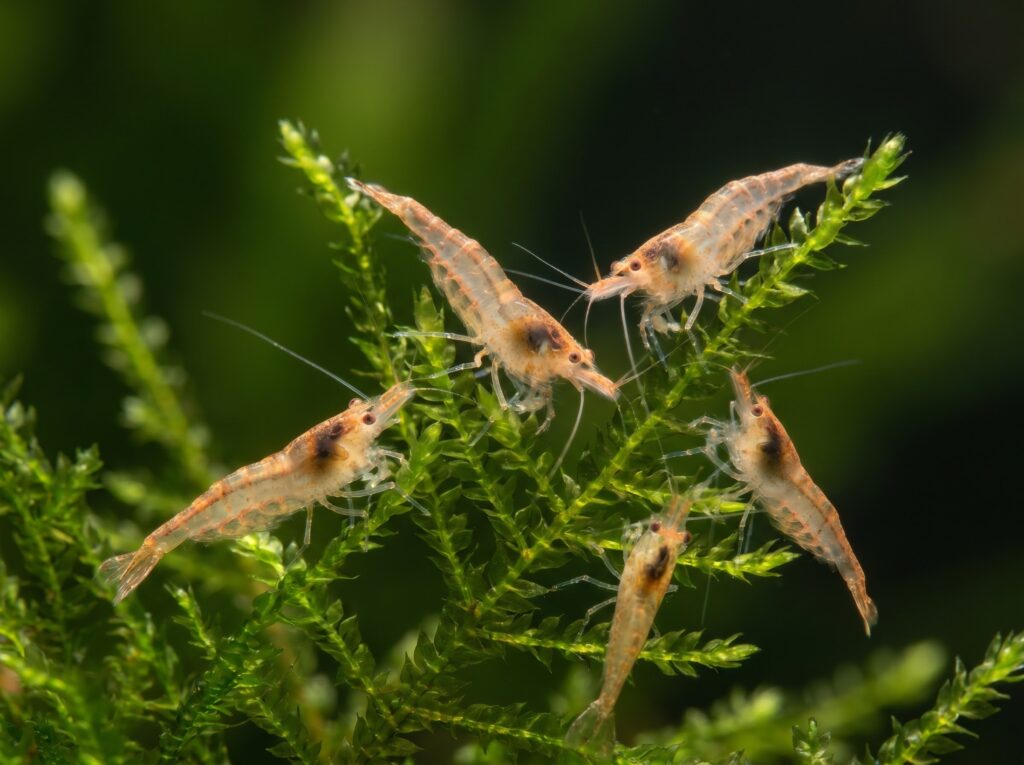
Shrimplets need no special care when the tank is genuinely mature. They hatch as fully formed, 1 mm miniature shrimp with no larval stage, and immediately begin grazing on the biofilm coating every surface. A tank with live plants, moss, leaf litter, or cholla wood has far more biofilm surface area than a bare-bottom setup, which is one reason planted tanks produce more surviving shrimplets per brood.
Two practical risks to manage early on:
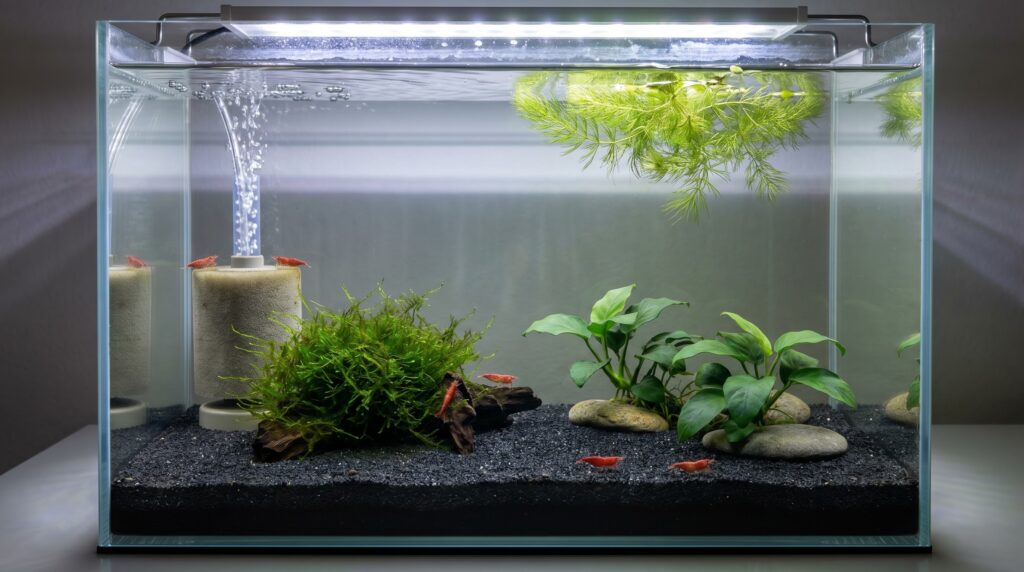
- Filter intake. Any powerhead or hang-on-back filter will draw in 1-2 mm shrimplets. A sponge filter is the standard solution: it provides gentle biological filtration, creates no suction that can pull in babies, and its surface doubles as a biofilm grazing spot. If you run a canister or HOB, cover the intake with a fine pre-filter sponge sleeve.
- Hiding spots. Shrimplets under a few weeks old are easily stressed by larger tank mates or even adult shrimp. Dense moss clumps, floating plants, and leaf litter give them physical refuge. Losses drop significantly in heavily planted tanks vs. sparse ones.
By week four to six, shrimplets are large enough to be clearly visible and are no longer in meaningful danger from filter suction. At the eight-week mark, the survivors are approaching sexual maturity themselves, and the cycle begins again. For a full walkthrough of shrimplet-specific care, see baby shrimp care.
Why breeding stalls - and how to diagnose it
If your colony has both sexes and the tank is mature, these are the most common culprits when breeding does not happen or stops partway through a brood cycle.
| Symptom | Most likely cause | Fix |
|---|---|---|
| No berried females after 6-8 weeks | Tank under 3 months old; biofilm not established | Wait; add botanicals and moss to accelerate biofilm growth |
| Mating swarms but no berried females | All visible "females" may be immature or male; confirmed females show a saddle marking and are visibly larger and more colorful than males | Use our shrimp sexing guide to verify you have mature females; if stock is uncertain, source confirmed adult females from the seller |
| Berried female drops eggs within days | Osmotic shock from a sudden TDS or parameter swing (a too-large water change, a fresh batch of differently mineralized water, or an un-acclimated move). The fast change in dissolved solids stresses her into shedding the clutch | Match temperature and TDS on every water change; keep changes small (10-15% or less) and slow. Drip-acclimate any new shrimp over 1-2 hours. See why a berried shrimp dropped her eggs |
| Eggs disappear late in incubation (week 2-3) | Dead or failed eggs (eggs that stopped developing). A healthy female fans the clutch and picks out the occasional failed egg one at a time so it cannot fungus over and spread. Full clutch loss at this stage usually signals a parameter crash or ammonia spike, not normal grooming | Check water parameters and test ammonia/nitrite immediately; add more cover so she is not stressed off the clutch |
| Colony breeds but shrimplets vanish | Filter intake; predation; starvation in new tank | Sponge filter; check for snails/fish; verify biofilm presence |
| Breeding suddenly stops in established colony | TDS creep; nitrate buildup; temperature too high or too low | Test all parameters; check for copper in fertilizers or medications |
Copper deserves a specific mention. Even tiny amounts kill shrimp outright, and the source is often invisible: some liquid plant fertilizers and nearly every anti-parasite medication contain copper compounds. If you added anything new to the tank around the time breeding stopped, check the ingredients list for copper sulfate or any copper compound. For a deeper look at why a colony that seemed fine suddenly stops breeding, see why shrimp are not breeding.
One point breeders consistently emphasize: parameters that never move are more productive than parameters that occasionally look good. Swinging from GH 5 to GH 9 across water-change days stresses shrimp and disrupts molting cycles, even when the midpoint technically lands inside the recommended range. Locking in the same water source, the same change volume, and the same schedule is what separates a colony that breeds sometimes from one that breeds all the time.
Keeping color grades from reverting
One last thing worth knowing before you start. Different Neocaridina color lines - red cherry, blue dream, yellow, bloody mary, carbon rili - are all the same species. When they cross-breed, offspring revert toward the wild brown-clear coloration over a few generations. Keep color lines in separate tanks. This is true even for grades within the same color (fire red with lower-grade cherries will produce a mixed-grade population over time). The problem often starts at the source, not in your own tank: before you buy, ask the seller whether their color lines are housed and bred separately. A reputable seller keeps them isolated from juvenile stage onward; mixed stock from a community display tank is a reversion risk from day one. For more on how this works, see our guides on Neocaridina color reversion and Neocaridina grading.
Frequently asked questions
How long does it take cherry shrimp to breed for the first time?
From adding a group of juveniles, the math runs like this: females reach sexual maturity at around eight weeks (roughly two months), but a female still has to molt, mate, and carry the eggs before you ever see a berried shrimp. That molt-and-mate step adds time, so a realistic first berried female lands around the ten-to-twelve week mark, not at the eight-week maturity point. Add another 2-3 weeks for that first brood to hatch (16-21 days at 22-24 °C, per Wikipedia and peer-reviewed data), and from day one you are looking at roughly twelve to fifteen weeks before the first shrimplets appear. A tank stocked with adult shrimp skips all of that and can produce its first berried female within two to four weeks, once the shrimp have settled in.
How many eggs do cherry shrimp carry?
Females typically carry 20-30 eggs per brood, attached to their swimmerettes under the tail. Larger, older females tend toward the higher end. The eggs are visible as a cluster and range from green-yellow early in incubation to a darker grey-brown just before hatching.
Do I need to do anything special once my shrimp is berried?
Mostly, leave her alone. Avoid large water changes, do not rearrange the tank, and minimize anything that could stress her. The thing that makes a berried female drop her clutch is osmotic shock from a sudden swing in dissolved solids, so the rule is small and slow: keep changes to 10-15% or less, and match both temperature and TDS to the tank water before you add it. The other practical task is confirming your filter intake cannot draw in 1 mm shrimplets at hatch time.
Do I need a separate breeding tank?
Not for cherry shrimp. Unlike some fish species, Neocaridina breed readily in a community shrimp tank and do not need isolation. A separate tank becomes useful if you want to raise a specific color line pure, or if you want to track individual broods for culling purposes.