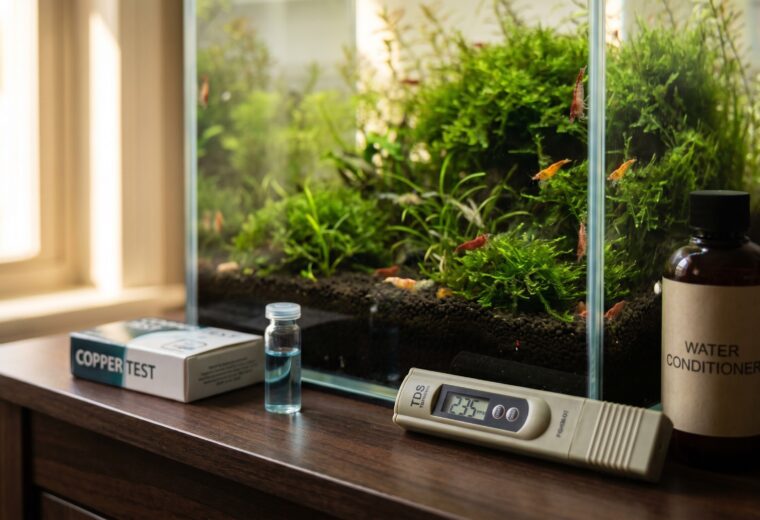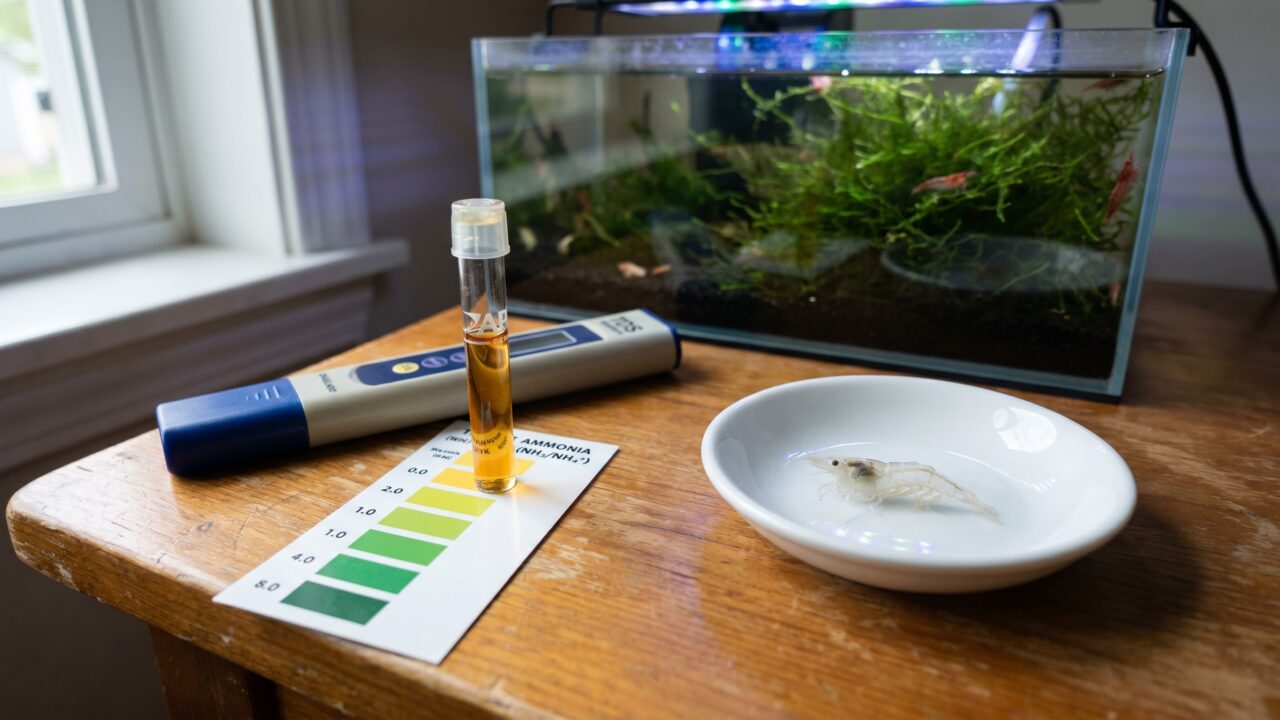
Before you move anything, test your water. Most shrimp deaths - sudden or gradual - trace back to a short list of problems, and the order you check them matters. Start with the most lethal first: ammonia and nitrite. If those read zero, move to TDS trends, then recent additions, temperature, acclimation history, and finally ask whether what you are seeing is actually a dead shrimp at all. This guide routes each scenario to its cause and fix, and the safe-ranges table below lets you check your numbers without leaving the page.
Safe ranges to check against first
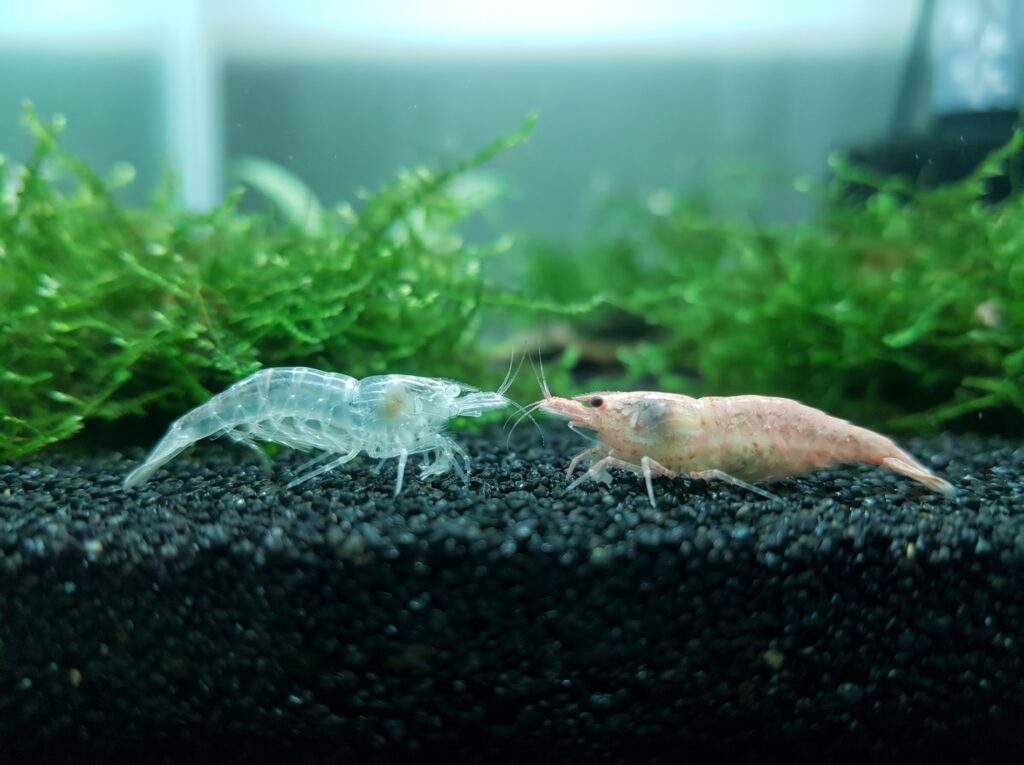
Before you diagnose anything, compare your readings to the targets your species actually wants. Neocaridina and Caridina are not interchangeable, and most "mystery" deaths are a colony kept just outside these windows. The values below are the everyday keeping ranges, not survival extremes.
| Parameter | Neocaridina (cherry and color variants) | Caridina (crystal red, taiwan bee) |
|---|---|---|
| GH | 6-8 dGH | 4-6 dGH |
| KH | 1-4 dKH | 0-1 dKH (near zero) |
| TDS | 150-250 ppm | 100-150 ppm |
| pH | 6.5-7.5 | 5.8-6.4 |
| Temperature | 18-26 C (64-79 F) | 20-24 C (68-75 F) |
If your tank sits outside these ranges, fix that before chasing anything more exotic. For the reasoning behind each number, see shrimp water parameters and the species comparison in Caridina vs Neocaridina.
If you have already confirmed parameters look fine on paper and shrimp are still dying, read our deeper look at why shrimp die even when parameters seem correct - that article covers the hidden culprits the basic test kit misses.
Step 1: Test ammonia and nitrite first, every time
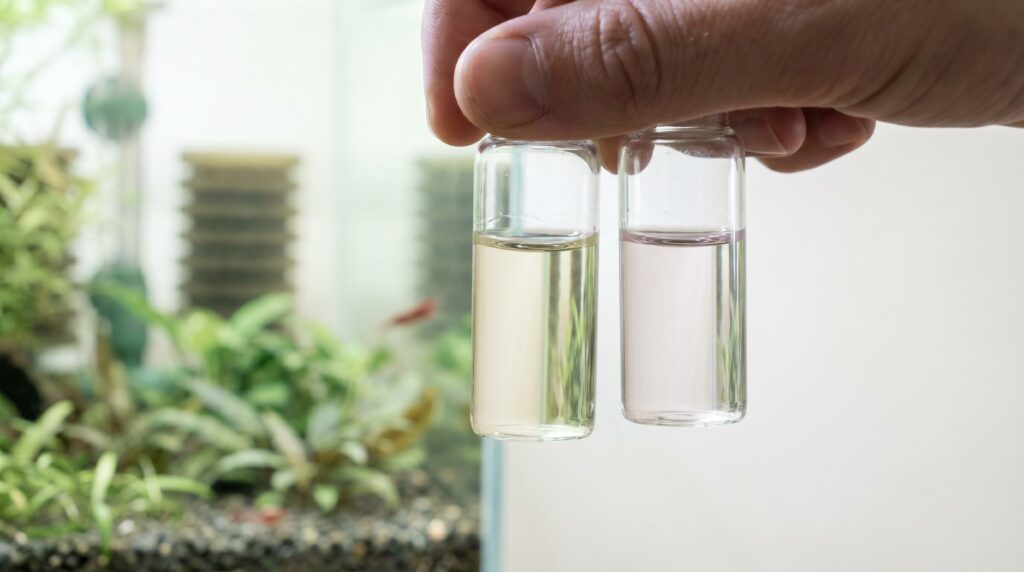
This is always the right starting point. Ammonia and nitrite are the two compounds that kill fastest, and they both appear in an uncycled tank or any tank whose biological filter has crashed.
Ammonia comes from fish waste, decaying plant matter, uneaten food, and dead animals. Nitrite is the intermediate product as beneficial bacteria convert ammonia - it is often more damaging to gill tissue than ammonia itself. Research on marine shrimp, whose gill physiology parallels freshwater species, published in the Global Seafood Alliance journal found nitrite to be "overall more damaging to gill filaments than ammonia and sulfide," causing hepatopancreatic cell death at elevated concentrations. Both compounds should read 0 ppm in a cycled, healthy tank. Anything above 0 is a problem worth acting on immediately.
A new tank that has not fully cycled is the most common source. Cycling typically takes four to eight weeks. During that window, ammonia spikes and then nitrite spikes before both settle to zero. Adding shrimp to a tank still mid-cycle is the single most common cause of complete colony loss in beginners.
What to do if either reads above 0:
- Do a 20-30% water change immediately (temperature and TDS matched to the tank).
- Stop feeding entirely for several days.
- Remove any dead animals or rotting plant matter.
- Add a proven bottled bacteria product and increase surface agitation for oxygen.
- Test daily until both hold at 0 through a full week.
Do not skip this step even if the tank has been running for months. Overfeeding, a dead animal hidden behind a decoration, or a filter media rinse with chlorinated tap water can crash a cycled tank in 24 hours.
Step 2: Check your TDS trend, not just the number
TDS (total dissolved solids) is the sum of all minerals and salts dissolved in your water. The number itself matters less than whether it has been drifting up or down, and whether any recent water change moved it sharply.
Neocaridina (cherry shrimp and color variants) are comfortable at TDS 150-250, with GH around 6-8 dGH and a little carbonate hardness for buffering. Caridina (crystal red, taiwan bee) run softer water at TDS 100-150 and GH 4-6 dGH. These are the zones the remineralizer manufacturers target. But the specific number is less dangerous than a sudden shift. Rapid TDS changes alter the osmotic pressure around shrimp faster than their physiology can compensate. Their gill membranes lose or gain water, and the result is osmotic shock - animals that appear drunk or spin erratically, then die within hours to a day.
Caridina are where this goes wrong most often, and the reason is the substrate. Unlike Neocaridina, Caridina need carbonate hardness held at or near zero and a low, stable pH of roughly 5.8 to 6.4. You cannot reliably hold that with tap-derived water on inert gravel, because any KH in the water props the pH back up. Caridina are kept over an active substrate (a buffering aquasoil such as ADA Amazonia, SL-Aqua, or Tropica) that actively pulls KH out of the water column down to zero and locks the pH into the acidic range the shrimp require. Keeping crystal reds on inert gravel with tap-derived KH is the single most common real-world cause of crystal red death: the KH never drops, the pH never settles, and the colony fails slowly. If you want Caridina, build the tank around an active substrate from the start and remineralize RO water with a GH-only (not GH/KH) salt. See Caridina water parameters for the full build, and active substrate for shrimp for how the buffering works.
Two scenarios cause TDS-related death most often:
- Water change with the wrong TDS: Topping off evaporation with fresh remineralized water (instead of plain RO or dechlorinated tap) slowly raises TDS over weeks. Then a large water change suddenly drops it - or vice versa. The fix is to top off evaporation with plain RO or dechlorinated water (minerals do not evaporate, so they stay behind and concentrate), and to match the TDS of your replacement water to the tank before every change. Confirm the diagnosis in why shrimp die after a water change.
- Starting a new tank with wrong parameters for the species: Caridina placed in Neocaridina water (hard, buffered, pH above 7) will slowly fail; the reverse is harder to kill but still stressful.
To track TDS properly, measure before and after every water change. If the difference is more than 20-30 points at once, slow the change rate or split it into two smaller changes a day apart. For more on managing TDS safely, see our guide on TDS for shrimp tanks.
Step 3: Audit every recent addition for copper
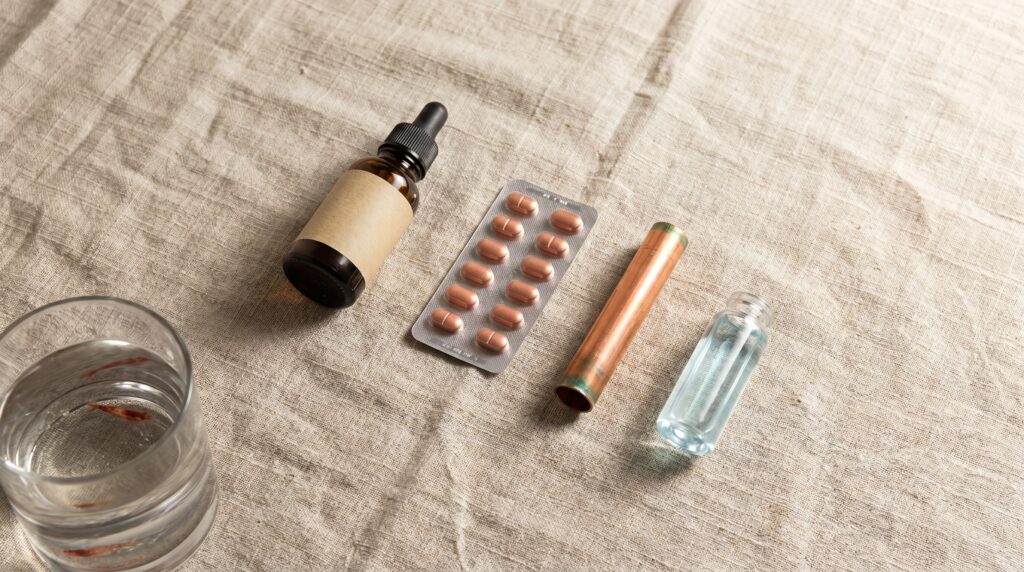
Copper is acutely lethal to shrimp. A peer-reviewed study on freshwater swamp shrimp (Macrobrachium nipponense) recorded a 96-hour LC50 of just 0.0313 mg/L - a concentration barely above trace level that kills half the population. The study found that "acute lethal effects of copper were attributed to excess mucous covering the gill tissues, leading to the breakdown of respiratory function." The proposed biologically safe concentration for shrimp is 0.003 mg/L, roughly ten times lower than that already tiny LC50.
This is why Seachem explicitly rates their copper-based medication Cupramine as unsuitable for tanks containing shrimp, describing it as "notably stressful to plants and invertebrates (corals, mushrooms, shrimp, crabs, etc.)." The same logic applies to any copper-bearing product.
Common sources of copper that beginners miss:
- Tap water from copper plumbing: Stagnant water sitting overnight in copper pipes carries elevated dissolved copper. Research published by the National Academies of Sciences confirms that "the length of time that the water has been sitting stagnant in the pipes can also greatly increase the concentration of copper to several milligrams per liter" - a level far above the shrimp-lethal threshold of 0.0313 mg/L. Run the cold tap for 30-60 seconds before filling a bucket, and never use hot water, as heat accelerates leaching.
- Fish medications: Any medication containing copper (look for cupric sulfate, copper sulfate, copper citrate on the label) is deadly. Tanks that were medicated months ago can still carry residual copper in substrate and silicone.
- Aquatic plant fertilizers: Some all-in-one fertilizers contain chelated copper as a micronutrient. Read the label. Overdosing even a shrimp-safe fertilizer concentrates copper to toxic levels.
- New plants from retail tanks: Plants sold in fish stores are sometimes treated with copper solutions to kill hitchhiker snails. Rinse and quarantine new plants before adding them to a shrimp tank.
- Ornaments and decorations: Painted resin decorations and some natural rocks contain copper-bearing minerals. Test new additions with a copper test kit if in doubt.
There is no safe way to medicate a shrimp tank with copper. Move fish to a separate hospital tank for treatment, and never add copper-treated animals back until the copper has fully cleared. For the complete guide, see copper and shrimp.
Step 4: Read your thermometer
Temperature is the cause people check last and should often check earlier, because heat kills through three mechanisms at once. First, warm water physically holds less oxygen. As the U.S. Geological Survey puts it, "cold water can hold more dissolved oxygen than warm water" - the relationship is inverse, so a tank that drifts from 24 C to 29 C in a summer heatwave loses a meaningful share of its dissolved oxygen at exactly the moment the shrimp need more of it. Second, heat raises a shrimp's metabolism, which speeds the molt cycle and forces more frequent molts under the very conditions that make molting risky. Third, the combined load of low oxygen and high metabolic demand falls hardest on the animals working hardest.
That last point is why berried (egg-carrying) females are usually the first to die in a warm tank. Fanning and oxygenating a clutch of eggs is metabolically expensive, so a berried female sits at the top of the oxygen demand curve. If you see losses concentrated among berried females while males look fine, suspect temperature and oxygen before anything exotic.
Keep Neocaridina at 18-26 C (64-79 F) and Caridina at 20-24 C (68-75 F), as in the safe-ranges table above. If your tank is running hot:
- Increase surface agitation immediately (raise the spray bar, add an air stone) to drive gas exchange and push oxygen back in.
- Float a sealed bag of ice or aim a small fan across the water surface to drop a few degrees through evaporative cooling. Lower the temperature gradually, not in one shock.
- Lift the lights off the tank and shorten the photoperiod during a heatwave; lighting and ambient room heat are the usual culprits.
Step 5: Review acclimation history for new arrivals
Shrimp dying within 12-48 hours of arrival almost always traces to acclimation failure. Shrimp arrive in bags with water that may differ by 1.0+ pH units, 50+ TDS points, and several degrees in temperature from your tank. Pouring them straight in causes an immediate osmotic insult.
The most widely used approach is gradual water mixing: float the sealed bag for 15 minutes to equalize temperature, then open the bag and slowly introduce tank water into the bag container at a rate of 1-2 drops per second via a siphon. At around 60-90 minutes, the water volume in the container has roughly doubled - this is a halfway marker, not a completion point. Many keepers run this process for 1-2 hours for Neocaridina (cherry shrimp and color variants) and at least 2 hours for Caridina (crystal red, taiwan bee), which are more sensitive to parameter shifts. Netting the shrimp in before meaningful volume exchange has occurred risks osmotic stress even when your tank parameters are otherwise correct.
Even correctly acclimated shrimp sometimes die in the first week if they were already stressed from shipping. This is different from a parameter problem - it shows up as 1-3 losses over several days without further deaths, not as a colony collapse. See the full protocol at how to drip acclimate shrimp.
If you are adding new shrimp to an established colony and deaths begin among the existing animals, the cause is more likely introduction of disease or parasites than acclimation. Read why shrimp die after adding new ones for that scenario.
The diagnostic flowchart: crash vs. slow attrition
Once you have worked through steps 1-5, use the pattern of deaths to confirm which branch you are in and where to go deeper. The table below maps what you are seeing to the most likely cause and the next action.
| What you are seeing | Most likely cause | First action | Where to go next |
|---|---|---|---|
| Multiple shrimp dead within hours, overnight | Ammonia/nitrite spike; copper poisoning; osmotic shock from large water change | Test ammonia and nitrite immediately; check for any copper source added in the past 48 h | Water change deaths / Copper |
| 1-2 deaths over first 24-48 h after new shrimp added | Shipping stress; acclimation shock | Confirm parameters are correct; watch for more losses over the next week | Drip acclimation |
| Deaths begin among existing colony after adding new shrimp | Introduced pathogen or parasite | Check all shrimp for visible signs of disease; isolate new additions if possible | Adding new shrimp / Disease ID |
| 1-3 losses per week, colony slowly shrinking | Chronic parameter mismatch (TDS creep, wrong GH, pH instability); persistent low-level infection; dietary deficiency | Log TDS, GH, and pH daily for a week; check feeding schedule and food variety | Parameters fine but dying |
| Shrimp found dead with a white band across the carapace | Failed molt (white ring of death) - GH too low or too high, or a sudden parameter shift | Test GH; target 6-8 dGH for Neocaridina, 4-6 for Caridina, and stop large water changes | White ring of death / Molt vs. dead |
| Empty shell found, no dead shrimp visible | Likely a normal molt (exuvia), not a death | Look for the living shrimp hiding; check the shell for organs and color | Molt vs. dead shrimp |
| Berried females dying most often; healthy males surviving | Oxygen deficiency (night oxygen crash); high temperatures | Increase surface agitation; check temperature and lighting schedule | Parameters fine but dying |
| Shrimp erratic, spinning, then dying | Acute poisoning (copper, ammonia spike, pesticide); severe osmotic shock | Large partial water change immediately; remove any suspect additions | Erratic swimming / Copper |
Step 6: Check whether you are looking at a dead shrimp or a molt
New keepers frequently mistake a shed exoskeleton (the exuvia) for a dead shrimp. Each adult molts roughly every three to four weeks, so a colony of 20 adults sheds on the order of five to seven exoskeletons a week - finding several empty shells in a single week is normal, not a die-off. Panicking over a molt while a real problem goes unchecked is a common and costly mistake.
The difference is straightforward once you know what to look for:
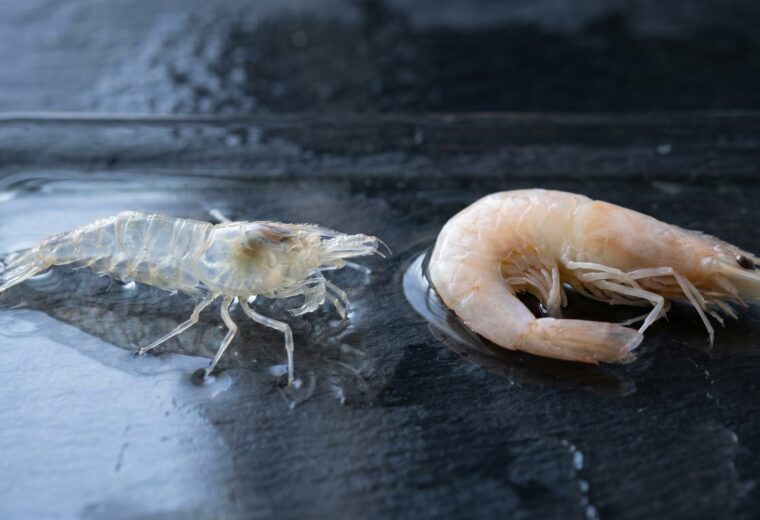
- Exuvia (molt): Translucent or near-transparent, hollow with no organs visible inside, split along the back where the shrimp crawled out, usually intact but soft-looking. Coloration is very faint even on species with strong pigment.
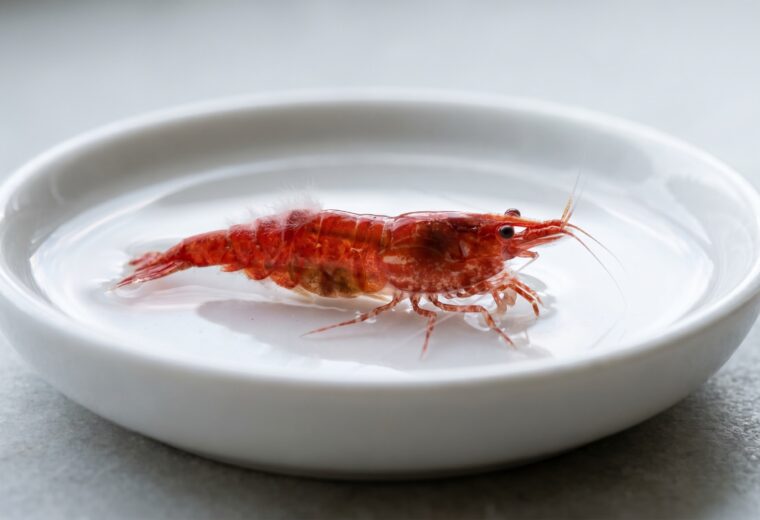
- Dead shrimp: Retains internal organs and body mass, turns pale pink to opaque within a day or two (similar to a cooked shrimp from the grocery store), loses its characteristic color. A red cherry shrimp turns dull and washed out; a blue dream turns milky.
After molting, the animal hides for 42-72 hours while its new shell hardens. If you find a transparent shell and cannot locate the shrimp anywhere, it is almost certainly hiding - not dead. See our full comparison at molt vs. dead shrimp.
If the molt itself shows abnormalities - a white ring across the carapace, or sections of shell that did not separate cleanly - that is a sign of a failed molt. The white ring of death is a clean break around the body where the old shell and the new one fail to part, trapping the shrimp mid-molt so it cannot pull free and dies. GH is the lever, and it cuts both ways. Too little calcium and magnesium (GH too low) leaves the new shell too weak, so it cracks instead of splitting cleanly. Too much (GH too high) makes the shell so rigid that the shrimp has to strain to shed it, and that exertion can exhaust and kill it; the aquarium scientist Dave Shaber notes that with excess calcium and magnesium "the shell will be too strong and require very heavy exertions for the shrimp to get it off." A sudden parameter swing during the vulnerable window after a molt is the third trigger. There is no intervention once the white ring has formed; the shrimp is already lost. Prevention is the whole game: hold GH inside the range in the table above (6-8 dGH for Neocaridina, 4-6 for Caridina), avoid large or fast water changes, and feed a varied diet that includes a calcium source. For the mechanism in detail, see the white ring of death and shrimp molting explained.
When to suspect disease
Once you have ruled out water quality, copper, acclimation, and molt confusion, a persistent die-off with no clear parameter cause often involves a pathogen. Before routing to a specialist guide, run through these home-checkable signs:
- Milky or opaque muscle visible through the shell: In a healthy shrimp the body tissue behind the head appears translucent or lightly colored. A cloudy white or opaque abdomen is a strong indicator of muscular necrosis or bacterial infection - not a parameter problem.
- Shrimp not grazing for 24 or more hours: Active shrimp constantly pick at surfaces. An animal that sits motionless in one spot for a full day without feeding, especially if it stays near the surface or on a heater, is showing behavioral distress that points toward infection or severe systemic stress.
- White fuzzy patches on limbs or carapace: Visible tufts or cottony growths on the body are characteristic of vorticella (a ciliate parasite) or bacterial biofilm infection. These are distinct from the pale cast of a newly molted animal, which is uniform and fades within hours.
A slow but steady loss of 1-2 shrimp per week with no parameter explanation and one or more of these signs warrants a disease check. The shrimp disease identification guide covers the most common infections and parasites with photos and treatments.