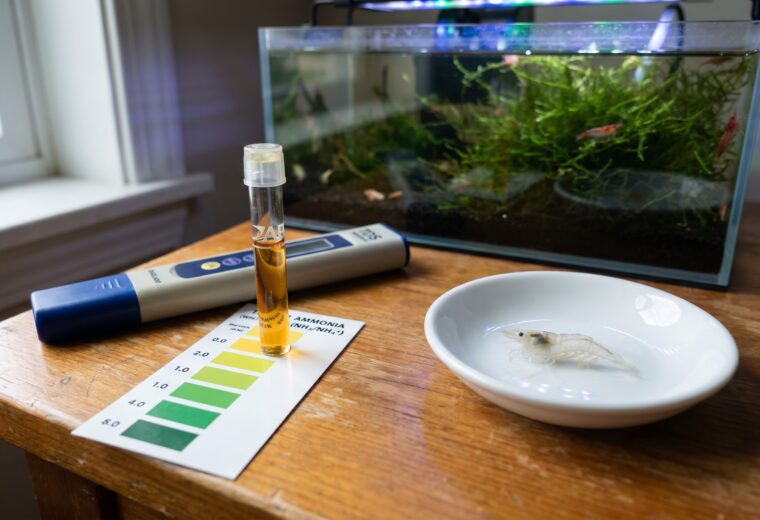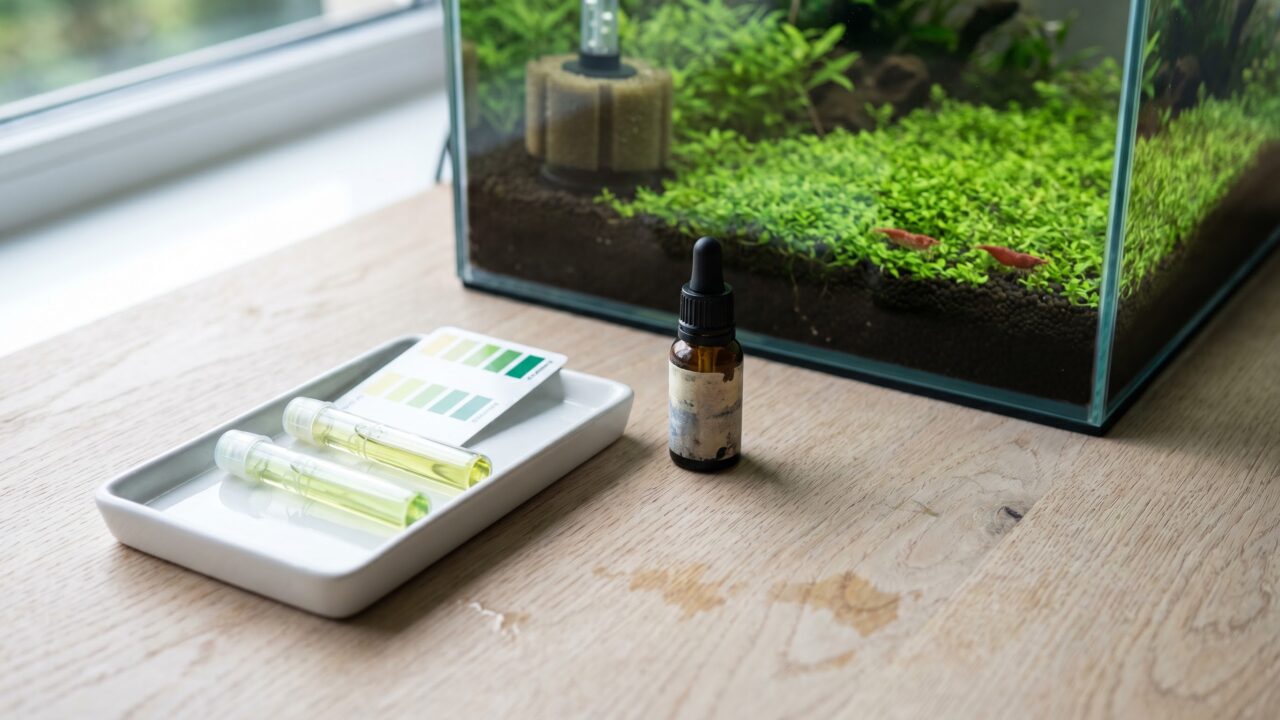
Your tap water reads pH 7.6. Your cherry shrimp are fine. Your neighbor runs pH 7.1 and his colony crashed. The number on the test kit tells only part of the story. How stable that number stays tells the rest. For most shrimp keepers, chasing a perfect pH while ignoring what drives it is where the trouble begins.
Here is the quick version: Neocaridina (cherry shrimp and all color variants) thrive between pH 6.5 and 7.5. Caridina (crystal red, crystal black, bee shrimp, Taiwan bee) need 5.8-6.4 and an active buffering substrate to hold it there. Within those bands, a pH that stays put beats a "correct" number that swings by half a unit each day. The single most important thing you can understand about aquarium pH is what controls it. That is KH, the carbonate hardness of your water.
What pH actually measures, and why KH controls it
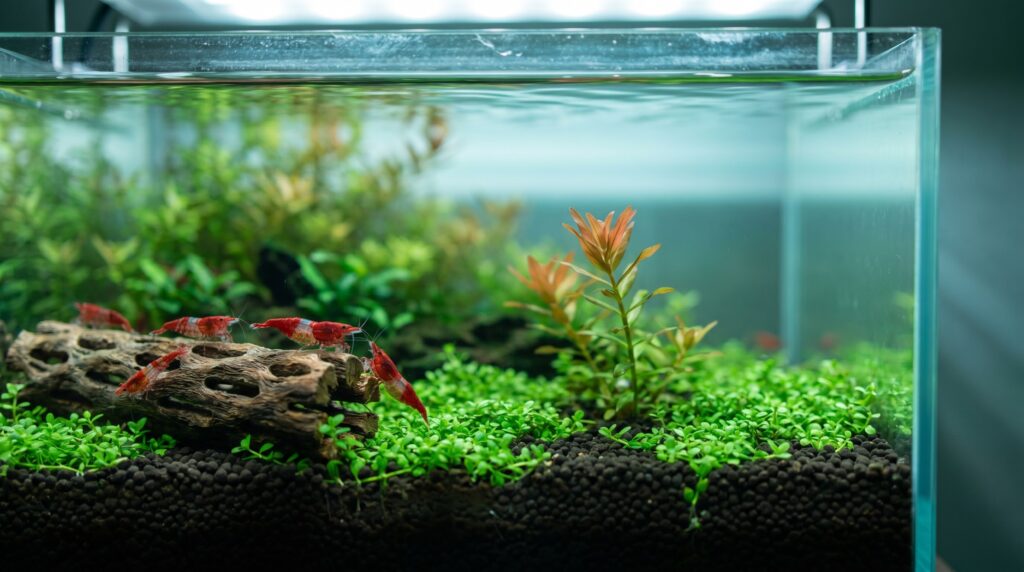
pH is the concentration of free hydrogen ions (H+) in your water. Lower pH means more H+ ions, which means more acidic water. The scale runs from 0 to 14, with 7.0 being neutral. Every full point on the scale represents a tenfold difference, so pH 6.0 is ten times more acidic than pH 7.0.
KH (carbonate hardness) is the buffer that fights pH change. It works by absorbing incoming acids (hydrogen ions) and bases before they can shift the pH reading. The higher your KH, the more acidic input the water can absorb before the pH moves. When KH is very low or zero, even a small addition of acid sends pH into a rapid fall. This is why FishLab's chemistry guide describes KH as a "pH anchor": it resists changes in both directions, making the pH reading predictably stubborn.
The main source of acid in most aquariums is CO2. When CO2 dissolves in water, it reacts with H2O to form carbonic acid (H2CO3). Those hydrogen ions are what drives the pH down. Plants remove CO2 through photosynthesis during the day, pulling pH upward. At night, photosynthesis stops and respiration puts CO2 back into the water, pulling pH down again. This produces a gentle daily rhythm: pH climbs a little during lit hours and dips a little overnight. In a moderately planted tank with reasonable KH, this swing is typically under 0.3-0.5 pH units, well within what shrimp tolerate.
What does not cause the swing is low KH. Research from Aquarium Science's chemistry section demonstrates that the size of a pH swing from a given CO2 change stays nearly the same whether KH is 15 dKH or 1.5 dKH, provided KH stays above roughly 1 dKH. The difference is where the baseline pH sits, not how far it travels. A tank with KH 6 will have a higher baseline pH than a tank with KH 1, but both will swing by similar amounts when CO2 shifts. This is an important distinction: if your pH swings a full unit or more, the cause is almost always a large CO2 swing (heavy plant load, CO2 injection turning on and off), not low KH itself.
One important caveat: phosphates, humic acids, nitric acids from biological filtration, and organic matter all add additional acids to the water, so the CO2/KH/pH relationship is never perfectly clean in a live aquarium. A heavily stocked or heavily fed tank will acidify faster than the chemistry formula alone predicts. For a deeper look at KH and how to manage it, see our guide to KH for shrimp tanks.
pH ranges by species: what the numbers mean in practice
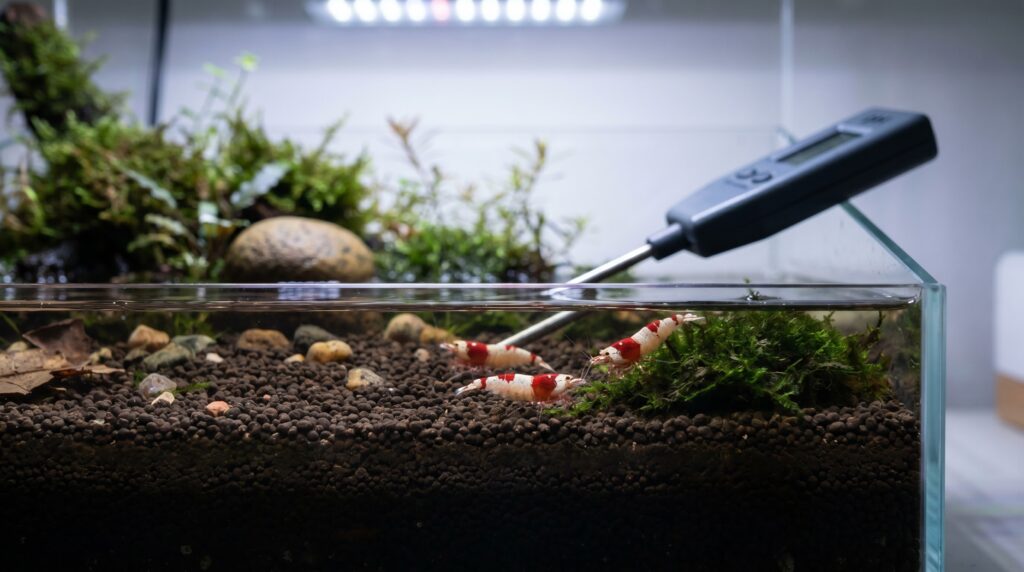
The two main groups of hobby shrimp want genuinely different water chemistry, and the pH ranges reflect that difference.
Neocaridina shrimp (cherry, blue dream, bloody mary, yellow, and all color variants)
Neocaridina originated in Taiwan's rivers and streams, in water that is moderately hard with a stable, near-neutral to slightly alkaline pH. In a home tank, they do well across a reasonably wide band:
| Parameter | Target range | Notes |
|---|---|---|
| pH | 6.5-7.5 | Sweet spot 7.0-7.4 |
| KH | 2-4 dKH | Provides buffering and a stable baseline |
| GH | 6-8 dGH | Calcium and magnesium for molting |
| TDS | 150-250 ppm | Reflects mineral load |
| Temperature | 18-26°C (64-79°F) | Cooler end favors better color |
The forgiving range is one of the reasons Neocaridina are recommended as the starting point for beginners. A colony holding pH 7.6 rock-steady will generally do better than one where the reading yo-yos between 6.8 and 7.6 every 24 hours, even if the average of that swing happens to land on a textbook 7.2. Most tap water in the US and UK falls right into this range, which is why many keepers run Neocaridina straight on filtered tap water with no remineralizing. If your source water is RO or very soft, SaltyShrimp's GH/KH+ remineralizer is designed for this: 2 g per 10 liters brings water to roughly 6 dGH and 3 dKH, which puts the KH buffer firmly in range. The GH/KH ratio from that product is 1.0 to 0.5, meaning for every unit of GH added, half a unit of KH is added alongside it.
One place pH genuinely matters for Neocaridina: ammonia toxicity. At higher pH, a larger fraction of total ammonia exists as the un-ionized NH3 form, which is approximately 100 times more toxic to aquatic animals than the ionized NH4+ form, according to University of Florida IFAS Extension research (FA031). At pH 7.0 and typical hobby temperatures around 24-25°C, roughly 0.52% of ammonia is in the toxic un-ionized form; at pH 9.0 at the same temperature, that fraction rises to approximately 34.6%. Both fractions climb further as temperature increases - at 28°C the equivalent figures are closer to 0.7% and 42% respectively. Running Neocaridina at the higher end of their range (pH 7.4-7.5) in a tank with any detectable ammonia is therefore riskier than running them at pH 7.0. This is another reason to keep pH stable and within the lower half of the recommended band if ammonia is a concern. And cycle the tank fully before adding shrimp.
Caridina shrimp (crystal red, crystal black, bee shrimp, Taiwan bee)
Caridina from China and Taiwan's highland streams evolved in soft, acidic water: low mineral content, low pH, virtually no carbonate buffering. Replicating that in a tank requires a fundamentally different approach:
| Parameter | Target range | Notes |
|---|---|---|
| pH | 5.8-6.4 | Active substrate holds this range |
| KH | 0-1 dKH | Near-zero; essential for substrate to buffer |
| GH | 4-6 dGH | Minerals still needed for molting |
| TDS | 100-150 ppm | Much softer than Neocaridina water |
| Temperature | 20-24°C (68-75°F) | Less tolerant of heat than Neocaridina |
Active buffering substrates (aqua soils like ADA Amazonia, Fluval Stratum, and similar products) work by releasing hydrogen ions that consume KH and acidify the water, pulling pH down into the 5.8-6.4 range and holding it there. This mechanism only functions when KH is near zero. If you add tap water with KH 4 to a Caridina tank, the substrate burns through its buffering capacity rapidly, the KH climbs back, and pH rises. The standard approach is RO water remineralized with a GH-only product. SaltyShrimp's Bee Shrimp Mineral GH+ adds minerals without raising KH (the product's KH-to-GH ratio is just 0.06 to 1.0), targeting a conductance of about 200 µS and a pH below 7, with the active substrate doing the fine pH work. The substrate typically lasts 12-24 months before exhaustion, depending on source-water KH. Higher incoming KH accelerates that wear.
Note that GH still needs to be in range for Caridina, even though KH is near zero. Molting requires dissolved calcium and magnesium from GH, not from KH. Low GH causes failed molts; low KH combined with an active substrate is what produces the acidic, unbuffered chemistry these shrimp need. See our full breakdown of GH for shrimp for the distinction.
If you are deciding between these two groups, the setup difference is significant. A comparison of care demands lives in our Neocaridina vs Caridina water guide.
Is my pH actually the problem? A quick check
Keepers frequently reach for pH as the explanation when shrimp die or fail to breed. Often the real culprit is KH, CO2, ammonia, copper, or an abrupt parameter change. Use this checklist before adjusting pH:
| Check | What to measure | What to look for | What it means |
|---|---|---|---|
| 1. KH | Carbonate hardness test | Neocaridina: KH 2-4. Caridina: KH 0-1 | KH out of range is the most common reason pH drifts or is uncontrollable. Fix KH first. |
| 2. pH timing | Test at same time each day | Is your reading always in the morning or always in the evening? | Morning (post-lights-off) = lowest daily pH; evening (post-photosynthesis) = highest. A 0.3-0.5 unit daily swing is normal in planted tanks. A swing above 1.0 suggests large CO2 fluctuation. |
| 3. Ammonia and nitrite | Standard liquid test kit | Both should read 0.0 ppm in an established tank | Any detectable ammonia is dangerous, especially at higher pH where more is in the toxic NH3 form. An uncycled tank kills shrimp regardless of pH. |
| 4. Copper | Copper test kit; check fertilizer and medication labels | Should read 0 ppm | Shrimp gills are acutely sensitive to copper; concentrations that do not affect fish can be fatal to dwarf shrimp. Even trace amounts from medications, copper-containing fertilizers, or old plumbing (always let first-draw tap water run before filling a bucket). No adjustment to pH fixes copper poisoning. |
| 5. Recent changes | Review what changed in the last 48 hours | Water change, new decoration, new food, medication in the room | A crash shortly after a large water change usually points to osmotic shock or a sudden parameter jump, not a sustained pH problem. See our guide to shrimp water parameters for the full picture. |
If all five checks are clean (KH is in range, the daily swing is modest, ammonia and nitrite read zero, no copper, no sudden changes) and pH sits anywhere in the species-correct band, the pH is probably not the problem. Look elsewhere: bacterial infection, parasites, diet, or substrate off-gassing.
Why chasing a perfect pH causes more harm than a stable "wrong" one
This is the advice that sounds counterintuitive but is supported by how shrimp actually die. Every time you pour in a pH-lowering additive to nudge the number from 7.4 down to 7.0, you are changing the chemistry of the water. If that additive is acidic, it briefly drops pH faster in one spot before it mixes. If it contains phosphate buffers, you are adding nutrients that can fuel algae. If you use a natural acid like peat extract, you are also adding humic acids that affect other parameters. And every addition risks a localized or temporary pH swing that stresses shrimp more than the "wrong" stable reading ever would.
Shrimp osmoregulate, maintaining the salt and water balance of their hemolymph (blood) against the surrounding water. A sudden shift in pH is also a shift in the ionic environment. Their gill tissue and hemolymph regulation adjusts to stable water over days. Abrupt changes in pH ask that system to work faster than it can, which is one contributor to the "crash after a water change" pattern many beginners experience. Gradual, small water changes that match the new water's parameters to the tank's are far safer than any chemical intervention aimed at hitting a specific pH target.
The practical rule: aim for the correct species range. Within that range, stop adjusting. A Neocaridina colony living steadily at pH 7.5 with KH 3-4 is healthier than one where the keeper is dosing pH-Down every three days trying to hold 7.0. When adding new shrimp, match their transport water to your tank gradually over at least an hour before releasing them; moving a shrimp from bag water at pH 6.8 directly into a tank running pH 7.4 is an avoidable ionic shock. Introduce slowly, change slowly, and test consistently at the same time of day so you are comparing like to like.
How to test pH accurately
Two methods exist: liquid test kits and pH meters (also called pH pens). Liquid test kits are affordable and reliable for detecting whether pH is in or out of range. They show color steps that correspond to roughly 0.2-0.5 pH unit increments, which is enough precision for shrimp keeping. High-quality digital pH meters can resolve to 0.01 pH units, but they require regular calibration with buffer solutions to stay accurate.
For calibration, two-point calibration using pH 4.0 and pH 7.0 buffers is standard for freshwater aquariums. The buffer solution should bracket the expected tank pH. If you are measuring an acidic Caridina tank at pH 6.0, calibrating with pH 4 and pH 7 buffers is correct. A reasonable recalibration schedule for routine aquarium monitoring is every three weeks. Never wipe the probe bulb; rinse it with RO or distilled water only.
One common mistake: testing a freshly prepared bucket of RO water. RO water has almost no dissolved CO2 buffering and its pH reading is unstable and often unrepresentative of what the tank will read once the water equilibrates. Test water after it has been in an aerated container for at least 30 minutes, or test the display tank directly.
Test at the same time every day if you are tracking a trend. Morning tests (before lights on) capture the nighttime low; evening tests (after several hours of light) capture the daytime high. Knowing both gives you the actual swing range, which is more useful than a single reading.